
Kaspa has long been one of the more technically ambitious proof-of-work projects in crypto, but its technology and its token price are currently telling two very different stories.
KAS is trading around $0.027, close to the lower end of its long-term range and far below the highs reached during the previous phase of the market. That weak performance is becoming harder to ignore, especially as Bitcoin and several major altcoins have recently recovered.
Bitcoin OG and crypto trader Lucky has now put that disconnect directly to the Kaspa community. Sharing a long-term KAS chart, he wrote:
“KAS holders have been saying ‘just wait’ for a long time now… Alright then… convince me. Is KAS dead or ridiculously mispriced?”
It is a provocative question, but his chart shows why it is worth asking.
What you'll learn 👉
Kaspa’s Chart Has a Lot to Prove
Lucky’s chart captures the central problem facing KAS.
Kaspa has been locked in a broad downtrend since its 2024 highs. The descending blue trendline on his chart connected a series of lower highs for nearly two years. Price recently moved beyond the end of that trendline, but there has not yet been the type of breakout that would clearly confirm a major trend reversal.
Instead, KAS remains near $0.027 and inside what Lucky identifies as a large demand zone.
That makes the current area particularly important. The good news for bulls is that the relentless sequence of lower highs appears to be losing some of its structure. KAS has also spent months around the same broad bottoming area rather than continuing directly lower.
The problem is that stabilization is not the same thing as a new uptrend.
A convincing bullish reversal would ideally require KAS to start producing higher highs and higher lows, followed by a move away from the current demand region. One nearby technical analysis similarly identifies roughly $0.025 as support and around $0.040 as the first important resistance area.
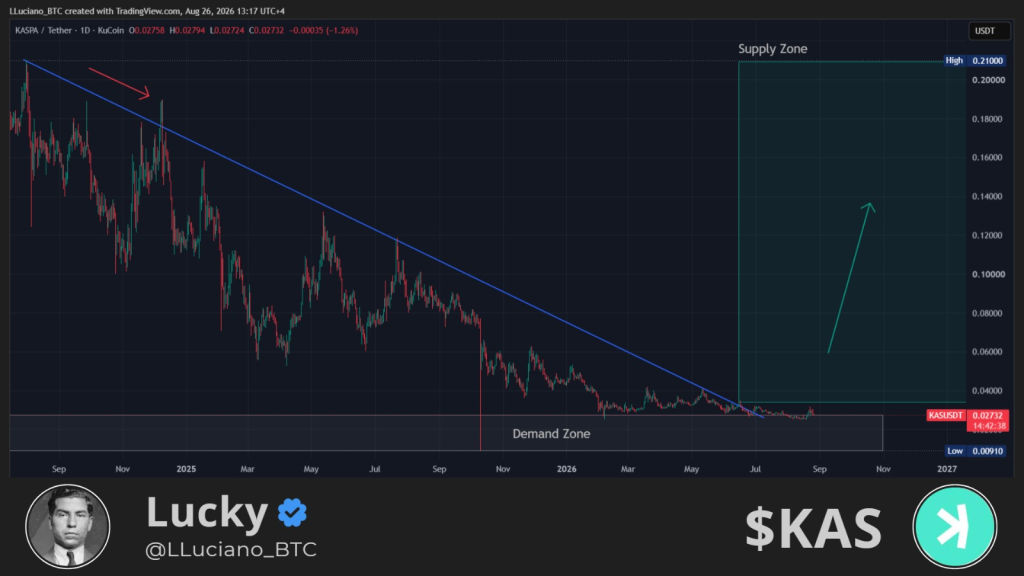
Lucky’s chart then illustrates a much more ambitious scenario. His large supply zone begins around $0.035 and extends all the way toward the old $0.21 high, with an arrow indicating that a genuine reversal could eventually send KAS substantially higher.
That is a possibility, not a prediction supported by the current price structure.
And this is where we largely agree with Lucky’s challenge. Kaspa’s technology gives investors reasons to continue watching the project, but the chart has not yet given them much reason to celebrate.
Read also: We Asked 3 AI Models If Kaspa (KAS) Price Can Ever Reach $10
Kaspa’s Technology Is Still a Strong Part of the Bull Case
The fundamental argument for Kaspa has not disappeared simply because KAS has performed poorly.
Kaspa uses a proof-of-work blockDAG architecture based on GHOSTDAG, allowing parallel blocks to be incorporated rather than treating competing blocks in the same way as a conventional linear blockchain. The network currently operates at 10 blocks per second, following the Crescendo upgrade.
That matters because Kaspa is attempting to preserve the security and decentralization properties associated with proof of work while providing much higher throughput.
There is an important distinction investors should make, however. Interesting technology does not automatically create demand for the token.
For KAS to undergo a lasting repricing, Kaspa ultimately needs more than technical performance. It needs growing usage, applications, developers, liquidity and economic activity that translate the network’s capabilities into demand.
That is arguably the biggest unanswered part of Lucky’s “convince me” challenge.
Crescendo Changed How Kaspa Nodes Handle Data
Another interesting development concerns how Kaspa manages the much larger amount of data produced since Crescendo increased block production from one to 10 blocks per second.
Kaspa nodes use pruning, meaning they do not need to permanently retain the network’s entire historical blockDAG. Following Crescendo, the standard pruning period fell from roughly 50 hours to around 30 hours, although operators can configure longer retention periods if they have sufficient storage.
This might initially sound concerning because older transaction and header information is removed from ordinary nodes. However, it is part of Kaspa’s architecture rather than an accidental loss of blockchain history.
Kaspa uses UTXO commitments that allow the current network state to be validated without requiring every normal node to retain the entire historical dataset.
The benefit is straightforward: producing 10 blocks every second generates enormous amounts of data over time. Requiring every participant to permanently store all of it would continuously increase the hardware requirements for operating a node.
Pruning keeps those storage requirements more manageable and makes synchronization easier, helping Kaspa pursue higher throughput without making ordinary nodes increasingly impractical to operate.
KuMining Adds Another Way to Mine KAS
Kaspa also received some mining-related news this week.
KuMining, a cloud-mining platform associated with KuCoin, officially launched a KAS mining product. It allows users to purchase access to mining hashrate without buying and operating their own ASIC miners or dealing directly with electricity, cooling and mining-pool configuration. KuCoin’s announcement says participation can begin with single-digit USDT amounts and mining output is distributed daily after operations begin.
One detail is worth correcting from the information circulating elsewhere: KuCoin’s current official announcement lists KAS mining durations of 7 to 90 days, not 7 to 360 days.
This does not fundamentally change the investment case for KAS, but it makes Kaspa mining more accessible to people who do not want to operate specialized hardware themselves.
Is Kaspa Dead or Ridiculously Mispriced?
Probably neither conclusion can be made yet.
Calling Kaspa “dead” looks premature. The network is operating at 10 blocks per second, its developers have delivered a major protocol upgrade, and its underlying blockDAG approach remains technically differentiated.
But calling KAS ridiculously mispriced requires another assumption: that those technical achievements will eventually translate into enough network adoption and token demand to justify a substantially higher valuation.
That part still needs to be demonstrated.
The chart makes the problem particularly clear. KAS has spent a long time declining while holders have repeatedly argued that the fundamentals will eventually be reflected in price. At some point, fundamentals need to produce measurable adoption and the market needs to respond.
For now, Kaspa may have strong technology which is underneath weak KAS price action.
If KAS can establish a real bottom around the current demand zone, reclaim roughly $0.04 and begin forming sustained higher highs, Lucky’s chart would become considerably more interesting. Until then, the burden of proof remains with the bulls.
Subscribe to our YouTube channel for daily crypto updates, market insights, and expert analysis.