Kaspa price is testing a support area that has protected KAS from deeper losses several times. Buyers now face another difficult test near $0.027, although something beyond ordinary holder activity may be contributing to the decline.
New data shared by KasCAP shows a major difference between Kaspa spot and futures volume. That difference raises an important question about whether the current KAS price comes mainly from holders selling their coins or from pressure created inside the derivatives market.
What you'll learn 👉
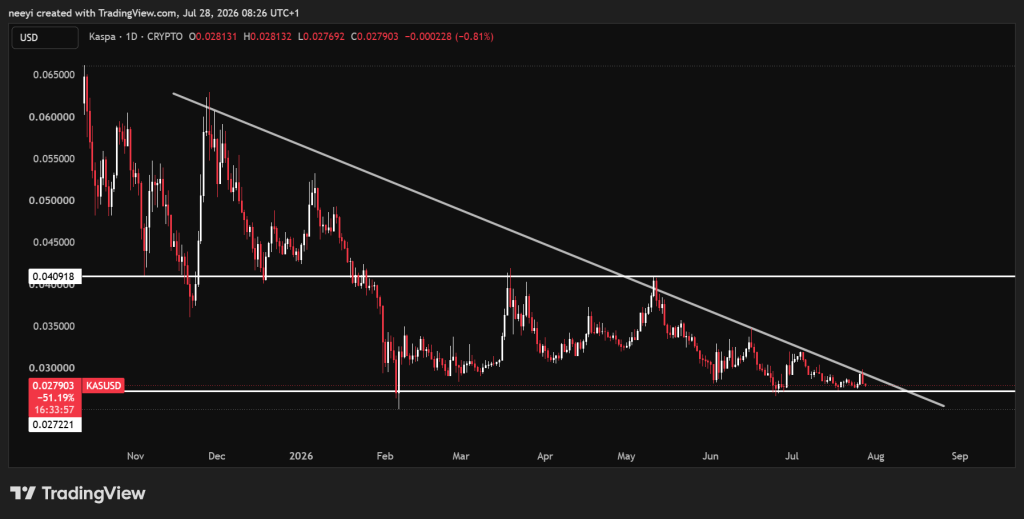
Kaspa Price Returns to the Crucial Support Between $0.027 and $0.025
Kaspa has continued to lose ground as sellers maintain control over the market. KAS price is now close to the important support around $0.027, which forms part of a broader demand area between $0.027 and $0.025.
This zone has protected Kaspa price for an extended period. Buyers will likely need to defend it again before any meaningful recovery can develop.
A period of consolidation around this support remains possible if neither side takes full control. KAS could trade inside a narrow range as buyers absorb pressure from sellers and wait for broader market conditions to improve.
Bitcoin could play an important role during this period. Continued weakness from BTC may place more pressure on Kaspa and other smaller cryptocurrencies. Stronger bearish conditions could eventually push KAS below its established support.
A confirmed break beneath $0.025 could expose lower levels near $0.021 and $0.020. Those areas may become the next important zones if buyers fail to protect the present range.
A Break Above the Descending Trend Line Could Support a KAS Price Recovery
Kaspa still has a possible recovery route despite its current weakness. Buyers first need to maintain control around the support between $0.027 and $0.025.
KAS must then break above the descending trend line that has restricted its recovery attempts. Such a breakout could open the way toward $0.03 and improve the short term outlook.
Continued strength above that level could allow Kaspa price to target $0.04 before the end of the quarter. That outcome depends on buyers reclaiming control and Bitcoin avoiding another deeper decline.
The main levels now provide 2 clear possibilities:
- Continued weakness below $0.025 could send KAS toward $0.021 or $0.020.
- A breakout above the descending trend line could open a recovery toward $0.03 and potentially $0.04.
Those technical levels explain where Kaspa price could travel next. Derivatives data may explain why the selling pressure has become so powerful.
Kaspa Futures Volume Is About 17 Times Higher Than Spot Volume
KasCAP questioned whether the current sell pressure affecting KAS may be artificially amplified. The analyst pointed to a large difference between activity in the spot and futures markets.
KAS records roughly $0.9 million in daily spot volume. Futures volume stands near $15.4 million, which is about 17 times larger.
Spot sellers must own KAS before selling their coins. Futures traders can open short positions without owning any Kaspa. Large amounts of capital can therefore place pressure on KAS through derivatives without first buying the underlying asset.
Perpetual futures trading below the spot market can influence spot prices through arbitrage and hedging activity from market makers. Continued price declines may then force leveraged long positions to close, which creates further sell orders.
That cycle can push Kaspa price lower than ordinary spot activity might produce by itself. The data does not prove deliberate manipulation, although it shows how futures activity can intensify a decline.
Read Also: Here’s Why the Crypto Market Is Down Today as Bitcoin Dips Below $64K Again
Kaspa’s October 2024 Liquidations Show How Futures Pressure Can Grow
KasCAP used the market activity from October 25 and October 26, 2024, as an example of how this process can affect KAS.
Roughly $800,000 in KAS long positions was liquidated across Binance, Bybit, and Huobi during that period. Futures open interest dropped by approximately 35% as leveraged positions left the market.
Binance’s KAS funding rate briefly reached negative 0.101276%. Funding stayed negative during 4 consecutive settlements.
Negative funding means traders holding short positions were paying those holding long positions. Such conditions point to a strong imbalance toward the short side of the perpetual futures market.
Is Kaspa’s current sell pressure being artificially amplified?
— 𝙆𝙖𝙨𝘾𝘼𝙋.𐤊𝘢𝘴 (@Kaspa_CAP) July 27, 2026
KAS currently records roughly $0.9M in daily spot volume, compared with approximately $15.4M in futures volume—about 17 times more.
Futures allow traders to short KAS without owning any actual KAS. When perpetual… pic.twitter.com/UROYpCjspl
Forced liquidations can deepen an existing decline because exchanges automatically close leveraged positions when losses become too large. Those closures introduce more sell pressure at a time when buyers may already be weak.
The October example does not confirm that the current decline follows the exact same pattern. It does show that derivatives activity has previously had enough power to deepen losses across the Kaspa market.
KAS Holders May Not Be the Only Source of the Current Sell Pressure
Kaspa price weakness may create the impression that holders have lost confidence and sold their coins. The large futures volume makes that explanation less certain.
Capital inside the derivatives market can influence price discovery without owning any KAS. Short positions, market maker hedging, arbitrage, and forced liquidations can all contribute to downward pressure.
This distinction matters because holder selling and derivatives pressure can produce similar price movements for different reasons. Heavy spot selling may point toward weaker conviction among holders. Futures pressure may disappear faster if short positions close and buyers regain control.
Short covering happens when traders buy back positions they previously sold. A large wave of those purchases could support a faster recovery, especially if KAS breaks above its descending trend line.
Such an outcome remains conditional. Futures pressure can continue for an extended period, and weak Bitcoin performance could make a KAS recovery more difficult.
Read Also: Here’s Why Kaspa Price Hasn’t Pumped Despite Its Biggest Milestone Yet
KasCAP noted that Kaspa would gain more than 7× if it moved from approximately $0.029 to its previous all time high near $0.207.
A possible move to $1 would represent roughly 35× from the same starting price. Reaching that target would require far more than the removal of short pressure, so the comparison should not be treated as a prediction.
Kaspa would need sustained demand, stronger market conditions, and continued buyer participation before such a price became realistic. The $0.207 level provides a more familiar reference because KAS has traded there before.
Immediate price action remains focused much lower. Buyers must first defend $0.027 and $0.025 before they can target $0.03 or $0.04.
FAQs
Subscribe to our YouTube channel for daily crypto updates, market insights, and expert analysis.