
Pi Coin is one of the rare altcoins “in green” today. The Pi Coin price pumped around 1.5% and is now trading around $0.083. The broader crypto market is in the red, but Pi is showing some resilience.
There are some important Pi Network news to cover today, so let me get into it right away.
What you'll learn 👉
Pi Network Completes SLICE Distribution
Pi Network just announced that the Pi Launchpad has completed the distribution of its second Testnet token, SLICE.
The Launchpad app in Pi Browser now shows individual allocation details, the launch and effective token prices, access to the SLICE liquidity pool, and a chart tracking changes in the SLICE price relative to Test-Pi.
The Pi team is encouraging Pioneers to explore the post-launch experience and see how liquidity pools work through the new price tracking feature. Users can go to the Pi mining app to learn more about the SLICE launch and liquidity pool mechanics.
Pi Launchpad has completed the distribution of its second Testnet token, SLICE!
— Pi Network (@PiCoreTeam) July 24, 2026
Explore the post-launch experience and see how liquidity pools work through the new price tracking feature!
The Launchpad app in Pi Browser shows individual allocation details, the launch and… pic.twitter.com/9N0RmQz6UG
This is the second testnet token launch for Pi Network. The first test token provided useful data and highlighted areas where the Launchpad experience needed improvement. The updated participation flow is now simpler and clearer, centered around the commitment amount and the “fair-access hold.”
Analyzing the Pi Coin Chart
I analyzed the Pi Coin chart on TradingView, and here are my thoughts.
The 4‑hour Pi Network/USDT chart remains firmly bearish. Price continues to print a clear sequence of lower highs and lower lows since late April. Every recovery attempt has been sold into, confirming that sellers remain in control of the broader trend. The current price around $0.0837 is trading well below the declining 200‑period moving average near $0.159 , which shows just how weak the medium-term structure remains.
Until PI price can reclaim that moving average, any rallies should be viewed as relief bounces rather than a confirmed trend reversal.
The most important support lies in the $0.080‑$0.082 area, where price is currently attempting to stabilize. This zone has attracted buyers several times over the past week, making it the first line of defense. A decisive break below this level would expose the recent swing low around $0.070‑$0.073. If that fails, the market could extend toward $0.065.
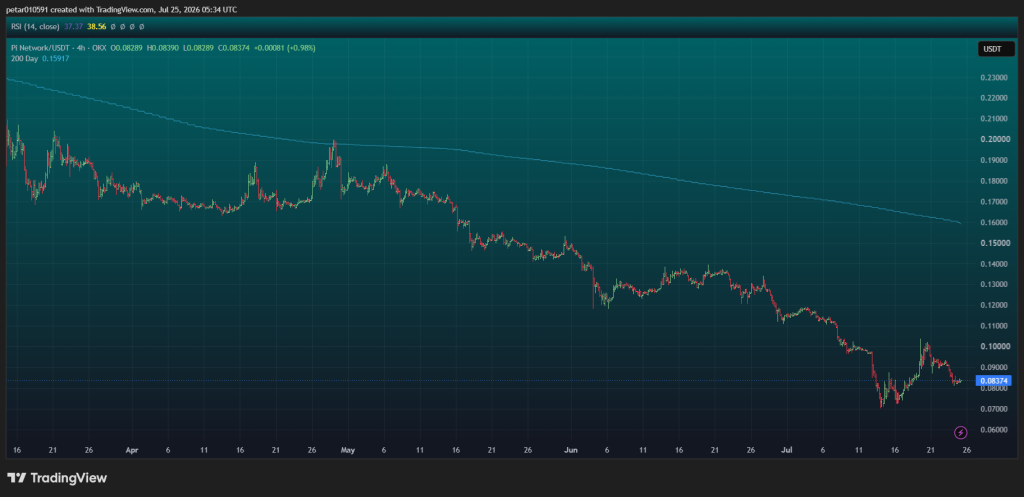
On the upside, immediate resistance is located around $0.090‑$0.095 , followed by the stronger supply zone between $0.100 and $0.105 , where previous rebounds have repeatedly stalled. Beyond that, $0.120‑$0.130 represents the next major resistance area that bulls would need to overcome to begin shifting market sentiment.
The 14‑period RSI is around 37 , which is below the neutral 50 level but still above the oversold threshold of 30. This suggests bearish momentum remains dominant, yet the market is approaching levels where sellers could become exhausted. A move in the RSI back above 45‑50 would provide the first technical indication that buyers are regaining strength, while a drop below 30 would likely accompany another sharp leg lower before any meaningful recovery.
The recent bounce from approximately $0.072 toward $0.098 failed to establish a higher high, and price has since drifted back toward support. That rejection reinforces the bearish trend and indicates buyers currently lack the volume needed to sustain a breakout. However, the recent candles also show reduced volatility compared to the heavy selloff earlier in July, which may indicate the market is entering an accumulation or consolidation phase before its next significant move.
The most likely near-term scenario is continued consolidation between $0.080 and $0.095 while the market searches for direction. A pump above $0.095‑$0.100, especially with increasing volume and an RSI recovery above 50, could trigger a move toward $0.110‑$0.120. Conversely, if $0.080 fails to hold, bearish momentum would likely resume, with $0.070 becoming the next target.
Read also: If You Invested $10,000 In Pi Network Last Year, Here’s How Much You Would Have Today
Will Pi Network’s Upgrade Actually Affect PI Price This Week?
The SLICE launch is a positive development for the Pi ecosystem. It shows the team is continuing to build and test new features. The liquidity pool mechanics and price tracking features are important for the long-term utility of the network.
However, will this actually move PI price this week? Honestly, I doubt it.
The testnet token launch is an ecosystem development, not a market catalyst. Pi’s price is driven by supply and demand dynamics, and the supply is still overwhelming. Over 127 million PI tokens are scheduled to unlock in the coming weeks. Roughly 1.21 billion PI are expected to unlock during 2026. That is a massive amount of supply flooding the market.
The SLICE launch does not change the supply-demand imbalance. It does not create new demand for PI. It is an internal ecosystem update that most external traders will ignore.
For PI price to move higher, we need to see a reduction in selling pressure or a significant increase in demand. Neither is happening right now. The chart remains bearish. The RSI is weak. The 200‑period MA is far above price.
The SLICE launch is good news for the Pi community, but it is not a price catalyst. The 1.5% pump today is a relief bounce, not a trend reversal. The path of least resistance remains lower until the supply unlocks slow down or demand picks up.
Subscribe to our YouTube channel for daily crypto updates, market insights, and expert analysis.