Crypto Prediction Markets Are Betting Billions on the World Cup Final as Spain Emerges Favorite Against Argentina

The 2026 World Cup final has become the central test for blockchain-based forecasting. Spain and Argentina will face off in a match that has drawn billions in cumulative trading volume across crypto prediction platforms.
This makes it the largest single-event information market in history. Unlike traditional sportsbooks that set fixed odds, these decentralized exchanges let users buy and sell shares in real time and create a probability gauge that moves with every injury report and tactical shift.
What you'll learn 👉
How much money is on the final?
Across Polymarket and Kalshi, the “World Cup Winner” market has traded more than $4.27 billion in total volume as of mid‑July, with the Spain–Argentina final driving the heaviest single‑event flow so far.
That figure counts contracts on who lifts the trophy, not just match‑result markets, and it already dwarfs most traditional sportsbook handle on a single football match.
On the final specifically, liquidity is concentrated in two lanes: the outright winner market (updated continuously) and the “Team to Advance” binary for Sunday’s match.
Together, these two contract families account for the bulk of the final‑stage volume. Polymarket typically hosts deeper order books and tighter spreads than Kalshi for World Cup outcomes.
What happened in the semis – and how did traders do?
By the time the semifinals were set, Spain vs France and England vs Argentina, crypto prediction markets had already logged roughly $5.4 billion in combined World Cup volume across Polymarket and Kalshi.
Industry data through July 12 pushed that figure to about $5.81 billion across 52 events, with the semifinals and final producing the heaviest single event flows.
The semifinals itself was about $1.2 to $1.4 billion in notional trading across “Team to Advance” and related match markets. That share equals roughly 20 to 24 percent of all World Cup prediction market volume recorded to that point.
The final, Spain vs Argentina, has already pulled in an estimated $1.6 to $1.9 billion across the outright winner market and final advance binaries. That works out to about 28 to 33 percent of total World Cup volume on these platforms. This means the final attracts 1.3 to 1.5 times more capital than both semifinals combined.
Beyond the raw numbers, traders found clear opportunities. Spain’s semifinal against France saw the market steadily reprice Spain from early tournament underdog to favorite by kickoff.
Accumulating “Spain to Win World Cup” shares in the 20 to 30 cent range earlier in the knockouts paid off cleanly.
In the other semifinal, England vs Argentina traded near even money for extended stretches before late money shifted to Argentina after team news and in play developments.
Traders who bought Argentina champion shares around 35 to 40 cents before the semifinal and faded the initial England hype captured a sharp mark to market gain once Argentina advanced.
How much is on Spain vs Argentina?
As of July 15–16, the outright “World Cup Winner” contracts price Spain at roughly 58¢ and Argentina around 43¢.
This implies a market‑derived probability of about 58% for Spain and 43% for Argentina (the sum exceeds 100% because of fees and the separate “draw/no‑draw” structure in some books).
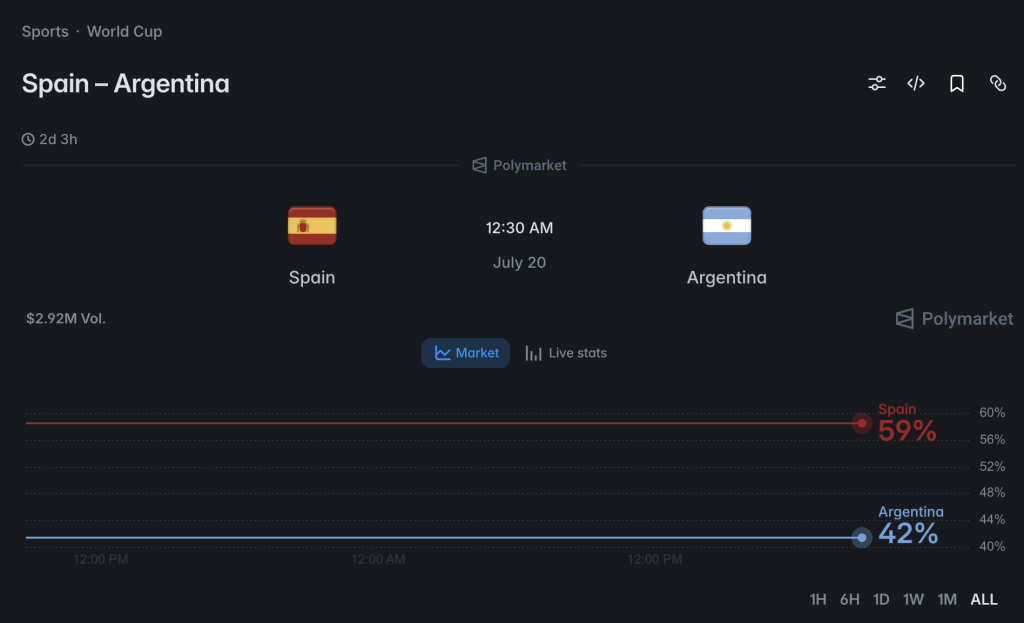
On the binary “Team to Advance” final market, Kalshi and Polymarket show very similar pricing: Spain near 58–60¢ and Argentina near 40–42¢.
Polymarket’s final‑market data (as of July 17) shows:
- Spain: 58.0¢ price, with $120.1 million in volume on the Spain side
- Argentina: 42.2¢ price, with $150.7 million in volume on the Argentina side
How can you actually predict the final on Kalshi and Polymarket?
For crypto‑native traders, the edge comes from treating these contracts like event‑driven binaries, not “gut feeling” bets.
Use the outright winner market as your base view. “Spain to Win World Cup” and “Argentina to Win World Cup” are the cleanest way to express a tournament‑level thesis. These contracts pay $1 if that team wins the final, $0 otherwise.
Overlay match‑specific binaries for timing. “Team to Advance – Final” lets you trade pure match outcome without caring about the scoreline. This is useful if you want to hedge or adjust exposure after lineups drop.
Watch liquidity and fees. Polymarket usually offers deeper books and smaller slippage on World Cup outcomes; Kalshi can have wider spreads but clearer regulatory treatment for U.S. traders. Both charge implicit fees via bid–ask and settlement structure, so always compare prices across venues before sizing up.
Incorporate information edges. Team news, fatigue, and referee assignments move these markets fast. Traders who monitor reliable sources (team sheets, injury reports, tactical previews) and act before the main feed reprices can capture 3–8¢ moves routinely in high‑profile matches.
A simple framework: start with a model or baseline (e.g., Opta‑style win probabilities), convert to fair values, then buy the side where market price is most below your fair value, scaling in as new information arrives.
Read also: Trouble for Cardano (ADA)? Another Major DeFi Project Suddenly Shuts Down
Our take: who wins?
The market is clear: Spain is the favorite, and the numbers back it. Six shutouts in seven matches, a cohesive system, and a younger core suggest Spain is better equipped to control a final than a Messi‑led Argentina side that has shown vulnerability in open play.
That said, Argentina’s path to the final, plus a comeback semi against England with Messi directly influencing both goals means the “underdog” label is somewhat misleading.
For traders, the more interesting angle isn’t necessarily picking a winner outright, but asking whether 58–60¢ for Spain is too high given Argentina’s late‑tournament momentum and set‑piece threat.
Frequently Asked Questions
Subscribe to our YouTube channel for daily crypto updates, market insights, and expert analysis.