
Stellar (XLM) has returned to investors’ watchlists after several years of underperformance versus larger cryptocurrencies. Unlike many Layer-1 projects, Stellar’s investment thesis hovers around payments, tokenized real-world assets (RWAs), stablecoins, and institutional settlement rather than speculative DeFi activity.
The key question isn’t simply whether XLM can rally; it is whether growing institutional usage can eventually translate into higher token value.
At approximately $0.19, a $5,000 investment purchases roughly 26,300 XLM. Small changes in price have a meaningful impact: $0.30 equals about $7,900, $0.50 equals about $13,150, and $1.00 equals about $26,300.
What you'll learn 👉
Where Is Stellar (XLM) Right Now, And What’s Been Driving It?
Based on current market data, XLM trades near $0.19 with a market cap around $6.4-6.6 billion. The token sits approximately 78% below its 2018 all-time high of $0.8756.
The monthly chart remains constructive but not yet fully bullish. XLM continues to make lower major highs since 2018. Price has repeatedly respected the $0.16-0.18 demand zone and created a long-term base.
The market has rejected attempts above $0.40 several times over the past cycle. Key support levels sit at $0.18, $0.16, and $0.10. Resistance exists at $0.21, $0.25, $0.32, $0.45, and $0.60. The chart suggests accumulation rather than distribution.
Momentum indicators show improving conditions. The Ultimate Oscillator on the monthly chart sits around 40, neutral, recovering from lower readings.
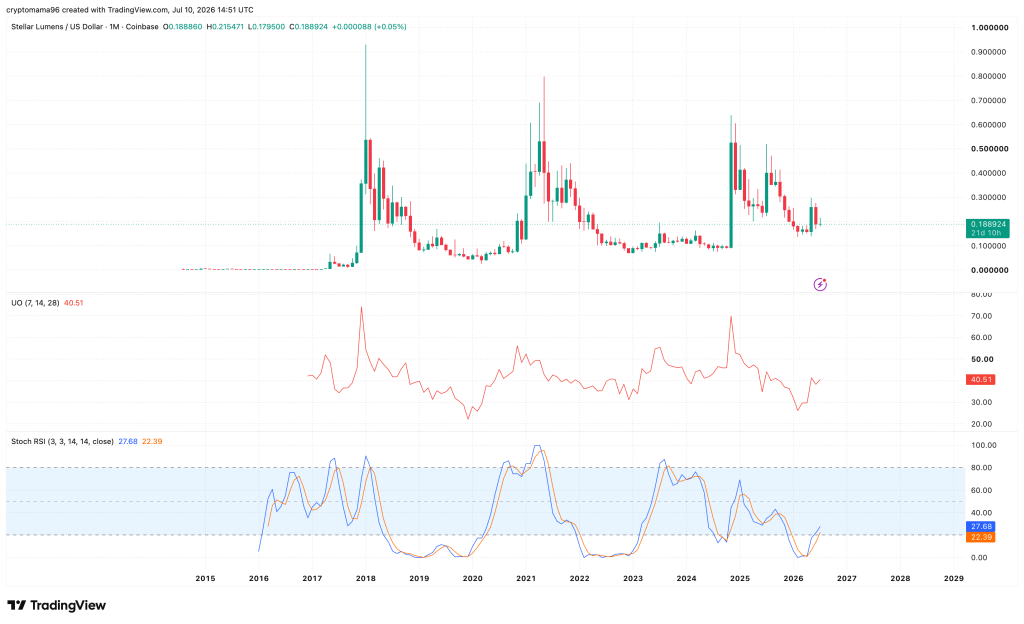
Selling pressure has eased but buyers have not yet taken full control. The Stochastic RSI recently turned upward from oversold territory with a bullish crossover beginning.
Historically, similar crossovers preceded multi-month advances in XLM. This is one of the stronger technical positives on the higher timeframe.
The 4-hour chart shows recovery from roughly $0.18, trading near $0.19 with higher lows beginning to develop.
The Ultimate Oscillator sits around 56, favoring buyers, while the Stochastic RSI above 90 means short-term overbought conditions.
The immediate rally may cool or consolidate, but the medium-term structure is healthier than it was several weeks ago.
Recent catalysts have improved Stellar’s narrative. Institutional tokenization continues to ramp up as infrastructure for tokenized assets, with more than $3 billion in real-world assets on Stellar.
Franklin Templeton, Ondo, and other institutional issuers continue to participate. Stellar joined the OpenUSD initiative alongside Visa and BlackRock. MoneyGram has expanded its long-running relationship with Stellar to support broader stablecoin payment infrastructure.
Read also: Why the SWIFT Blockchain News Is Bigger for XRP Than Most People Realize
What Could $5,000 in Stellar (XLM) Actually Be Worth by Q4 2026?
Current price sits at $0.19. A $5,000 investment purchases approximately 26,300 XLM.
Conservative Scenario
Crypto market remains range-bound. Institutional adoption grows steadily but slowly. Target price: $0.25. Portfolio value: approximately $6,575. Gain: approximately 31%.
Base Case
Bitcoin remains in a constructive bull cycle. Stablecoin usage expands. Soroban ecosystem gains traction. RWAs continue growing. Stellar breaks above long-term resistance near $0.25. Target: $0.40. Portfolio: approximately $10,520. Return: approximately 110%.
Bull Case
Crypto enters a strong risk-on environment. Institutional tokenization improves. Stablecoins on Stellar grow quickly. Payments activity expands materially. XLM revisits levels not seen since previous cycles. Target: $0.75. Portfolio: approximately $19,725. Return: approximately 295%.
Extreme Bull Case (Low Probability)
Altcoin supercycle. Major institutional settlement adoption. Token value improves. Retail participation returns aggressively. Target: $1.00. Portfolio: approximately $26,300. This would require XLM to exceed its previous all-time high and sustain a materially larger market capitalization than today.
4. The Bull and Bear Case: Two Very Different Endings for XLM Holders
Bull Case
Supporting arguments include Stellar’s institutional infrastructure. Unlike many speculative projects, Stellar continues to bring in established financial institutions.
Growth areas include tokenized Treasuries, stablecoins, cross-border payments, and digital asset settlement. The growing RWA ecosystem continues to expand.
If tokenization becomes one of crypto’s largest sectors, Stellar could become a major beneficiary. The technical setup shows monthly indicators improving with a Stochastic RSI bullish crossover, long-term base formation, and higher probability of trend reversal than six months ago.
The recent Bitwise ETF inclusion proves important. Bitwise rebalanced its flagship Bitwise 10 Crypto Index ETF (BITW) and removed Polkadot and Avalanche to add Stellar and Hyperliquid.
XLM entered the fund with a 0.38% portfolio weight. This shows institutional preference changing toward assets with strong adoption narratives.
Bear Case
Several risks remain. One of the largest criticisms is that increased network usage does not necessarily create proportionate demand for XLM because many assets settle using stablecoins and network fees remain extremely low.
Stellar competes with Ripple, Ethereum tokenization, Solana, Avalanche, and other enterprise blockchain networks.
Several years of trading have created resistance at $0.25, $0.32, and $0.45. Breaking through all three would need stable buying pressure. Overall crypto risks could derail bullish projections: higher interest rates, ETF outflows, regulatory tightening, global recession, or weak Bitcoin performance.
5. Our Final Take: Is Stellar Worth the Bet Right Now
Positives include improving long-term technical structure, institutional adoption expansion, strong positioning in payments and tokenized assets, long-term momentum indicators turning more constructive, and price remaining well below its previous all-time high.
Risks include token adoption not automatically equaling token appreciation, strong competition across payments and tokenization, XLM price repeatedly failing to hold major breakouts over the past several years, and near-term charts suggesting the latest bounce may need consolidation before another advance.
For investors considering a $5,000 allocation, XLM offers an asymmetric opportunity with moderate downside if support around $0.18 holds and meaningful upside if institutional adoption begins to turn into stronger token demand.
A realistic base-case target by Q4 2026 falls in the $0.40 region, while a move toward $0.75-$1.00 would likely need a combination of a crypto bull market, improving RWA adoption, and evidence that Stellar’s growing network activity is helping sustained demand for XLM rather than simply increasing on-chain usage.
Frequently Asked Questions
Subscribe to our YouTube channel for daily crypto updates, market insights, and expert analysis.