Pi Network just made a move that could change how its ecosystem grows. The team has updated Pi Launchpad’s participation model, drawing directly on data from its first Testnet token rollout on Pi Day 2026. Whether this translates into price momentum for PI coin is a question worth examining carefully.
The first test token launched on Pi Day 2026 attracted over 478,000 participating Pioneers. That scale of participation gave the Pi Core Team a substantial base of user feedback to work with, and the team has now built those lessons into the platform.
The result is a simpler participation flow, updated Launchpad mechanics, and a noticeably improved user experience. A second test token called “SLICE” is currently live on Testnet, designed to evaluate whether the updated model meets its goals and to give Pioneers another opportunity to interact with ecosystem token mechanics.
SLICE is purely a Testnet token and will not move to Mainnet. Participation requires opening Pi Launchpad in Pi Browser, reviewing the project, selecting a commitment amount in Test-Pi, confirming participation, engaging with the Slice of Pi app, and submitting feedback. The window stays open until Pi2Day on June 28.
Pi Launchpad has updated its participation flow and model, incorporating data and feedback from the first Testnet token that launched on Pi Day 2026!
— Pi Network (@PiCoreTeam) June 12, 2026
The first Launchpad test token attracted over 478,000 participating Pioneers and generated valuable feedback on the Launchpad… pic.twitter.com/TE394SyaYk
This upgrade is about more than a smoother interface. The Pi Core Team’s model for 2026 requires that ecosystem projects have working products before they can launch native tokens through the PiRC1 Token Standard. That design choice matters for PI’s value proposition.
If functional projects launch through Pi Launchpad and create real transactional activity, circulating supply gets absorbed into productive use rather than sitting on exchanges. That absorption is exactly what PI needs given its current supply dynamics.
The network operates on a continuous unlock mechanism, releasing roughly 144 million PI tokens every 30 days, which works out to approximately 4.8 million tokens per day. Ongoing KYC completions continue to push older mined balances onto centralized exchanges in waves. The sell-side is structurally heavy, and only genuine utility demand can offset that pressure over time.
What you'll learn 👉
Where PI Coin Stands After a Year of Significant Price Decline
PI’s trading history since its Open Mainnet launch on February 20, 2025 has been difficult. The asset hit an all-time high of $2.99 on February 26, 2025, then fell sharply to $0.40 by April. A partial recovery through mid-year held prices between $0.40 and $0.52, but the momentum faded through autumn.
The coin closed 2025 at $0.2045 on December 31, having lost the majority of its early peak value over the course of the year.
The first half of 2026 extended that downtrend. PI began the year near $0.20 and briefly tested $0.27 during ecosystem updates and migration phases, but could not hold those levels. Since Q2 2026, the price has slipped steadily past $0.15, reaching a monthly low near $0.119 on June 6. It has since recovered slightly, trading around $0.127 at the time of writing.
Over the past 30 days, PI has lost roughly 25% to 27% of its value. The picture is one of compressed, declining volatility, not base-building.
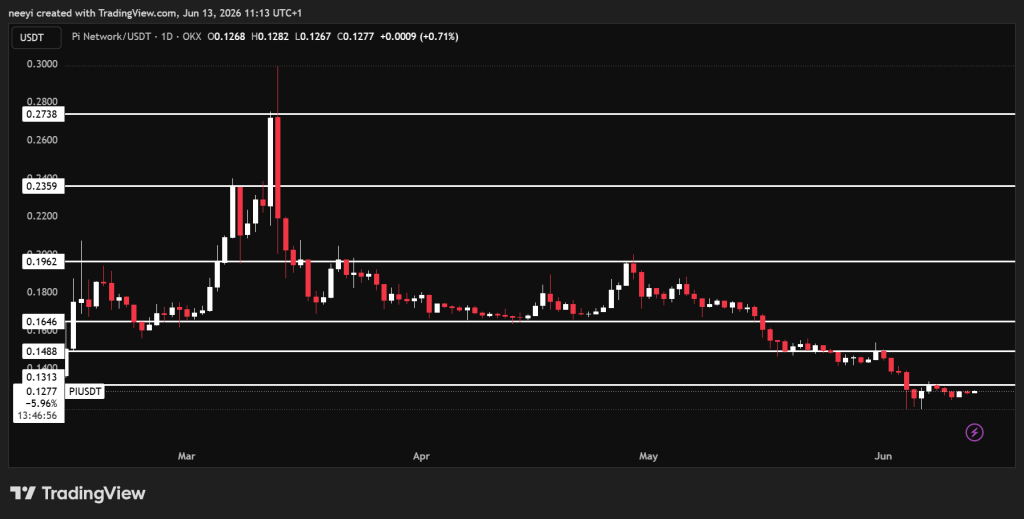
A look at the PI price chart places the current action in a tight consolidation just below the $0.13 level, which now functions as immediate resistance. A clean break above that zone opens the door to a test of $0.148. The next key area sits around $0.165, followed by $0.196.
A sustained move above $0.196 would be a meaningful shift in the coin’s structure, with $0.29 representing the 2026 peak cited in the price history. That remains a significant distance from current levels, and the chart makes clear that each resistance level needs to be cleared before the next becomes relevant.
Pi Coin Price Prediction: 3 Scenarios for the Rest of 2026
The path forward for PI depends heavily on a set of factors that are still unresolved. Token unlock pressure, Launchpad adoption, exchange listings, and macro conditions all feed into where the price goes from here.
The pessimistic case
It could trade within a range of $0.04 to $0.08 by year-end. This scenario plays out if daily unlock volumes continue without meaningful demand to absorb them, and if Protocol 25’s DEX and liquidity pool rollout underperforms.
A broader crypto market downturn and the absence of a Binance or Coinbase listing would remove any remaining catalyst.
Below the $0.119 floor, the coin has limited structural support, and a grind toward the lower range becomes the path of least resistance. Key triggers here include continued KYC unlock waves, thin Launchpad adoption, macro weakness, and no tier-1 listing.
Read Also: Why Is Official Trump (TRUMP) Price Pumping? Analyst Warns Against Chasing the Rally
The realistic scenario
This could see the price trade range between $0.15 and $0.30 by the end of the year. This path requires PI to break above $0.13 and work through the resistance levels at $0.148, $0.165, and $0.196 in a choppy, incremental way.
Protocol 25 rolls out without major problems, a handful of functional projects launch through Pi Launchpad following the SLICE feedback cycle, and the Pi2Day event on June 28 provides a short-term sentiment boost.
This also assumes that no Binance listing materializes in 2026, but existing liquidity on OKX, Bitget, and Kraken stabilizes as unlock velocity begins to plateau. A mild altcoin season in Q4 could push prices toward the $0.25 to $0.30 range. Recovery exists in this scenario, but it is fragile and event-dependent.
The optimistic case
The optimistic target will be around $0.50 to $1.20. This range requires a convergence of catalysts that individually are plausible but collectively are ambitious. A Binance or Coinbase listing is the single biggest potential unlock, bringing deep liquidity and institutional attention simultaneously.
If that lands alongside strong Pi Launchpad developer adoption and early evidence that Pi’s KYC and human identity layer has real commercial licensing demand, the fundamental narrative shifts from speculative to utility-backed.
| Scenario | Price Target | Core Assumption |
|---|---|---|
| Pessimistic | $0.04 – $0.08 | Supply glut, no catalysts, macro weakness |
| Realistic | $0.15 – $0.30 | Gradual ecosystem growth, no major listing |
| Optimistic | $0.50 – $1.20 | Tier-1 listing plus utility traction |
A stretch target of $1.00 to $1.20 would require a major payment processor or retail integration to be announced before year-end, giving PI a transactional use case that extends beyond internal ecosystem activity. Key triggers include a tier-1 exchange listing, strong Launchpad adoption, KYC identity layer commercialization, and a Bitcoin-led bull market.
FAQs
Subscribe to our YouTube channel for daily crypto updates, market insights, and expert analysis.