
The crypto market is under pressure again, and this time it isn’t subtle.
The total crypto market cap is down about 3% today, now sitting near $3.13 trillion. Bitcoin has dropped roughly 2.7%, while most major altcoins are taking even heavier hits. Ethereum, XRP, Dogecoin, and several other large caps are down between 3% and 7% over the last 24 hours.
With Bitcoin sliding toward the $90,000 zone, traders are asking the same question: is this just another routine dip, or something more?
The short answer is that this move wasn’t random.
What you'll learn 👉
This Wasn’t a Crypto-Specific Sell-Off
Despite how it looks on charts, this drop didn’t start inside crypto.
The trigger came from geopolitics and macro risk, not blockchain fundamentals.
Reports surfaced that the European Union is preparing up to $100 billion in retaliatory measures against the United States, following renewed trade threats from President Donald Trump tied to Greenland. That immediately revived fears of a fresh trade war cycle, something markets had largely stopped pricing in.
Once U.S. futures opened in the red, risk assets across the board started to slide. Crypto followed fast.
Bitcoin fell about $3,600 in a short window, and roughly $130 billion was erased from the total crypto market cap in just 90 minutes. This wasn’t slow distribution. It was a sharp repricing of risk.
🚨 THIS WASN’T A RANDOM DUMP
— Wise Advice (@wiseadvicesumit) January 19, 2026
Here’s what actually triggered it:
• EU prepping $100B in retaliation against the U.S.
• Sparked by Trump’s threats linked to Greenland
• Trade war risk suddenly back on the table
• U.S. futures opened red
• $BTC down $3,600
• $546M longs… pic.twitter.com/E5gRetWblz
Leverage Made the Drop Worse
While geopolitics lit the fuse, leverage did the real damage.
According to CoinGlass, $124.32 million in Bitcoin long positions were liquidated in 24 hours, representing a 2,615% jump compared to the prior day. That kind of spike tells you how stretched positioning had become before the move.
At the same time, derivatives open interest surged by nearly 27% to $688 billion, showing traders were heavily exposed on the long side going into the drop.
Once Bitcoin started slipping, forced selling kicked in. Liquidations triggered more selling, which triggered more liquidations. It became a feedback loop that accelerated the decline.
This is why the move felt sudden and aggressive rather than gradual.
Why $92.5K Now Matters for Bitcoin
From a market structure perspective, $92,500 is now the key level to watch.
If Bitcoin holds above that zone, the current move can still be classified as a leverage flush rather than a trend reversal. If it breaks cleanly below, however, another cluster of liquidations estimated at over $200 million could be triggered.
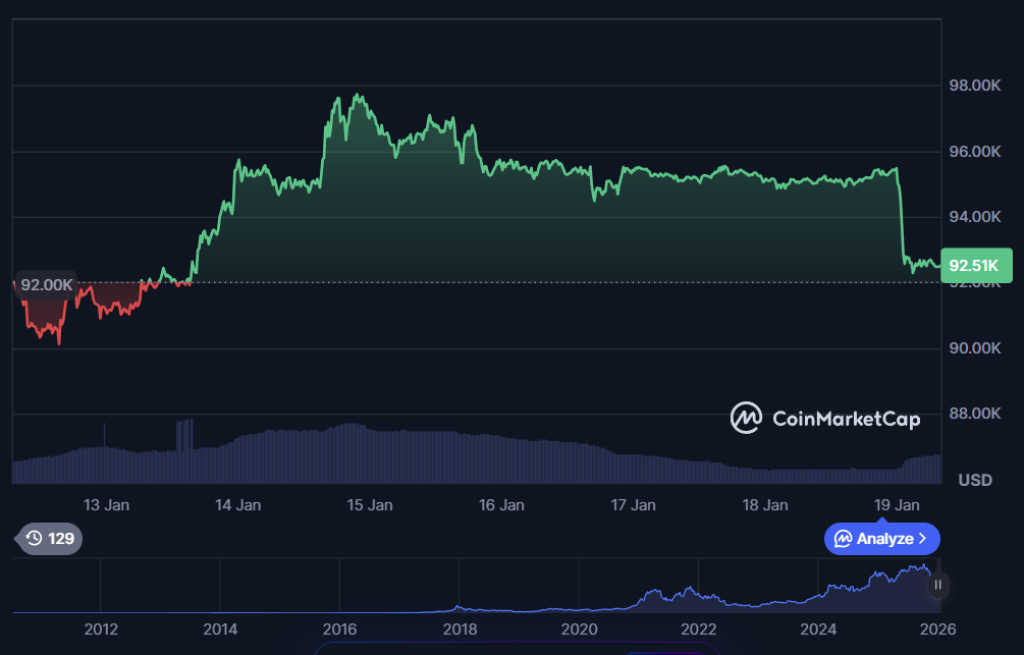
In simple terms, below that level, mechanical selling risk rises sharply.
So far, buyers have stepped in to defend the area, but the market remains fragile while volatility stays elevated.
Read also: ChatGPT Predicts BTC and ETH Prices Following Newest Trump Tariffs
Geopolitical Risk Is Back in Focus
Beyond liquidations, the bigger story is that macro risk is back in play.
Trump’s announcement of 10% tariffs on EU imports, with the threat of rising to 25% by June, changed how traders view near-term stability. Even though these moves have nothing directly to do with crypto regulation, crypto remains deeply tied to global risk sentiment.
Interestingly, crypto’s correlation with the Nasdaq 100 has turned negative over the past week, sitting near -0.41 on a 7-day basis. That suggests crypto is not simply tracking tech stocks anymore, but reacting more directly to macro uncertainty.
In other words, this was not about Bitcoin failing or Ethereum weakening. It was about markets quickly repricing political and economic risk.
Subscribe to our YouTube channel for daily crypto updates, market insights, and expert analysis.