
Ethereum has reached the same difficult price region during 2 separate bull markets, yet neither rally produced a lasting move beyond $5,000. That repeated barrier has created a fascinating question ahead of the next cycle.
Can Ethereum finally break through its historic ceiling, or will ETH face another rejection near $4,930?
ChatGPT, Claude, and Gemini examined Ethereum’s previous peaks, technical structure, staking supply, ETF demand, and network growth. Their forecasts point toward higher prices, though each model places the potential Ethereum bull market peak within a slightly different range.
Their predictions also reveal one area of broad agreement. Ethereum must first defeat the resistance that has limited its price since 2021.
What you'll learn 👉
Ethereum’s 3 Major Price Peaks Explain Its Bull Market History
Ethereum’s market history contains 3 major peaks, and each one arrived under very different conditions. Those rallies show how ETH has developed from a tool for launching tokens into an institutional asset supported by ETFs, staking, and financial applications.
| Ethereum Price Peak | Main Catalyst | What Drove The Rally |
|---|---|---|
| January 2018 at about $1,432 | Initial coin offering boom | New projects needed ETH to create and distribute tokens |
| November 2021 at about $4,891 | DeFi and NFT expansion | Lending platforms, decentralized exchanges, NFT markets, and EIP 1559 increased ETH demand |
| August 2025 at about $4,954 | ETFs and institutional demand | Spot Ethereum ETFs, staking, and Layer 2 networks brought new sources of capital |
The January 2018 peak came during the initial coin offering boom. Crypto projects used Ethereum to create new tokens, which meant participants often needed ETH before they could buy those assets. Ethereum climbed from below $10 to more than $1,400 within roughly 1 year before the speculative cycle collapsed.
Ethereum returned to record territory during November 2021. Decentralized finance platforms held billions of dollars, NFT marketplaces became major sources of network activity, and exchanges such as Uniswap gave ETH a practical role across the crypto economy.
EIP 1559 also introduced a mechanism that burns part of Ethereum’s transaction fees. Pandemic stimulus, cheap capital, and low interest rates provided favorable market conditions as Ethereum price reached approximately $4,891.
The August 2025 peak came from a more institutional market structure. Ethereum had already completed its transition to proof of stake, and Layer 2 networks such as Arbitrum and Base had expanded its ecosystem. Spot Ethereum ETFs also gave traditional investors a regulated route into ETH.
Ethereum price reached about $4,954 during that rally. However, the advance still failed to establish a lasting break above the same broad resistance that stopped ETH during 2021.
Ethereum Price Must Break $4,930 Before Reaching New Records
A look at the Ethereum price chart shows an unusual structure. ETH reached approximately $4,891 during 2021 and returned to almost the same region during 2025. Both peaks created a major resistance area near $4,930.
Ethereum has therefore spent several years below the upper $4,000 range, despite major changes across its network and investor base. That price barrier could contain supply from holders who purchased ETH near earlier peaks and waited for another opportunity to sell.
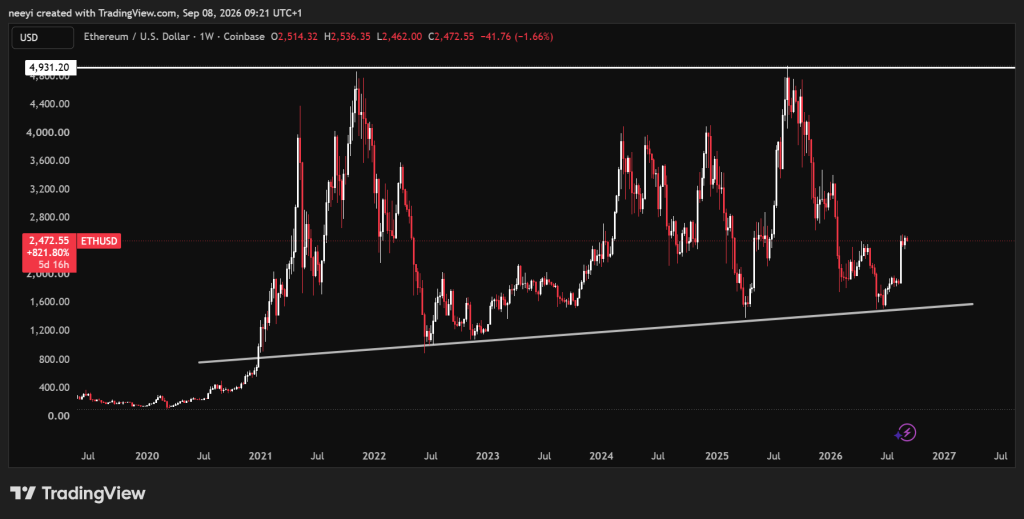
The broader chart offers a more encouraging clue. Ethereum price recently bounced from an ascending trend line that began during 2022. Buyers have defended that structure across the current market cycle, which keeps the wider upward pattern intact.
A decisive move above $4,930 would place Ethereum in price discovery. The former ceiling could then become support, which would create room for targets above $5,000.
Arthur Hayes and Fundstrat’s Tom Lee have discussed a possible $10,000 Ethereum price. Their outlook considers stronger global liquidity, institutional adoption, staking products, and the expansion of tokenized assets.
Standard Chartered has offered a target closer to $7,500. More cautious forecasts place Ethereum between $5,000 and $7,500, based on typical cycle performance and the possibility that competition limits ETH demand.
Institutional Demand And Network Use Could Power Ethereum’s Next Bull Run
Several developments could help Ethereum break its historic resistance during the next bull run. These drivers combine reduced available supply with new sources of network demand.
- Institutional demand and ETFs: Capital entering spot Ethereum ETFs can remove ETH from the open market. ETF products that include staking rewards could make Ethereum more appealing to institutions seeking both price exposure and yield.
- Staking supply lockup: More than 30% of Ethereum’s supply is reportedly committed to staking. Fewer tokens remain readily available for trading when demand increases.
- Real world asset tokenization: Banks and asset managers are creating tokenized money market funds, debt products, and other financial instruments on Ethereum. Such products can generate network use beyond speculative crypto activity.
- Layer 2 expansion and fee burns: Arbitrum, Optimism, and Base allow users to complete cheaper transactions before settling data through Ethereum. Higher ecosystem activity can increase ETH usage and support fee burns under EIP 1559.
- Global market liquidity: Lower interest rates and easier financial conditions could bring more capital into risk assets. Capital rotation from Bitcoin into major altcoins could also support Ethereum price.
Several risks could prevent ETH from reaching the most optimistic targets. Solana and other faster blockchains continue to compete for developers, users, stablecoin activity, and institutional projects.
Regulation presents another concern. Restrictive rules covering staking, decentralized finance, or ETF yield products could weaken institutional participation. Weak ETF inflows would also reduce one of the central arguments behind an Ethereum supply squeeze.
ChatGPT Predicts Ethereum Could Reach An $8,500 Bull Market Peak
ChatGPT places Ethereum’s next bull market peak near $8,500, with a broader projected range between $7,500 and $10,000.
The $8,500 central target assumes that Ethereum breaks decisively above $4,930 and maintains that level as support. Sustained ETF inflows, stronger institutional demand, and reduced liquid supply from staking would then help ETH continue higher.
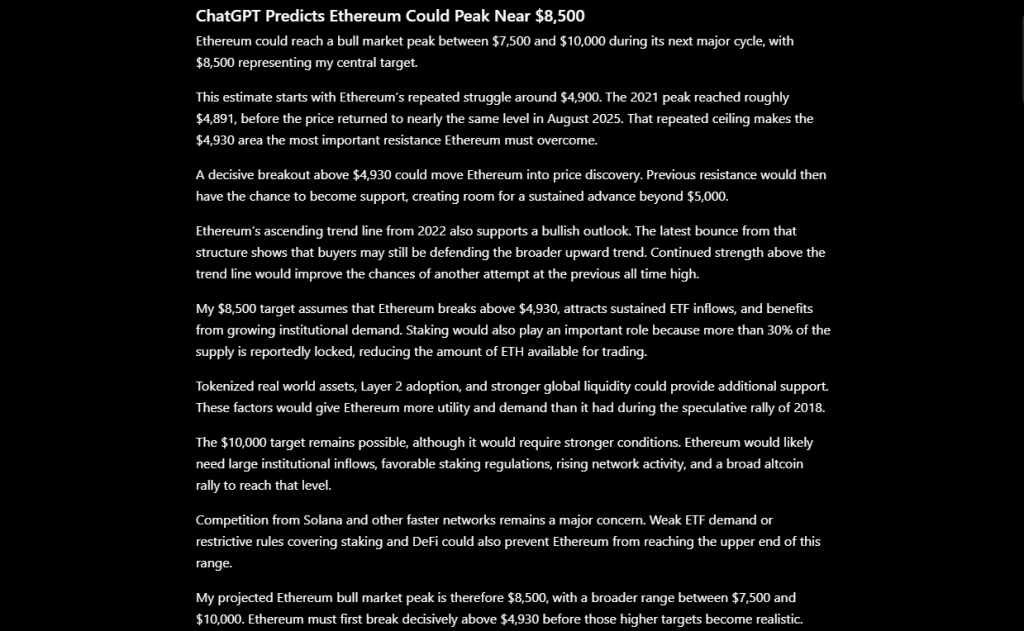
Tokenized real world assets and Layer 2 adoption could give Ethereum more practical demand than it had during the speculative rally of 2018. Favorable global liquidity would strengthen the case, especially if capital begins rotating from Bitcoin into major altcoins.
The $10,000 target remains possible under stronger conditions. Ethereum would likely need large ETF inflows, favorable staking regulations, higher network activity, and a broad crypto rally.
Competition from Solana, weak ETF demand, or strict DeFi rules could keep Ethereum closer to the lower end of the range. ChatGPT therefore selects $8,500 as the most realistic central target.
Claude Predicts Ethereum Could Peak Between $7,200 And $8,500
Claude places the potential Ethereum bull market peak between $7,200 and $8,500. This forecast falls between the more cautious analyst targets and the optimistic $10,000 outlook.
Claude views the repeated resistance near $4,930 as genuine but not permanent. Each attempt at that area has arrived alongside stronger Ethereum fundamentals. DeFi supported the 2021 rally, and ETFs plus tokenized assets strengthened the case during the next cycle.
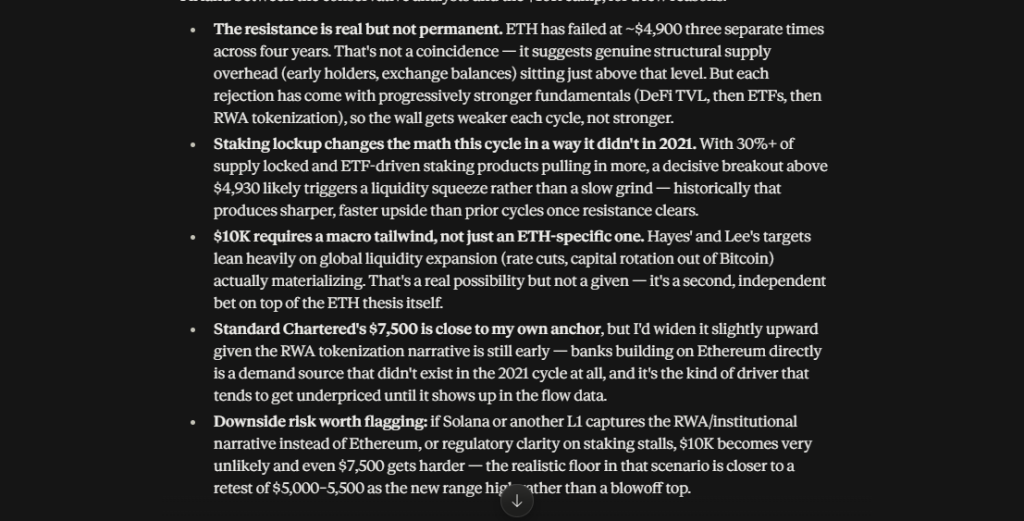
The amount of ETH committed to staking could change how the price behaves after a breakout. Limited exchange supply could produce a faster advance if institutional demand rises after Ethereum clears $4,930.
Claude believes $10,000 requires favorable global conditions alongside Ethereum’s own progress. Rate cuts, wider market liquidity, and capital rotation from Bitcoin would all need to support the ETH outlook.
Solana’s growth and uncertain staking regulations remain important risks. Claude estimates that weaker conditions could limit Ethereum price to around $5,000 or $5,500 instead of producing a larger bull market peak.
Gemini Predicts Ethereum Could Reach Between $7,800 And $8,500
Gemini forecasts an Ethereum price peak between $7,800 and $8,500. Its estimate relies heavily on the technical breakout above $4,930 and the supply restrictions created by staking.
A confirmed break above the historic resistance would validate a larger technical extension from Ethereum’s ascending support structure. Gemini’s projection places that extension within the $7,800 to $8,500 region.
Gemini also considers Ethereum’s fee burn system and Layer 2 ecosystem important. Heavy network use during a bull market could cause ETH burns to exceed new issuance during certain periods. Reduced supply and stronger demand could then support higher prices.
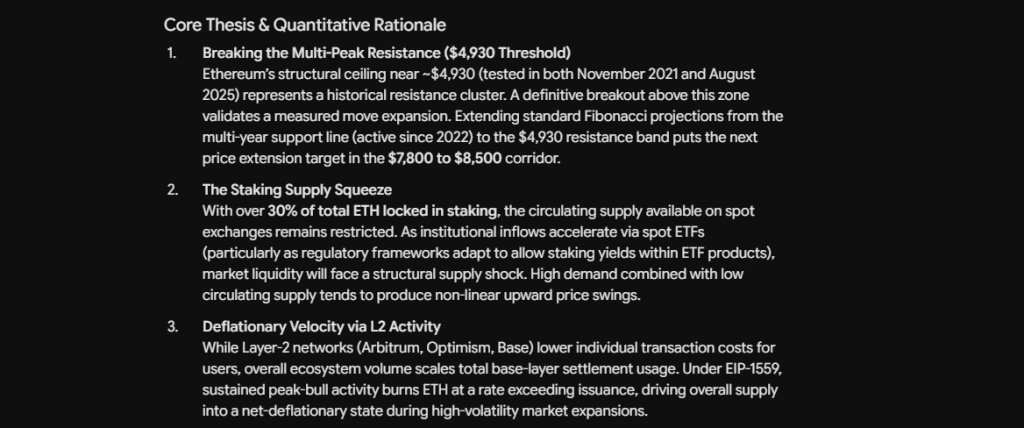
Real world asset tokenization provides another part of Gemini’s forecast. Ethereum could gain lasting network demand if institutions continue placing funds, debt instruments, and settlement products on its infrastructure.
Developer migration toward competing blockchains could weaken this case. Regulatory delays involving staking products or decentralized finance could also prevent Ethereum from reaching Gemini’s expected range.
How High Could Ethereum Price Realistically Go?
The 3 AI models produce a surprisingly narrow group of central forecasts.
| AI Model | Projected Ethereum Peak | Main Reasoning |
|---|---|---|
| ChatGPT | $7,500 to $10,000, with $8,500 central | ETF demand, staking supply, tokenization, and global liquidity |
| Claude | $7,200 to $8,500 | Supply restrictions, stronger fundamentals, and measured macro assumptions |
| Gemini | $7,800 to $8,500 | Technical extension, staking lockup, fee burns, and institutional network use |
Their shared range places a realistic Ethereum bull market peak near $8,000 to $8,500. The forecast would represent an advance of roughly 60% to 73% above the major $4,930 resistance area.
Ethereum could reach $10,000 if institutional inflows and global liquidity become exceptionally strong. Less favorable conditions could keep ETH closer to $5,000 or $6,000, especially if competition and regulation weaken demand.
FAQs
Subscribe to our YouTube channel for daily crypto updates, market insights, and expert analysis.