The cryptocurrency market has changed dramatically since Litecoin first appeared in 2011. Thousands of digital assets have launched, blockchains have become faster, and stablecoins have emerged as a popular way to move value online. Yet Litecoin continues to occupy a recognizable place in the crypto economy.
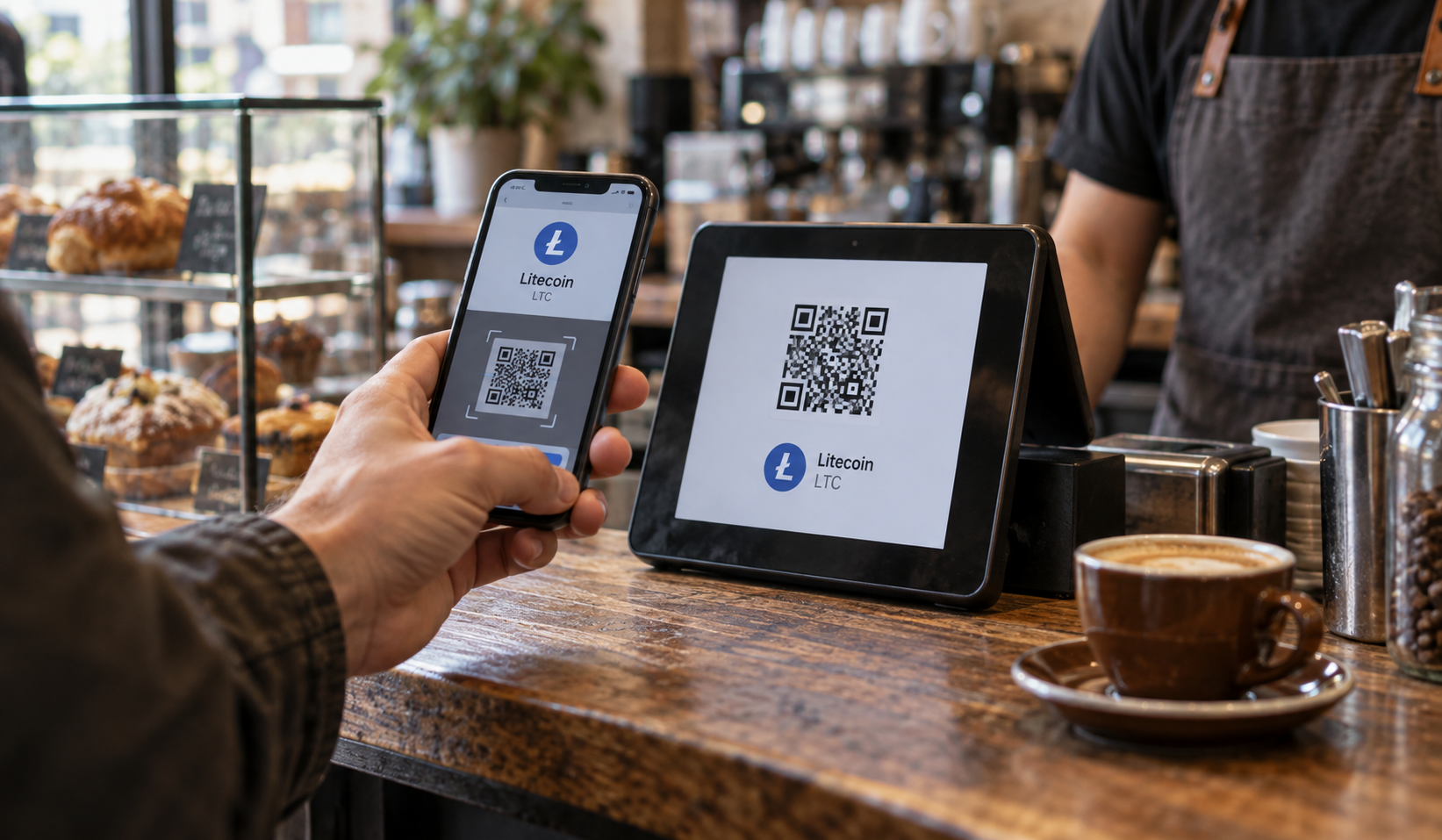
Its staying power is partly explained by a straightforward idea: cryptocurrency should be usable as money.
While much of the crypto conversation revolves around investment returns, decentralized finance, and new blockchain ecosystems, Litecoin remains closely associated with payments. That practical focus has helped LTC maintain relevance more than a decade after its launch.
What you'll learn 👉
Litecoin Was Built With Payments in Mind
Litecoin was created as an alternative to Bitcoin with several technical changes intended to make transactions more practical for frequent use. One of its most noticeable characteristics is its faster block generation time.
Bitcoin targets a new block approximately every ten minutes, while Litecoin targets roughly 2.5 minutes. Faster block production does not automatically make every payment instantaneous, but it can help transactions receive confirmations sooner.
Cost is another important part of the equation. The official Litecoin website describes the network as digital money designed to enable fast, near-zero-cost payments around the world.
For everyday users, that is easier to understand than many of crypto’s more complicated use cases. A digital currency becomes more useful when sending it does not require worrying about substantial transaction costs.
Real Utility Matters More Than Transaction Speed Alone
Speed is often treated as the main benchmark for payment-focused cryptocurrencies, but it is only one part of the user experience.
A cryptocurrency can process transactions quickly and still have limited practical value if few merchants, exchanges, wallets, or online services support it. For a payment network to remain useful, users need places where they can actually spend the asset.
This is where Litecoin’s long history can work in its favor. LTC has existed through several crypto market cycles, giving exchanges, wallet developers, payment processors, and online businesses plenty of time to integrate it.
That infrastructure creates a different type of value from speculation. Someone holding Litecoin does not necessarily have to treat it purely as an asset sitting in a wallet. Depending on the services available in their region, LTC can also function as a transferable digital currency.
Online Platforms Show How Crypto Payments Are Evolving
Digital-first industries are often among the earliest places where cryptocurrency payment behavior becomes visible.
Online gaming is one example. Some platforms allow users to fund accounts with cryptocurrencies rather than relying exclusively on cards or bank transfers. Resources covering gambling platforms that accept Litecoin illustrate how LTC has been integrated into this broader category of crypto-enabled online payments.
The significance extends beyond any individual industry.
Every time a cryptocurrency is integrated into an online service, users encounter the practical side of blockchain technology. Instead of asking what a token might be worth next month, the relevant questions become much simpler: How quickly can I send it? What does the transaction cost? How easy is the process?
Those are the questions that ultimately determine whether cryptocurrency can work as a payment method.
Litecoin Also Benefits From Familiarity
Crypto users are constantly introduced to new networks promising faster transactions or more advanced technology. Newer does not always mean easier to use, however.
An established cryptocurrency has had more time to develop infrastructure around it.
Litecoin is supported by many major crypto wallets and exchanges, which reduces friction for people who already own LTC. Users generally do not need to learn an entirely new ecosystem simply to send or receive the currency.
That familiarity may be particularly important for mainstream adoption. Most consumers do not care about blockchain architecture in the same way developers or investors do. They care whether a payment works.
If crypto payments become more common, simplicity could matter just as much as technical sophistication.
Competition Has Become Much Stronger
Litecoin is certainly not alone in pursuing the payments market.
Stablecoins have become particularly important because they address one of the biggest problems associated with paying in volatile cryptocurrencies. A dollar-pegged token can make it easier for buyers and sellers to understand exactly how much is being transferred.
Other blockchain networks also advertise extremely low transaction costs and rapid settlement.
That means Litecoin’s early-mover advantage does not guarantee future dominance. Instead, LTC competes in a much broader payment environment that includes Bitcoin’s Lightning Network, stablecoins, payment-focused cryptocurrencies, and increasingly efficient blockchain networks.
This competition is healthy because it pushes the industry toward better user experiences.
Payments Could Be Crypto’s Most Understandable Use Case
Blockchain technology can be difficult to explain. Concepts such as liquidity pools, restaking, tokenized assets, and zero-knowledge proofs often require considerable background knowledge.
Payments are different.
Almost everyone understands the basic problem of transferring money from one person to another.
That simplicity gives payment-focused cryptocurrencies an interesting role in broader adoption. A user does not need to understand every technical detail of Litecoin to appreciate the ability to transfer digital value directly.
For merchants and online platforms, the calculation is similarly practical. They need to consider transaction costs, confirmation times, liquidity, integration requirements, regulatory obligations, and customer demand.
Litecoin’s Longevity Is Part of the Story
Crypto moves quickly enough that surviving multiple market cycles is noteworthy on its own.
Litecoin has watched countless trends arrive, dominate the conversation, and eventually disappear. Through those changes, its basic proposition has remained relatively consistent: provide a decentralized digital currency that people can transfer efficiently.
That does not mean Litecoin will automatically become a dominant global payment network. Cryptocurrency adoption remains unpredictable, and competition continues to increase.
Still, Litecoin offers an interesting lesson about what gives a cryptocurrency staying power.
Sometimes the most durable idea is not the most complicated one. It is simply giving people a digital asset they can hold, send, receive, and increasingly use across online services.
As the crypto industry continues searching for applications that matter beyond speculation, that straightforward utility may be exactly why Litecoin remains part of the conversation.