Silver just printed a move that almost never happens.
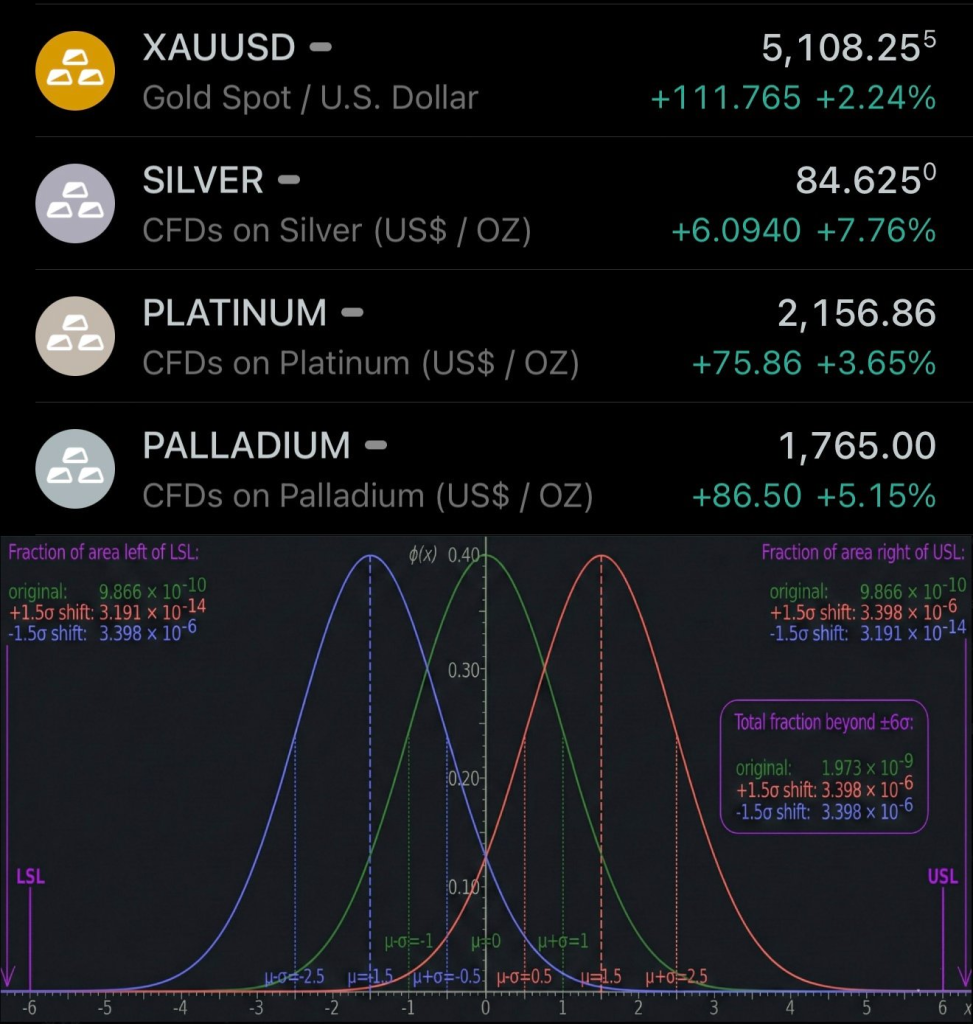
The metal is trading around $84.60, up nearly 8% on the session, after an explosive sequence that one well-known market analyst says qualifies as a 6-sigma event. Alex Mason flagged the move on X, warning that what’s unfolding across bonds and precious metals is statistically extreme, and structurally important.
His claim is bold: three 6-sigma-type events in one week across Japanese bonds, silver, and now gold.
That’s not normal volatility. That’s regime-level stress.
What you'll learn 👉
What Alex Mason Is Pointing To
In his post, Mason lays out the framework clearly.
In finance, price movements are often measured in standard deviations (or sigma) from the average. A 1-sigma move is noise. A 2-sigma move is common. A 3-sigma move is rare. By the time markets hit 5 or 6 sigma, you’re talking about events that statistically should occur once in millions, even hundreds of millions, of observations.
Mason argues that Japanese 30-year government bonds recorded a 6-sigma session last week. Days later, the silver price experienced a 5-sigma rally immediately followed by a 6-sigma drop in a single session. Gold, meanwhile, is up more than 20% in under a month and approaching similar statistical extremes.
The image attached to his post illustrates how far out on the probability curve these moves sit. On a normal distribution curve, 6-sigma events live at the extreme tails — areas so thin that, in theory, they should barely ever be touched.
Yet three separate markets have brushed those tails within days.
Why Silver’s Move Matters
Silver’s price action was particularly violent. A 5-sigma upside burst followed by a 6-sigma reversal in one session signals instability, not just strength.
That kind of move rarely comes from a routine macro headline. It typically stems from structural stress: heavy leverage, crowded positioning, forced liquidations, or collateral pressure.
When positioning gets extreme, even a modest catalyst can trigger chain reactions. Margin calls force selling. Short squeezes force buying. Liquidity thins out. Volatility feeds on itself.
Silver is especially vulnerable to these dynamics because it sits at the intersection of industrial demand and monetary demand. It reacts to growth expectations and to currency credibility at the same time.
When volatility explodes there, it often signals broader tension underneath the surface.
Bonds, Gold, and the Bigger Picture
Mason’s argument doesn’t stop at silver.
The Japanese bond market is one of the pillars of global liquidity. Long-dated government debt in Japan plays a critical role in funding flows, carry trades, and cross-border capital allocation.
A 6-sigma move in that market indicates that something in the funding structure tightened abruptly.
Then came silver’s violent whipsaw. Now gold is accelerating rapidly, climbing more than 23% in less than a month. That type of move in gold is not typical unless capital is repositioning aggressively.
Historically, precious metals attract flows when confidence in currencies or sovereign balance sheets starts to wobble. Long-term interest rates speak to government debt sustainability. Gold and silver speak to trust in the currency itself.
When both bonds and metals behave erratically at the same time, the message often extends beyond a single trade idea.
It points to stress in the monetary framework.
Read also: Silver Price Already Exploded – Now Copper Is Following the Exact Same Breakout Playbook
Is This a Systemic Warning?
Extreme sigma clusters have appeared before major turning points in financial history.
October 1987. The COVID crash in March 2020. The Swiss franc shock in 2015. Oil going negative in April 2020.
Those episodes weren’t caused by small data surprises. They were pressure-release moments after imbalances built up for months or years.
Mason’s warning is not that a crash is guaranteed tomorrow. His point is structural: clusters of high-sigma events rarely happen in isolation. They often show up when leverage unwinds and when capital rapidly reprices risk.
Silver’s 6-sigma signal fits into that pattern.
For now, the metals complex is flashing volatility that exceeds what traditional probability models would predict. Whether this resolves into stabilization or escalates into broader contagion depends on how funding markets and bond yields behave in the coming sessions.
But one thing is clear.
Three near-impossible statistical events in one week is not business as usual.
And silver just became the loudest signal in the room.
Subscribe to our YouTube channel for daily crypto updates, market insights, and expert analysis.