The strongest argument against self-custodial trading has never been about security. It has been about friction: the seed phrase, the bridge, the gas token you didn’t have, the swap you had to make before you could make the trade you actually wanted. ApeX Omni has spent the past year dismantling that list item by item, and in September 2026 it removed one of the largest remaining pieces.
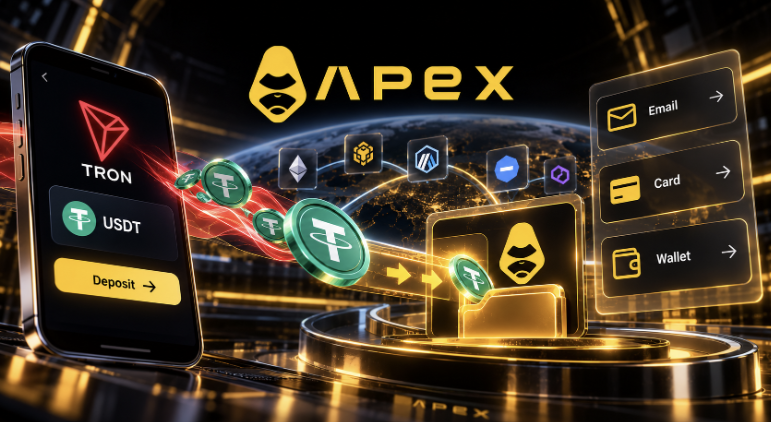
USDT held on the TRON network, which carries a large share of the stablecoin’s circulating supply, can now be deposited directly into an ApeX Omni account in a single flow, with no manual bridge and no detour through a centralised crypto exchange.
What you'll learn 👉
The Custody Trade-Off, Stated Plainly
Centralised exchanges won the onboarding war by hiding complexity: one login, one deposit address, one balance. The cost was custody. Users handed over their assets and trusted the venue to hold them. Decentralised venues kept custody with the user but historically exported the complexity back to them.
ApeX Omni’s design goal is to hold both ends. Trading runs on a central limit orderbook with up to 10,000 transactions per second of throughput, zero gas fees on orders, and settlement secured by zero-knowledge proofs on zkLink X, an infrastructure whose smart-contract audit reports are publicly available. Assets stay under the user’s control throughout. The rest of the platform’s onboarding work is about making that self-custody feel as routine as an exchange login.
Three Ways In, None of Them Requiring a Crypto Background
By email. An ApeX Omni account can be created with nothing more than an email address and a six-digit confirmation code. Account creation is free, no gas is required, and the account comes with a dedicated wallet address, so a new user can fund it from an exchange or another wallet exactly the way they would fund any exchange account.
By card. Fiat deposits, powered by Alchemy Pay, accept Visa, Mastercard, Apple Pay, and Google Pay across 40 fiat currencies, and funds land in the Funding Account within one minute. ApeX Omni charges no fee on fiat deposits; any applicable fees are Alchemy Pay’s.
Smaller deposits (up to 150 USDT a day and 1,000 USDT a month via card or mobile wallet) require no identity verification, and where verification is needed it is handled entirely by Alchemy Pay. ApeX Omni does not collect or store KYC information. Availability depends on the user’s currency and card-issuing region.
By wallet. Users who already hold crypto connect any of nearly 20 supported wallets, from MetaMask and Trust Wallet to Phantom and Ledger Live, and deposit from Ethereum, BNB Chain, Base, Arbitrum One, or Mantle. For assets that aren’t on the supported list, Multichain Swap converts a held token into a supported deposit asset inside the deposit window, and Swap & Deposit does the same conversion into USDT on the way into prediction markets.
TRON USDT: Closing the Largest Gap
The September launch addresses the most common shape of stablecoin balance in the market. Through a partnership with cross-chain infrastructure provider Halliday, USDT sent over TRON is swapped and credited to the user’s Funding Account automatically, with settlement executed on Arbitrum behind the scenes.
The practical details are the point:
- Available on web, mobile app (version 3.66.0 and later), and H5, for both email and wallet accounts.
- Pay from TronLink, TokenPocket, a centralised exchange, or any third-party TRON wallet. The paying wallet does not need to match the wallet logged into ApeX Omni.
- 5 USDT minimum and 10,000 USDT maximum per transaction, with deposits typically completing in three to five minutes.
- A 0.25% cross-chain swap fee charged by Halliday, which ApeX has said it expects to reduce over time, and no ApeX platform service fee on top.
One rule matters more than the rest: deposit addresses and QR codes are single-use and change from transaction to transaction. The platform generates a fresh address for every deposit, and reusing an old one risks permanent loss of funds. Withdrawals over TRON and support for tokens beyond USDT are planned for future releases.
What Self-Custody Actually Buys You Here
Custody is only meaningful if getting funds out is as clean as getting them in. ApeX Omni offers two withdrawal paths: a normal withdrawal that settles with the next Layer-2 block (typically within four hours) and a fast withdrawal routed through a liquidity provider that lands almost instantly on Ethereum, Arbitrum, or BNB Chain for a flat 2 USDT on non-Ethereum chains. An optional Withdrawal Verification setting adds an extra confirmation step to every withdrawal request.
Deposited assets do not sit idle while a user decides what to trade. Cross-Collateral lets USDT, USDC, WBTC, WETH, ETH, cmETH, mETH, cbBTC, and USDe all serve as margin in one account, each valued at its live index price with an asset-specific collateral ratio, and no forced conversion into a single settlement asset.
The platform’s security posture is treated as ongoing work rather than a launch feature. A security system upgrade shipped on Omni web in the first week of September, one of a series of background hardening releases, and the support model is deliberately narrow.
The Cost of Entry
For a first-time user, the numbers are unusually legible. Account creation: free. Trading gas: zero, subsidised by the platform. Fiat deposit fee from ApeX: zero. Trading fees: 0.02% maker and 0.05% taker at the base tier, discounted progressively through the VIP program to 0% for makers at the top tiers. The remaining costs, a network gas fee on a crypto deposit, Alchemy Pay’s on-ramp fee, or Halliday’s 0.25% on a TRON deposit, are third-party charges shown before the user confirms.
That transparency is the quiet argument the platform is making: self-custody was never supposed to be the hard option. It only felt that way because the setup was.
About ApeX Protocol
ApeX Protocol is a decentralized, non-custodial trading platform for perpetual derivatives, incubated by Davion Labs. ApeX Omni is the protocol’s flagship platform, consolidating crypto perpetuals, TradFi perpetuals, prediction markets, and yield products into a single multi-chain interface. Its mission is straightforward: deliver the speed and depth of a centralized exchange without asking traders to give up custody of their assets.
To get started, visit ApeX Omni or read the documentation at the ApeX Protocol GitBook.