Pump.fun is one of the strangest contradictions Solana has produced this cycle. On one side, it is a revenue monster. On the other, its token price tells a very different story.
By almost every operational metric, Pump.fun has been a success. As analyst Jussy pointed out on X, Pump.fun. became the highest-revenue protocol on Solana and generated close to $1 billion in fees in under two years. It also pulled off one of the largest token sales in crypto history, raising $1.3 billion at a $4 billion fully diluted valuation. At the time, the project sold roughly 4.1 million SOL, worth about $741 million then. That made it the third-largest sale the industry has ever seen.
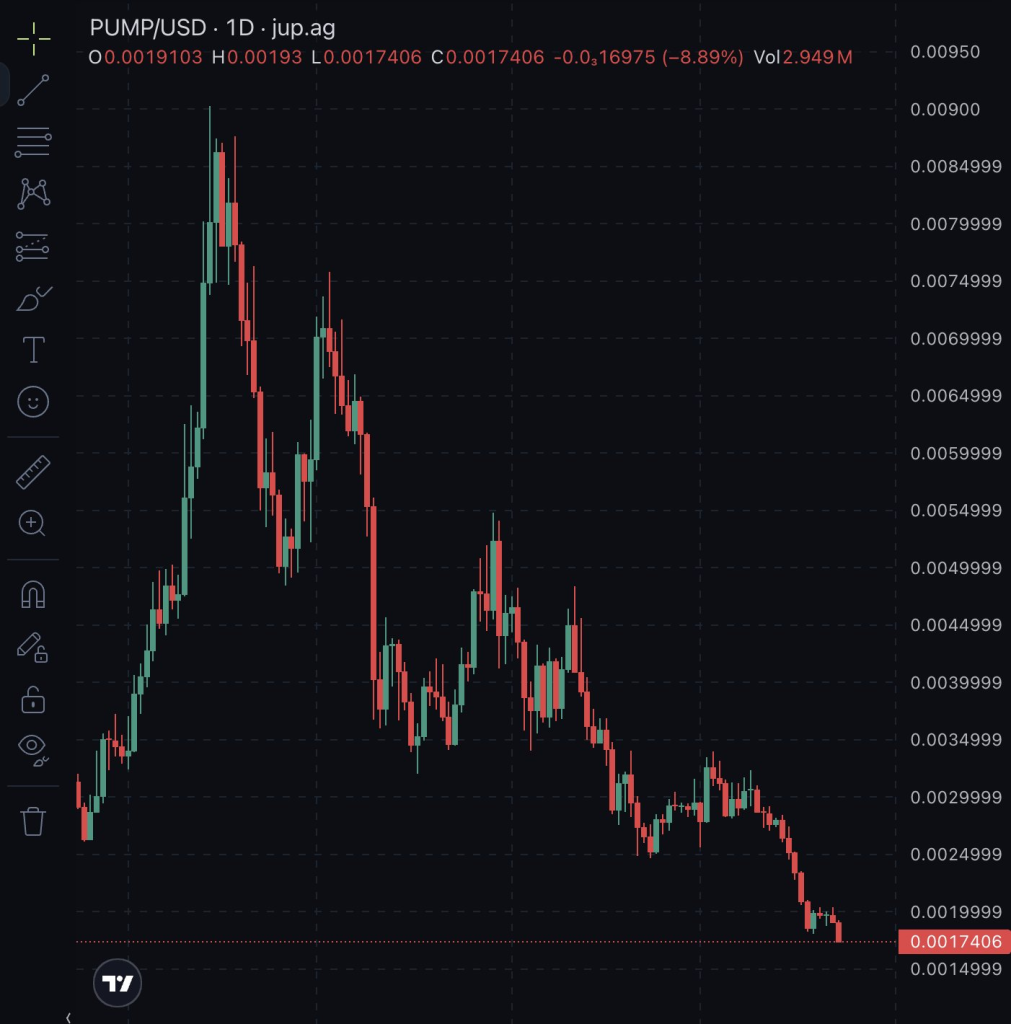
Yet today, the PUMP token trades about 60% below its ICO price and roughly 80% below its all-time high. Volume has dried up, price structure looks broken, and the project’s founder has been silent on social media for nearly two months. For a protocol that prints cash, the market response has been brutal.
Revenue success, token disappointment
The core issue is not whether Pump.fun makes money. It clearly does. The question is who that money benefits.
Pump.fun’s model was built around speed, scale, and volume. It turned memecoin launches into an assembly line, capturing fees at every step. That worked exceptionally well for protocol revenue. What never fully materialized was a clear mechanism that tied that success back to sustained token demand.
Raising $1.3 billion at a $4 billion FDV set expectations extremely high from day one. At that valuation, the market needed to see either rapid token utility expansion or aggressive value return to holders. Instead, PUMP entered trading with heavy supply overhang, limited narrative follow-through, and a sector that was already starting to cool.
As memecoin activity slowed, so did speculative interest. Revenue stayed strong, but price did not. That disconnect matters, because markets rarely price cash flow alone in crypto. They price future demand for the token itself. In Pump.fun’s case, that link never became obvious enough to defend valuation.
Silence, sentiment, and Solana’s broader problem
The recent silence from the founder has only added to the pressure. In crypto, perception matters almost as much as fundamentals. When leadership goes quiet during a deep drawdown, traders tend to assume the worst. Whether that assumption is fair or not, it affects sentiment.
The broader Solana backdrop does not help either. Pump.fun became a symbol of the chain’s memecoin era, where massive volume and extraction coexisted with heavy retail losses. As that phase cooled, projects closely associated with it lost narrative support fast. Even strong revenue was not enough to offset fatigue.
This does not mean Pump.fun is finished as a product. It still generates fees, still dominates its niche, and still sits at the center of a large on-chain funnel. But the token market is making a clear statement: revenue alone is not enough without a credible path for value to flow back to holders.
For now, PUMP trades like a reminder of this cycle’s biggest lesson. Being the top cash machine does not guarantee token performance. In fact, without alignment, it can highlight the gap even more.
Read also: Crypto Whales Just Gave Up on Ethena (ENA) and Pump.fun (PUMP): $27M Gone in a Brutal Exit
Subscribe to our YouTube channel for daily crypto updates, market insights, and expert analysis.