Kaspa (KAS) is preparing for a major hardfork on May 5, 2026, and the countdown has already started.
In a thread, Terah explained that the upgrade will add more Layer 1 features, including programmability and native assets, without changing Kaspa’s proof-of-work core.
For KAS holders, this is a key step that could define what comes next for the network.
What you'll learn 👉
What the Covenant Hardfork Is All About
According to Terah’s breakdown, Kaspa’s upcoming hardfork is designed to push Layer 1 beyond pure speed and payments. The new network will also bring native assets, enhanced covenant functionality, and the ability to perform zero-knowledge verification.
Kaspa (KAS) is already operating on a proof-of-work blockDAG consensus mechanism, and its Crescendo upgrade in 2025 increased the network’s throughput to 10 blocks per second.
Core developers have described it as a scoped but meaningful upgrade that opens the door to a more flexible Kaspa ecosystem.
compiled the vprogs/zk/native assets answers from the Q&A into one place 🧵
— Terah (@terah4d5) February 8, 2026
this is where we pretend things are simple, just for a moment.
what's the upcoming HF actually about?
covenant-centric HF with native assets. vprogs foundations being laid but thats not the main event…
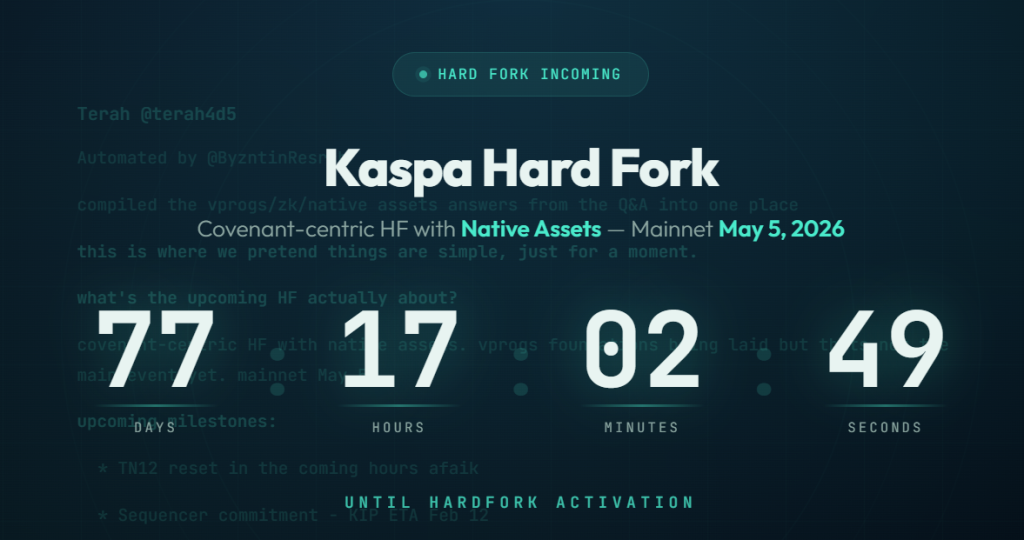
The Timeline Leading Up to May 5, 2026 For KAS Upgrade
The hardfork is not a single-day event. Several steps come before the mainnet activation.
Terah noted that Testnet 12 will reset in early February 2026 to support covenant and native asset testing. A sequencer commitment proposal is expected around mid-February, aimed at improving decentralization through miner payload commitments.
Another key milestone is the release of SilverScript, a high-level programming language built to make covenant development much easier.
All of this leads into the main event on May 5, 2026, with future upgrades like DAGKnight planned afterward.
Source: Kas.live
Native Assets Are Coming to Layer 1
One of the biggest additions is the launch of native assets directly on Kaspa’s base layer. This includes support for KRC20-style tokens, which will exist on Layer 1 instead of relying on external smart contract systems.
These assets will support atomic transfers, meaning token movements happen cleanly inside the Kaspa transaction model. Inline covenants will generate proofs immediately within wallets, keeping execution deterministic and tightly connected to the chain itself.
This is a major shift for Kaspa’s utility, especially for developers who want token issuance without moving to another network.
Covenants++ Bring More Programmability
Kaspa’s covenant system is inspired by Bitcoin research around programmable spending rules. With Covenants++, the network will support more advanced transaction conditions.
Terah highlighted use cases like escrow setups, conditional transfers, vault-style security controls, and structured token logic. Importantly, Kaspa keeps its UTXO model instead of moving toward full account-based smart contracts.
This gives Kaspa (KAS) a different style of programmability, one focused on rules and execution safety at the transaction level.
CDAG and vProgs Lay the Groundwork for Bigger Systems
The hardfork also introduces something called the Computational DAG (CDAG). This tracks program resource usage, dependencies, and execution commitments.
On top of that, Kaspa (KAS) is preparing the foundation for vProgs, which are sovereign programs that execute outside Layer 1 but settle results back on-chain through proofs.
These are not meant for everyday apps right away. Terah suggested vProgs may appeal more to teams building appchains, rollup-style systems, or large AI-driven on-chain architectures.
It’s a deeper infrastructure move that positions Kaspa for long-term scalability.
Another important part of the upgrade is native zero-knowledge proof verification on Layer 1. The roadmap includes Groth16 support and trustless bridging possibilities.
Early ZK use cases are expected to run inline, with wallets generating proofs directly. Contributors have noted that this can work on standard hardware, without needing specialized prover setups.
Privacy-focused programs become possible after this, even if privacy is not the main focus of Kaspa’s roadmap today.
Read Also: Here’s the Cardano (ADA) Price If Bitcoin Reclaims $100K in 2026
SilverScript Could Make Building on Kaspa Easier
SilverScript is one of the most developer-friendly parts of this upgrade. It is designed as a readable, high-level language for writing Kaspa programs and covenants.
The goal is to lower the barrier for new builders and make covenant-based applications more accessible once native assets go live.
If Kaspa wants a stronger ecosystem, tooling like SilverScript will matter just as much as raw throughput.
However, Kaspa’s May 5, 2026 hardfork is shaping up to be its biggest upgrade yet. Native assets, extended covenants, ZK verification, and new execution infrastructure all point toward a more programmable Layer 1.
The network keeps its proof-of-work base and avoids raising node requirements, but adds new layers of functionality that could attract developers and new use cases.
With the countdown already running, this hardfork could become a defining moment for Kaspa’s long-term growth, and possibly a key catalyst for the KAS price if adoption follows the tech.
Subscribe to our YouTube channel for daily crypto updates, market insights, and expert analysis.