Kaspa has spent months in a downtrend, and the KAS price is now back at a level that matters on the weekly chart. A second look at a recent breakout has created a tidy setup on paper, although one stubborn question keeps following the chart.
Three analysts have shared their views on Kaspa lately, and each one covers a different piece of the puzzle. Their posts range from chart levels to network activity to a frank look at what could hold the token back. Here is what the data shows and what it still leaves open.
What you'll learn 👉
Kaspa Price Retests a Broken Descending Channel on the Weekly Chart
Analyst Lana Valentis, who posts as @LanaValentis, says Kaspa is retesting a broken descending channel on the weekly timeframe. She calls the pullback a clean second-chance entry for traders who missed the first breakout. Her post also points to nearly 2.5 billion transactions and 566,000 wallets, along with a new security tool that uses real hostile attacks to stress test contracts.
$KAS The Retest Is Here 🔍 Kaspa is retesting the broken descending channel on the weekly timeframe. The pullback offers a clean second-chance entry for those who missed the breakout. There have been nearly 2.5 billion transactions and 566,000 wallets, as well as a new security tool that uses real hostile attacks to stress-test contracts. The network is not slowing down. Target levels: 🎯 $0.050 🎯 $0.075 🎯 $0.130 🎯 $0.190
— Lana Valentis (@LanaValentis) November 3, 2026
A retest matters because it shows whether an old resistance area can work as new support. When the level holds, the breakout stays intact. When it fails, the move can turn into a false start that traps late buyers. That is why the weekly timeframe gets so much focus in this Kaspa price setup.
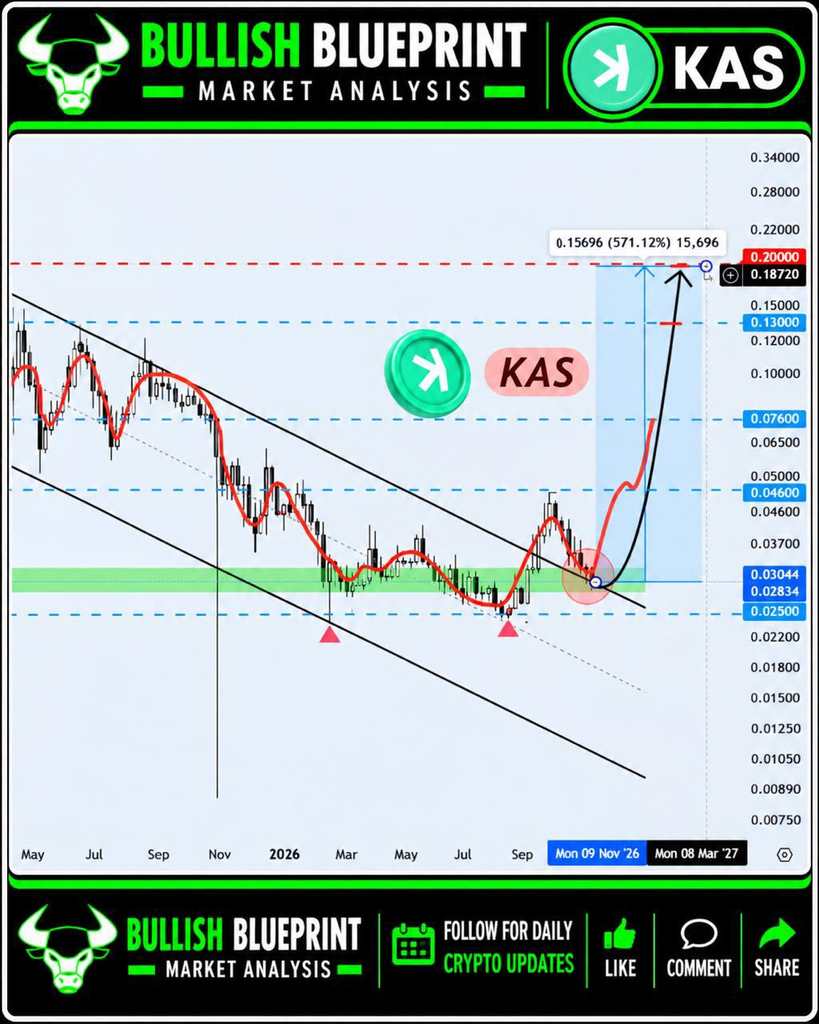
KAS Price Holds Near The $0.028 To $0.030 Support Zone
Bullish Blueprint Signals, posting as @SamWilliam18504, shared a Kaspa (KAS) chart that shows the price holding near a key support zone around $0.028 to $0.030 after an extended descending trend. The account says a confirmed breakout could bring resistance levels near $0.046, $0.076, and $0.13 into focus. It also made clear that these levels are a technical scenario and not a guaranteed outcome.
A market snapshot reviewed on November 3 gives useful context for the current KAS price:
- Price: $0.03135
- Circulating market capitalization: $871 million
- Valuation at maximum supply: about $900 million
- Circulating supply: about 27.79 billion KAS
- Estimated maximum supply: about 28.70 billion KAS
That puts the Kaspa price a little above the support zone that the chart analysis marks. It also means about 96.8% of the estimated maximum supply has already been issued.
Kaspa Fair Launch History Compares Differently With Newer Vested Tokens
Jimmyyy, who posts as @Jimmyy_yyyy, spends a good part of the analysis on how Kaspa started. The published history states that there was no premine and no insider coin allocation, and every coin entered supply through mining. Many newer projects carry investor and team vesting schedules, but Kaspa does not have that overhang.
Jimmyyy adds an important limit to that point. A fair launch describes how coins were distributed at the start. It does not prove equal ownership today, because early miners, later buyers, mining companies, and exchange customers can hold very different amounts.
The funding model is different too. A 100 million KAS community grant supported the Rust rewrite, which later enabled the Crescendo upgrade and the move to 10 blocks per second. The newer Toccata upgrade adds native covenant programming and infrastructure for based zero knowledge applications, and the project site records its activation on June 30, 2026.
Read Also: Kaspa Price Could Be Setting Up for a Bigger Drop!
Two Scenarios For Kaspa Price: A Confirmed Breakout Or A Demand Shortfall
The first scenario is the bullish one. If the retest holds and the breakout gets confirmed, the first resistance areas named by the analysts are $0.046 and $0.050, followed by $0.075 and $0.076. Both Lana Valentis and Bullish Blueprint Signals list those levels on the way toward $0.19 or $0.20.
The second scenario is a demand shortfall. Jimmyyy points out that if demand falls faster than issuance declines, the price can still weaken. Most of the supply is already issued, so future dilution is small, but that does not guarantee buyers. Miners also pay for hardware, electricity, and operations, so they may sell coins to cover those costs. This scenario would put the $0.028 to $0.030 support zone back in focus for the KAS price.
Lana Valentis And Bullish Blueprint Signals Share Similar Kaspa Price Targets
The two chart posts land in similar territory. The table below compares the target levels each analyst listed.
| Target Level | Lana Valentis | Bullish Blueprint Signals |
|---|---|---|
| First | $0.050 | $0.046 |
| Second | $0.075 | $0.076 |
| Third | $0.130 | $0.13 |
| Final | $0.190 | $0.20 |
Both lists end close together, and the top target is more than 6 times the current $0.03135 price. Bullish Blueprint Signals describes its $0.20 level as a longer-term projected target, so it is a distant marker and not a near-term expectation.
Jimmyyy Gives Kaspa A B Grade, But Questions Fee Demand and the Security Budget
Jimmyyy ends the analysis with a scorecard that mixes optimism and caution:
- Product and Technology: B
- Token Economics: B
- Growth Potential: B
- Risk Profile: C
Read Also: XRP Price Is Weak, But Millionaire Wallets Are Sending a Bullish Signal
The overall fundamental grade is B. The reasoning centers on mining economics. Lower issuance reduces dilution, but it also leaves fewer new coins to pay miners, so the network security budget depends more on coin value and transaction fee demand over time. Jimmyyy adds that transaction count alone is not enough, because the fees paid and their contribution to miner income are what matter.
Jimmyyy also says a comprehensive, reconciled revenue figure showing a mature application economy could not be established. The strongest signals to watch would be applications with repeat users, liquidity that stays after incentives, payments for goods and services, and fees generated by useful activity.
Subscribe to our YouTube channel for daily crypto updates, market insights, and expert analysis.