Bitcoin is back in an uncomfortable spot, and this time the pressure isn’t coming from the U.S. or the Fed. Instead, all eyes are on Japan. With a rate hike expected, traders are starting to revisit an old pattern that hasn’t treated Bitcoin very kindly in the past.
A recent post from NoLimit summed up the concern clearly. Every time Japan has stepped away from ultra-low rates, the Bitcoin price has struggled soon after.
When you look at the chart, it’s hard to ignore. These moves didn’t lead to slow, orderly pullbacks. They tended to spark sharp drops that caught traders off guard.
What you'll learn 👉
Why Japan Still Has Outsized Influence
Japan might not dominate crypto headlines, but it plays a huge role in global liquidity. For years, the yen has been one of the cheapest currencies to borrow. Funds could take out low-cost loans, convert that money into dollars, and put it to work in stocks, bonds, and crypto, including Bitcoin.
That strategy works as long as borrowing stays cheap. Once rates rise, the equation changes fast. Suddenly, those positions become more expensive to maintain, and some have to be unwound. When that happens, funds usually sell whatever they can move quickly. Bitcoin, trading 24/7 with deep liquidity, often ends up on the sell side.
This helps explain why previous Bank of Japan moves didn’t lead to calm corrections. They triggered fast selloffs, often during illiquid hours, when buyers were thin and the BTC price could drop quickly.
The Bitcoin Chart Is Sending a Familiar Signal
On the weekly Bitcoin chart shared by NoLimit, the timing stands out. Past Japanese rate hikes tend to line up with periods where the Bitcoin price topped out and then rolled over.
In several cases, price moved sideways for weeks, giving the impression that things were stable, before breaking lower.
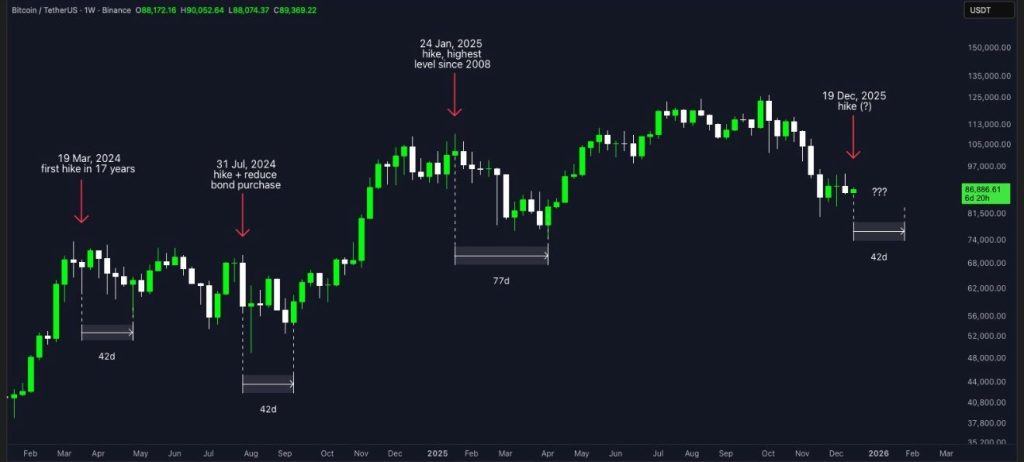
Right now, Bitcoin looks like it’s in a similar phase. The price is stuck in a tight range, volatility is creeping higher during Asia sessions, and sudden drops are showing up without any major news. Those are the same warning signs traders saw before earlier resets.
This Isn’t a Repeat of 2022, But It’s Not Nothing Either
To be fair, Bitcoin today isn’t the same market it was in 2022. Back then, aggressive Fed hikes helped drive a brutal drawdown of more than 60%. Since then, market structure has improved, and institutional participation is broader.
Still, being more mature doesn’t make Bitcoin immune to liquidity shocks. If Japan signals that higher rates are here to stay, it reinforces the idea that cheap global leverage is fading.
That doesn’t mean Bitcoin is about to collapse, but it does indicate the easy-money phase that fueled fast rallies may be behind us for now.
Read Also: Institutions Are Loading Up on Bitcoin (BTC), So Why Is the Price Still Falling?
What This Means for Bitcoin Going Forward
For traders running high leverage, this kind of environment can turn dangerous quickly. Sudden moves, thin liquidity, and macro-driven selling don’t leave much room for mistakes.
For more patient market participants, though, these moments have often marked the early stages of larger resets rather than the end of the story.
Bitcoin isn’t breaking down yet. But with Japan back in focus, the market is being reminded that global liquidity still matters. What comes next may depend less on hype and more on how markets adjust when one of the world’s cheapest sources of money finally starts to tighten.
Subscribe to our YouTube channel for daily crypto updates, market insights, and expert analysis.


![Best Online Crypto Casino 2026: Spartans, Betpanda, Bitz & Cloudbet [Expert Review]](https://captainaltcoin.com/wp-content/uploads/2026/04/image-283-336x220.jpeg)