Buying Polygon (POL) today comes with a simple question that keeps popping up: how much could it be worth in the future? To address this, we will take a closer look at how much 10,000 POL tokens could be worth in 2027 if you buy now.
At the current Polygon price of $0.16 at the time of writing, picking up 10,000 POL would cost around $1,600. That entry point feels modest, yet the long term outcome depends on how the network and the wider market evolve over the next two years.
Polygon has spent the last cycle quietly rebuilding its foundations. Price action has not been exciting, but development and adoption have continued in the background. That contrast makes the POL price story worth breaking down carefully.
What you'll learn 👉
Recent Developments That Have Shaped Polygon Price Movement
The last year has been busy beneath the surface for Polygon. Network enhancements and enterprise integrations pushed activity higher, even while the POL price struggled. Transaction volumes expanded steadily, while stablecoin usage became a major pillar of on chain demand.
Tokenomics also shifted in a meaningful way. Polygon moved toward a deflationary structure using treasury-funded buybacks and token burns. Daily burns reached about 1 million POL tokens, gradually tightening circulating supply. That change altered how long term value is modeled, especially if usage keeps rising.
Operationally, Polygon processed about 1.4 billion transactions in 2025. Stablecoin supply on the network climbed to roughly $2.8 billion, while on chain volume reached about $780 million. Those figures showed that real economic activity continued even as price sentiment cooled.
Early January 2026 brought a temporary pause when Bithumb suspended POL transactions during a network upgrade. That event created short term uncertainty, though it was tied to infrastructure improvements rather than deeper issues.
The Rio upgrade marked one of the biggest technical steps. The network gained support for about 5,000 transactions per second, lighter nodes, and stronger finality reliability without re organization risks. Those upgrades focused squarely on long term scalability rather than short term hype.
Partnerships And Real World Usage Expanding Polygon Utility
Enterprise adoption has remained one of Polygon’s strongest narratives. Revolut integrated Polygon for stablecoin payments, trading, and staking, processing more than $690 million in volume. Stripe crossed $50 million in stablecoin volume on Polygon, leading all EVM chains, while Flutterwave selected the network for cross border payments across Africa.
The world’s largest funds network, processing £250B+ monthly, chooses Polygon to launch tokenized fund share classes to 4,500 financial institutions in 58 markets.
— Polygon | POL (@0xPolygon) November 12, 2025
Calastone is bringing institutional finance onchain, on Polygon rails. pic.twitter.com/vPYFcbXPKg
Traditional finance also entered the picture. Calastone launched tokenized fund distribution on Polygon, handling billions in monthly flows. Mastercard enabled username based crypto transfers through Mercuryo. Collaborations with Starbucks, Reddit, Google Cloud, and DeFi platforms like Aave and Chainlink expanded Polygon’s footprint across payments, identity, and decentralized finance.
Many of these initiatives are driven by Polygon Labs, which has focused on positioning Polygon as an enterprise friendly blockchain rather than a retail hype asset.
Read Also: Litecoin (LTC) Price Slips Again Amid Questions on Long‑Term Demand
Factors Expected To Influence Polygon Price in 2026 and 2027
Several forward looking developments could shape Polygon price over the next two years. AggLayer became fully operational in Q4 2025, connecting liquidity across zkEVM, Supernets, and the PoS chain. POL staking plays a role in cross chain governance, which could deepen long term token demand.
The Gigagas roadmap targets up to 100,000 transactions per second. Planned upgrades include recursive zkEVM proofs to reduce gas costs and speed up finality. Validators are also expected to migrate fully to POL, reinforcing its role as the core asset.
Strategic acquisitions added another layer. Coinme and Sequence were brought into the ecosystem to strengthen regulated U.S. stablecoin payments, fiat on ramps, and enterprise grade wallets. Enterprise momentum may continue through potential expansions into payments and tokenized funds, alongside staking growth that already stands near 3.6 billion POL.
Polygon Price Levels And Technical Scenarios To Watch
Polygon price has traded below the $0.3 resistance level since February 2025. Price slipped into that zone and failed to reclaim it for nearly a year, turning that level into a major psychological barrier. Conditions worsened in November 2025 when POL price dropped below support around $0.16.
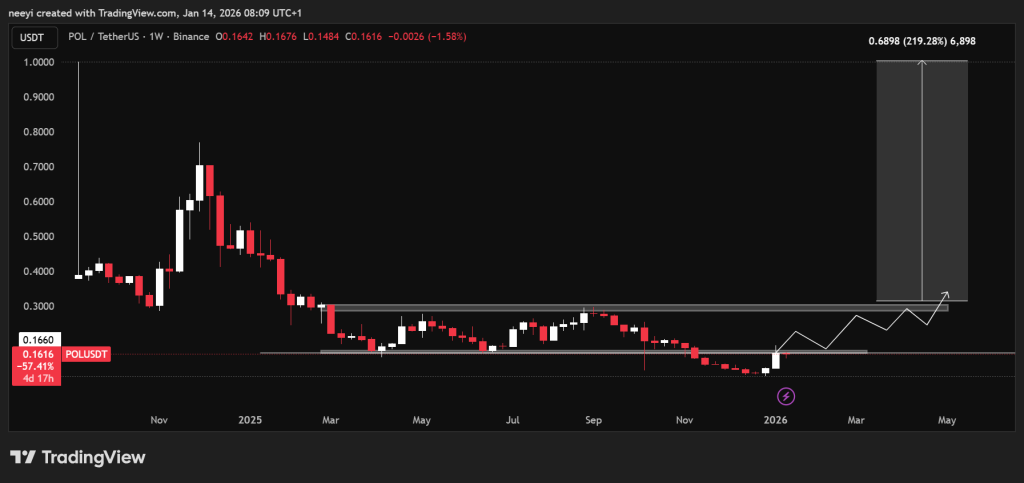
Price now trades close to that same $0.16 area again. A clean move above it could allow consolidation between $0.16 and $0.3 for a period of time. That kind of sideways action would signal stabilization rather than further decay.
A breakout above the $0.3 resistance that has capped price for a year could restore confidence. That shift could attract fresh buyers and open the path toward higher levels. Sustained strength above $0.3 may allow a move toward the December 2024 high near $0.7, with $1 becoming realistic by 2027 if broader market conditions remain constructive.
How Much 10,000 POL Could Be Worth In 2027
A bullish scenario assumes Polygon price reaches $1 by 2027. Under that outcome, 10,000 POL tokens would be worth $10,000. That represents a significant return from the current $1,600 entry, driven by adoption, scaling success, and favorable market conditions.
A neutral scenario assumes price breaks above $0.3 and trades in a broad range between $0.5 and $0.7. In that case, 10,000 POL would be valued between $5,000 and $7,000. That outcome reflects moderate growth without full market euphoria.
Read Also: How Much Could $1,000 in Cardano Turn Into by 2027? ADA Price Prediction
A bearish scenario keeps the long consolidation intact. Price continues ranging between $0.2 and $0.3, extending the structure that began in 2025. Under that outcome, 10,000 POL would be worth between $2,000 and $3,000, suggesting limited progress amid a sluggish crypto market or internal challenges.
Polygon sits at an interesting crossroads. Price action looks quiet, yet development and adoption continue to stack up. Watching how POL behaves around the $0.16 and $0.3 levels may offer clues about which path unfolds as 2027 approaches.
Subscribe to our YouTube channel for daily crypto updates, market insights, and expert analysis.