Gold Price Today (November 16): China Buys 26 Tonnes as Bullion Starts New Week Under Pressure


Gold price opened the new trading week on the defensive, but one of the world’s largest central-bank buyers is doing the opposite of nervous investors.
China added roughly 26 tonnes of gold to its reserves in October, its largest monthly purchase in around three years and the 24th consecutive month that official holdings increased.
Meanwhile, spot gold slipped about 0.3% on Monday to $3,867 per ounce, with December U.S. gold futures near $3,870. A stronger dollar, elevated Treasury yields and expectations for another Federal Reserve rate hike continue to weigh on bullion.
That creates an interesting contrast: gold price remains under short-term pressure, but China has accelerated its accumulation as prices fall.
What you'll learn 👉
China Accelerates Gold Buying as Price Drops
Official reserve data shows Chinese gold holdings increased by 830,000 ounces during October, equivalent to approximately 25.8 tonnes.
China now holds about 78.30 million ounces, or 2,435 tonnes of gold.
That leaves the country only around two tonnes behind France in reported official reserves.
The pace of accumulation is particularly notable.
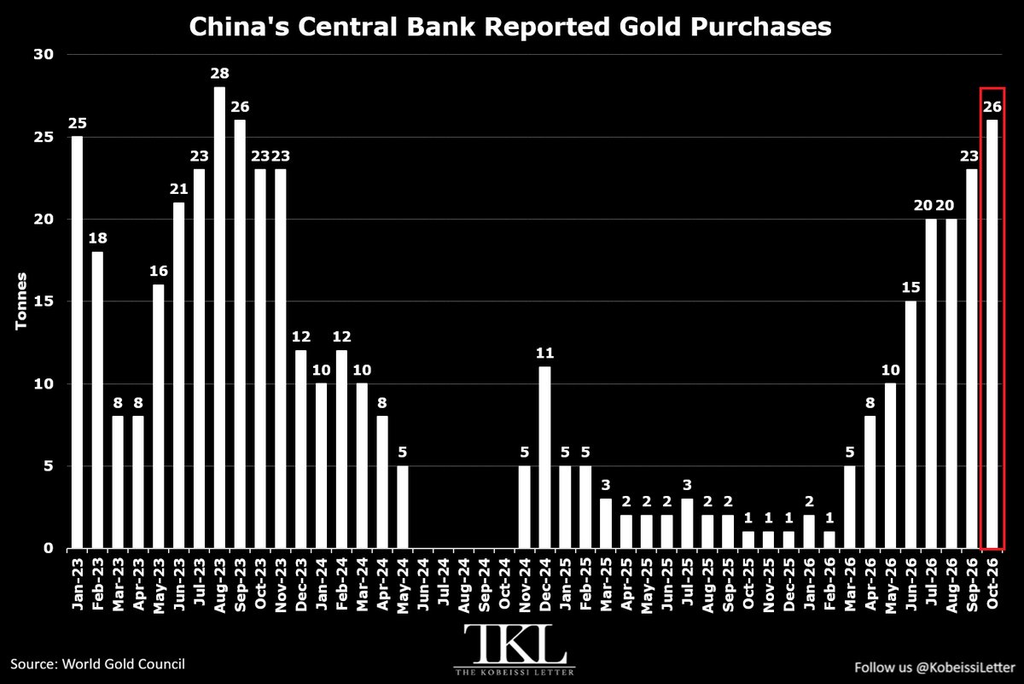
China bought approximately 23 tonnes in September before increasing that figure again in October. Across the first ten months of 2026, its purchases reached roughly 129 tonnes.
Gold also fell almost 7% during October, meaning the People’s Bank of China was substantially increasing reserves during one of bullion’s weakest periods of the year.
That does not prove China believes the exact bottom is near. Central banks typically operate on much longer horizons than ordinary traders.
But it does show that lower gold prices have not discouraged official Chinese demand.
Why Is Gold Price Down Today?
Gold’s problem at the start of this week is monetary policy.
The dollar remains close to its strongest level since April 2025, while markets are pricing about a 90% probability of a 25-basis-point Fed hike in December.
Higher interest rates increase the appeal of interest-bearing assets relative to gold, which provides no yield.
Investors are now waiting for Fed Chair Kevin Warsh’s comments and Wednesday’s release of the October FOMC meeting minutes for clues about how aggressive policymakers could remain.
Gold already had a difficult previous week, falling roughly 4.5% as inflation concerns and higher-rate expectations pushed prices below $4,000.
Read also: Time to Buy Gold? This 1970s Gold Pattern Says the Bull Market May Not Be Over
Gold Price Outlook: Short-Term Pressure Meets Long-Term Demand
The immediate gold price structure remains weak below $3,900.
If selling continues, the $3,800-$3,850 area becomes important, with deeper support around $3,700-$3,750.
A recovery above $3,900 would help stabilize the market, but gold probably needs to reclaim $4,000 before the technical picture starts improving materially.
China’s buying does not remove those short-term risks.
What it does show is that one of the world’s largest reserve holders is taking advantage of lower gold prices rather than retreating from the asset.
For traders, a strong dollar and hawkish Fed remain problems.
For China, the correction appears to have been an opportunity to buy more.
For more financial news and price predictions, click here.
Subscribe to our YouTube channel for daily crypto updates, market insights, and expert analysis.