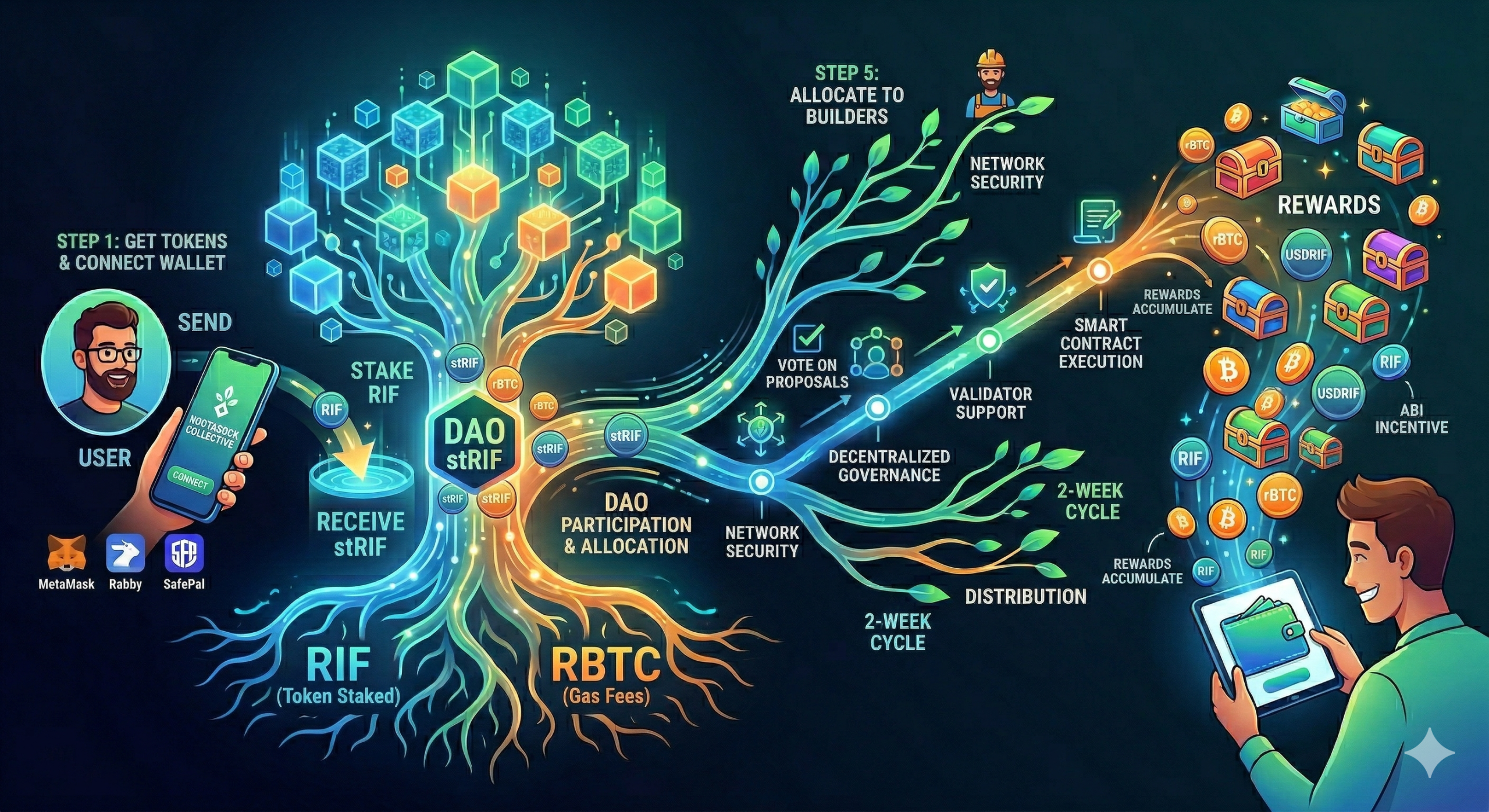
Staking on RootstockCollective transforms your RIF tokens into active participants in Bitcoin’s most powerful Layer 2 ecosystem, and the rewards start flowing within two weeks. If you’ve ever wondered what actually happens after you click “stake,” this guide reveals every step of the journey, from connecting your wallet to claiming your first rBTC, USDRIF and RIF rewards.
Staking on RootstockCollective isn’t complicated, but understanding the full cycle empowers you to maximize your returns and make strategic decisions about which builders to support. Whether you’re a first-time staker or a crypto veteran exploring Bitcoin DeFi, this guide demystifies the Collective Rewards on Rootstock explained in practical, actionable terms.
What you'll learn 👉
Understanding the RootstockCollective Staking Ecosystem
RootstockCollective operates as a decentralized DAO built on Rootstock, Bitcoin’s merged-mined sidechain. When you stake RIF tokens, you’re not just parking assets, you’re joining a community that funds builders, shapes governance decisions, and earns real rewards paid in rBTC (Bitcoin on Rootstock), RIF and USDRIF tokens.
The staking journey begins with RIF, the utility token powering the Rootstock ecosystem. Once staked, your RIF converts to stRIF at a 1:1 ratio. This staked version unlocks three powerful capabilities: voting rights on proposals, the ability to back builders you believe in, and eligibility for bi-weekly reward distributions. Your stRIF remains fully in your control, non-custodial staking means you never surrender ownership of your tokens.
What makes this system unique is its dual-reward structure. Unlike traditional staking where you simply earn yield, RootstockCollective rewards you for active participation. The more engaged you are in backing builders and voting on proposals, the more you can earn. Current participants enjoy a ~30% Annual Backer Incentive (ABI), with over 2.69 BTC and 1.1 million RIF already distributed through the Collective Rewards program.
Prerequisites: Setting Up Your Wallet and Acquiring Tokens
You need two tokens to begin your staking journey: RIF for staking and a small amount of RBTC for gas fees. Several EVM-compatible wallets work seamlessly with the Rootstock network, giving you flexibility in how you manage your assets.
Compatible Wallets
The RootstockCollective dApp supports multiple wallet options to suit your preferences:
- MetaMask: The most popular choice, offering browser extension and mobile options
- Rabby: Known for its security features and user-friendly interface
- SafePal: Provides both software and hardware wallet solutions
- Bitget Wallet: Offers integrated exchange features
- Ledger/Trezor: Hardware wallet options for maximum security
- SubWallet, Wigwam: Additional alternatives with RootstockCollective support
To configure your wallet for Rootstock, you’ll need to add the network manually or use a service like Chainlist. The key network details include Rootstock’s mainnet RPC and chain ID, which your wallet will use to communicate with the blockchain.
Where to Get RIF and RBTC
RIF tokens are available across numerous platforms, making acquisition straightforward regardless of your preferred exchange type.
| Platform Type | Examples | Best For |
|---|---|---|
| Centralized Exchanges | Binance, Gate.io, MEXC | Beginners, fiat on-ramps |
| Decentralized Exchanges | SushiSwap, Changelly | Privacy, no KYC required |
| Bridges | Symbiosis, Sovryn, Jumper | Moving assets from other chains |
| On/Off Ramps | Lemon, Bit2Me, Mt Pelerin | Direct fiat purchases |
For RBTC, you have several options: the PowPeg (native Bitcoin bridge) or Boltz for quick conversions, or multi-chain DEXs like Symbiosis, OKU, SushiSwap, Orbiter, Jumper, or even purchase it with fiat using Mt. Pelerin, Onramp, Buenbit, etc. services. Many users find DEXs the most convenient, as they allow converting ETH or other assets directly to RBTC in minutes.
The Staking Process: Step-by-Step Walkthrough
The actual staking transaction takes just minutes, but understanding each step ensures a smooth experience. Here’s exactly what happens when you stake RIF on RootstockCollective.
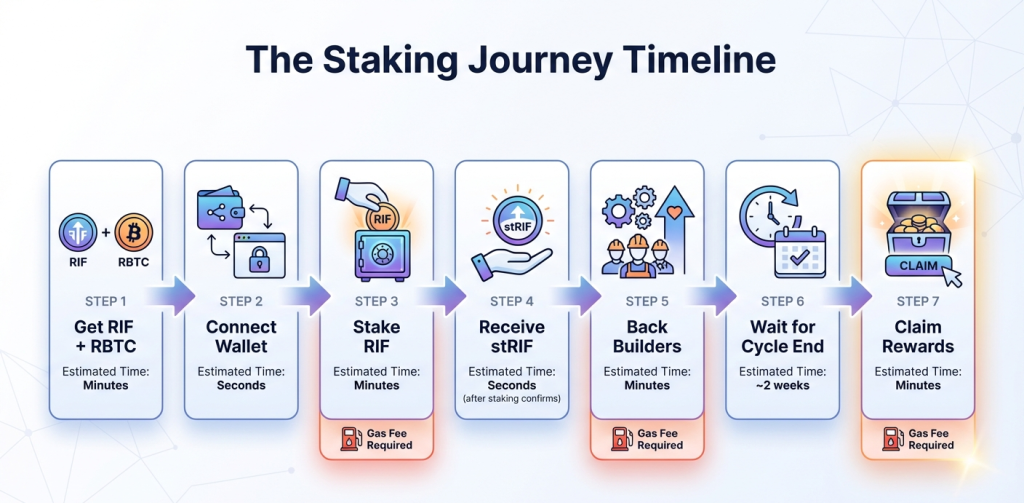
Alt Text: Infographic showing the 7-step RootstockCollective staking journey: Get RIF and RBTC, connect wallet, stake RIF, receive stRIF, back builders, wait for 2-week cycle, and claim rewards in rBTC, RIF and USDRIF.
Step 1: Connect Your Wallet
Navigate to app.rootstockcollective.xyz and click “Connect Wallet.” Select your preferred wallet from the supported options. Your wallet will prompt you to sign a connection request, this verifies ownership without sending any transaction or spending gas.
Step 2: Initiate the Stake
Once connected, locate the “Stake” button on the main dashboard. Enter the amount of RIF you wish to stake. Remember, you can stake any amount, there’s no minimum requirement, though having at least 100 RIF gives you meaningful voting power.
Step 3: Approve and Confirm
Your wallet will prompt two transactions. The first is an approval transaction, authorizing the staking contract to interact with your RIF tokens. The second confirms the actual stake. Each requires a small RBTC gas fee, typically fractions of a cent given Rootstock’s low transaction costs.
Step 4: Receive stRIF
Within seconds of confirmation, your wallet balance updates to show stRIF tokens. These appear at a 1:1 ratio to your staked RIF, stake 1,000 RIF, receive 1,000 stRIF. Your stRIF now represents both your staked position and your voting power within the DAO.
The beauty of this system lies in its flexibility. You can unstake at any time by returning stRIF to the governance contract, which burns the stRIF and releases your original RIF. There are no lock-up periods or withdrawal penalties.
Becoming a Backer: Allocating Your stRIF
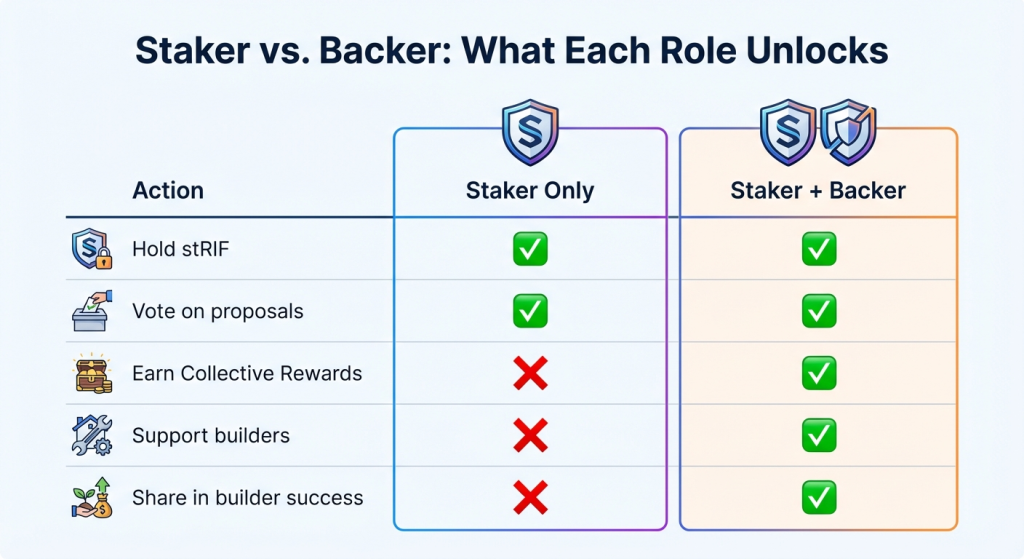
Alt Text: Comparison table showing Staker vs. Backer roles on RootstockCollective: both can hold stRIF and vote on proposals, but only Backers earn Collective Rewards, support builders, and share in builder success.
Staking alone makes you a DAO member, but becoming a backer unlocks the Collective Rewards program. Backers allocate their stRIF to support specific builders, projects and developers creating dApps, protocols, and infrastructure on Rootstock.
When you back a builder, you don’t lose ownership of your stRIF. Think of it like voting with your tokens while keeping full control. Your allocated stRIF continues to represent your stake, but it now also directs rewards toward builders you believe in, and earns you a share of their success.
How to Allocate Your Backing Power
The allocation process happens through the RootstockCollective dApp’s “Builders” section. Browse the leaderboard of activated builders, each displaying their project description and the “Backing Share” they’ve chosen to share with supporters.
Select the builders you want to back by clicking “Select” on their cards. You can choose multiple projects to diversify your support. Once you’ve made your selections, click “Back Builder” to distribute your stRIF among your chosen builders.
The dApp offers flexible allocation tools: input fields for exact amounts, sliders for quick adjustments, or percentage-based distribution. For example, if you have 2,000 stRIF, you might allocate 1,000 to a promising DEX project and 500 each to two infrastructure builders. Unallocated stRIF remains in your balance, ready for future backing decisions.
After finalizing your choices, save your allocations. This creates an on-chain record of your backing, and you immediately become eligible for rewards from the builders you’ve supported.
The Reward Cycle: Understanding Bi-Weekly Distributions
Collective Rewards operate on a bi-weekly cycle, creating a predictable rhythm of earning potential. Each cycle, the RootstockCollective treasury distributes rewards to activated builders based on the backing they’ve received from the community.
Here’s the flow of how RootstockCollective rewards explained simply: treasury funds flow to builders proportionally based on community support, and builders share a percentage of their earnings with the backers who supported them.
How Builder Rewards Are Calculated
Each builder’s share of the cycle’s total rewards corresponds to their percentage of total backing. If Builder A receives 10% of all backing votes and Builder B receives 5%, Builder A earns 10% of the distributed rewards while Builder B earns 5%.
Builders set their own “Backer Reward Percentage”, the portion of their earnings they share with supporters. This percentage is visible on each builder’s profile, allowing you to factor it into your backing decisions.
How Backer Rewards Work
Your share of a builder’s distributed rewards depends on how much stRIF you allocated to them relative to their total backing.
Example calculation: Suppose a builder earns 20% of the total rewards for a cycle and sets their Backer Reward Percentage at 25%. The backers collectively receive 5% of that cycle’s total rewards (20% × 25% = 5%). Your individual share is then calculated based on your proportion of the builder’s total backing. If you contributed 10% of their backing, you’d receive 10% of that 5%.
This model rewards both commitment and strategic selection. Backing builders with strong traction and generous reward percentages maximizes your earning potential.
Claiming Your Rewards
Rewards become claimable after each cycle ends and the distribution process completes. The RootstockCollective dApp displays your accumulated rewards in the “My Collective” -> “Holdings” section, showing rBTC, USDRIF and RIF amounts ready for withdrawal.
To claim, navigate to the rewards section and initiate a claim transaction. Your wallet will prompt you to confirm the withdrawal, requiring a small RBTC gas fee. Once confirmed, your rewards transfer directly to your connected wallet.
There’s no deadline to claim rewards, they accumulate in your account until you’re ready to withdraw. Some users claim every cycle, while others let rewards build up and claim monthly or quarterly. The choice depends on your preferences and whether you want to compound by restaking RIF rewards.
Monitoring Your Staking Performance
The dApp provides comprehensive dashboards for tracking your staking journey. Key metrics include your total stRIF balance, allocated versus unallocated amounts, current backing positions, and reward history. You can also view estimated rewards for the current cycle, helping you gauge whether adjusting your allocations might improve returns.
Maximizing Your Staking Strategy
Successful backers develop strategies that balance reward optimization with ecosystem impact. The most effective approaches combine several tactics that leverage the platform’s unique mechanics.
Diversify Your Backing
Spreading allocations across multiple builders reduces risk and exposes you to more reward streams. If one project underperforms, others may compensate. Consider mixing established projects with promising newcomers, established builders often have consistent backing, while newer projects may offer higher backer reward percentages to attract supporters.
Research Builder Quality
Before backing, examine each builder’s project, track record, and contribution to the Rootstock ecosystem. Strong projects tend to attract more backing over time, which can increase the total reward pool. Builders who actively engage with their backers and deliver on roadmaps build loyal support bases.
Monitor and Adjust Allocations
Your backing strategy shouldn’t be static. Review performance each cycle and reallocate if certain builders consistently underperform or new opportunities emerge. The dApp allows adjustments at any time, though changes to builder reward percentages require a 7-day notice period, giving you time to react before new rates take effect.
Consider Delegation Options
If you can’t actively manage your backing every cycle, RootstockCollective supports delegation. You can assign your voting power to trusted delegates who make backing decisions on your behalf while you still earn rewards. This feature ensures passive participants can still benefit from the ecosystem.
The Technology Behind Your Staking Journey
Understanding the technical foundation provides confidence in the security and transparency of your staking. RootstockCollective operates on Rootstock, the first and longest-running Bitcoin sidechain, which inherits Bitcoin’s security through merged mining. This means the same computational power securing Bitcoin also protects your staked assets.
The governance system uses battle-tested smart contract frameworks, including OpenZeppelin libraries that power many of crypto’s most trusted protocols. All contracts are open-source and auditable, allowing community members to verify exactly how staking, voting, and rewards function.
Rootstock’s EVM compatibility means the experience feels familiar if you’ve used Ethereum-based DeFi. The same tools, MetaMask, Solidity-based contracts, standard token interfaces, work seamlessly on Rootstock, just with Bitcoin-grade security and significantly lower fees.
What Makes RootstockCollective Different
This isn’t another yield farm promising unsustainable APYs. RootstockCollective ties rewards to genuine ecosystem growth, builders creating real value receive funding, and backers share in that success. The 30% Annual Backer Incentive reflects actual treasury distributions, not inflationary token emissions.
The platform operates with full transparency through on-chain governance hosted on Tally. Every proposal, vote, and fund allocation is publicly recorded, allowing anyone to verify how the community’s resources are deployed. This level of accountability distinguishes RootstockCollective from opaque alternatives.
Currently, over 28 million RIF tokens are staked in the DAO, with more than 2.69 BTC and 1.1 million RIF already distributed through Collective Rewards. Backed projects include major ecosystem players like OpenOcean, Boltz, Money On Chain, Tropykus, and many others building the infrastructure for Bitcoin DeFi.
Starting Your Staking Journey Today
The path from wallet to reward is clear: acquire RIF and RBTC, connect your wallet to RootstockCollective, stake your RIF to receive stRIF, allocate backing to builders you believe in, and claim your rewards every two weeks.
Every vote you cast and builder you back contributes to Bitcoin’s evolution as a programmable, DeFi-capable network. You’re not just earning rewards, you’re actively shaping which projects receive funding and how the Rootstock ecosystem develops.
Ready to begin? Head to app.rootstockcollective.xyz, connect your wallet, and stake your first RIF. In two weeks, you’ll be claiming your first rewards and experiencing firsthand what makes community-driven Bitcoin DeFi so compelling.
The RIF staking process on RootstockCollective offers something rare in crypto: transparent rewards tied to real ecosystem growth, full custody of your assets, and a genuine voice in how Bitcoin’s future unfolds. Your staking journey starts with a single transaction, and the rewards keep flowing as long as you participate.
DISCLAIMER: CAPTAINALTCOIN DOES NOT ENDORSE INVESTING IN ANY PROJECT MENTIONED IN SPONSORED ARTICLES. EXERCISE CAUTION AND DO THOROUGH RESEARCH BEFORE INVESTING YOUR MONEY. CaptainAltcoin takes no responsibility for its accuracy or quality. This content was not written by CaptainAltcoin’s team. We strongly advise readers to do their own thorough research before interacting with any featured companies. The information provided is not financial or legal advice. Neither CaptainAltcoin nor any third party recommends buying or selling any financial products. Investing in crypto assets is high-risk; consider the potential for loss. Any investment decisions made based on this content are at the sole risk of the readCaptainAltcoin is not liable for any damages or losses from using or relying on this content.