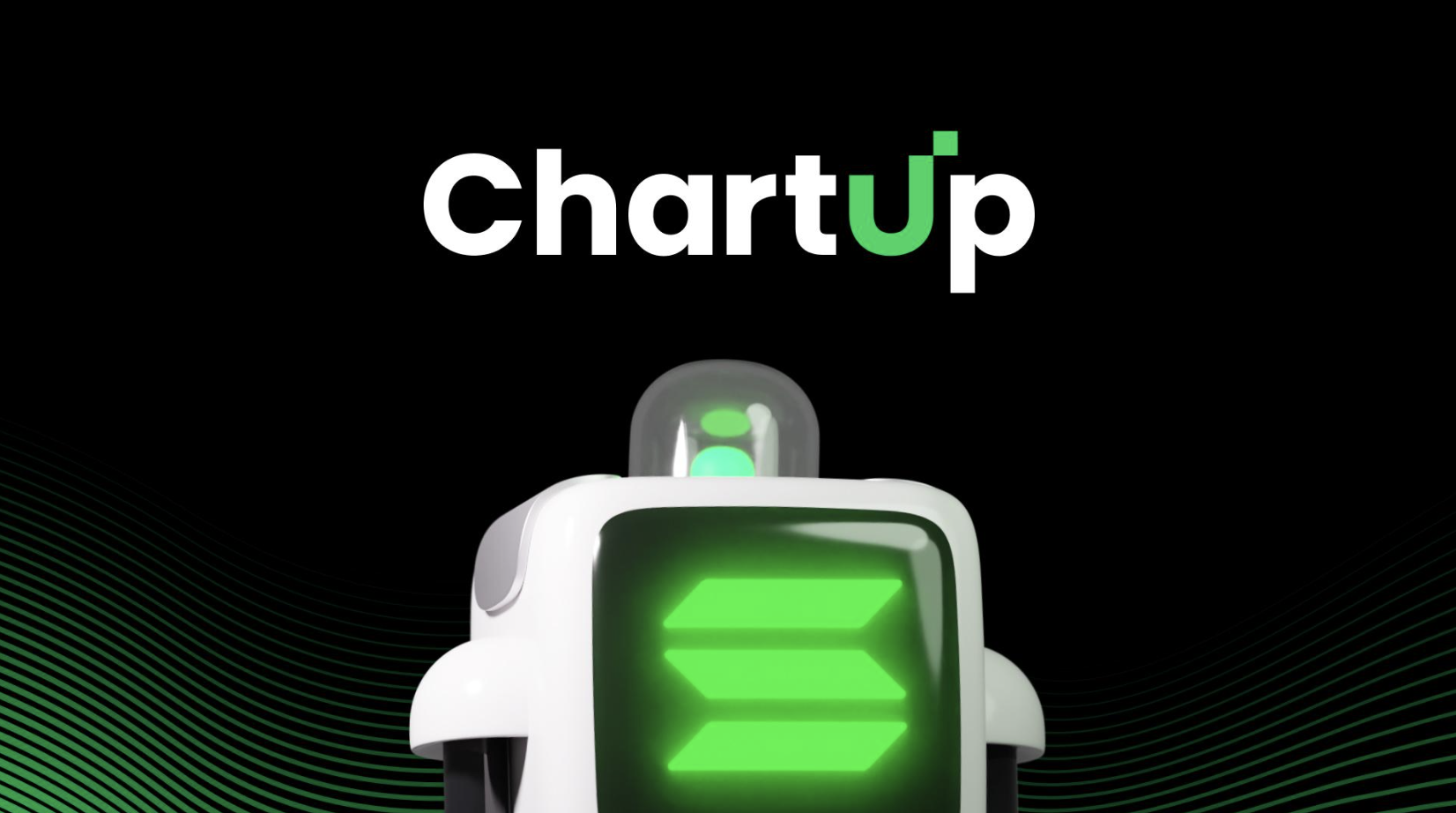
ChartUp has developed from a Solana-focused Telegram tool into a wider blockchain automation platform. At the center remains its Solana Volume Bot, now joined by services for BNB Smart Chain, Robinhood Chain, and Base. This gives developers one recognizable project for testing activity across several distinct network environments.
That multi-chain direction is the most important part of this ChartUp review. Solana operates differently from EVM networks, while BNB Chain, Robinhood Chain, and Base each have their own liquidity venues, fees, and transaction conditions. ChartUp does not present them as one generic product. Its website provides separate access points for each supported network, while the established Solana toolkit remains the most extensively documented part of the platform.
What you'll learn 👉
What Is ChartUp?
ChartUp is a Telegram-based trading-simulation toolkit created for developers and project teams. Its main service automates sequences of buys and sells across separate wallets and configurable time intervals. The objective is to provide controlled activity that teams can observe during private development, liquidity testing, and pre-deployment analysis.
The platform is broader than a basic transaction generator. Its documented tools include fast and organic volume modes, maker activity, holder distribution, real-time order statistics, adjustable execution speed, contract-address changes, and automatic pool migration. Users can pause or resume an active task instead of losing control after an order begins.
Telegram keeps the workflow compact. A user can configure a task, follow its progress, and make permitted changes without installing a separate desktop program. ChartUp also states that it does not request private keys, seed phrases, or a standing wallet connection. Payments use one-time blockchain addresses, separating order funding from permanent wallet credentials.
Solana Volume Bot: ChartUp’s Most Established Product
The Solana Volume Bot is the foundation of the ChartUp platform and its most mature service. ChartUp provides two main execution approaches. Fast mode is designed for shorter, higher-speed tasks, while organic mode varies transaction values and delays to create less uniform activity during longer observation periods.
The official documentation explains that volume tasks distribute buys across separate wallets and continue according to the selected allocation. This architecture gives developers a way to observe transaction routing, token behavior, pool reporting, and interface updates under controlled conditions.
Solana venue support is one of ChartUp’s strongest features. The published list includes Raydium, Pumpfun, PumpSwap, Meteora, LaunchLab, Bonkfun, Jupiter Studio, Meteora DBC, BelieveApp, Bags, Heaven, Moonit, and Moonshot. This range matters because a token may pass through different launchpad and liquidity environments during development.
Automatic pool migration adds another useful layer. If a supported token moves to a new liquidity pool, ChartUp is designed to identify the change and redirect an active task. Users can also pause an order, change its contract address, adjust execution speed, and continue with the available budget.
ChartUp supplements volume testing with Makers and Holders tools. The Makers Bot creates randomized micro-buy activity through distributed wallets, while the Holders Bot assigns small token allocations for holder-distribution testing. Keeping these functions within one interface gives Solana teams a more complete toolkit than volume automation alone.
BNB Volume Bot: Extending ChartUp Into BNB Smart Chain
The BNB Volume Bot brings ChartUp’s model to BNB Smart Chain, which is also commonly called BSC. This is a natural expansion because BNB Chain has an active token and decentralized-finance ecosystem, while its EVM compatibility supports familiar contract and wallet standards.
BNB Chain still requires its own execution logic. It uses BNB for transaction fees and has different liquidity venues, block conditions, and fee calculations from Solana. A dedicated ChartUp product allows the service to address that environment without treating BNB transactions as if they were Solana transactions.
For project teams, the practical advantage is consistency at the service level. They can approach ChartUp through a familiar brand and Telegram-based workflow while selecting a network-specific product. This is more convenient than combining unrelated automation services with different interfaces and control systems.
Robinhood Volume Bot: Early Support for a New EVM Network
The Robinhood Volume Bot shows that ChartUp is following newer blockchain ecosystems rather than limiting its scope to established networks. Robinhood Chain is a permissionless Layer 2 developed on Arbitrum infrastructure and intended for financial applications and tokenized real-world assets.
The network uses an EVM environment, but it should not be confused with a conventional Robinhood brokerage account. This ChartUp service relates to Robinhood Chain and its decentralized applications, pools, and on-chain assets.
Uniswap has confirmed that v2, v3, v4, and UniswapX are available on Robinhood Chain. That creates a recognizable liquidity environment for developers building on the network. ChartUp’s early support could be useful for teams that want one established workflow while testing token and pool behavior on a newer chain.
Adding Robinhood Chain also demonstrates the advantage of ChartUp’s wider direction. Instead of remaining tied to one ecosystem, the project can adapt its automation model to emerging networks as their DEX infrastructure develops.
Base Volume Bot: ChartUp on Coinbase-Incubated Infrastructure
The Base Volume Bot gives ChartUp a presence on the Ethereum Layer 2 incubated by Coinbase. Base has attracted a broad range of applications, tokens, developers, and liquidity venues, making it a relevant network for a multi-chain testing platform.
Base is EVM-compatible, which can make contract and wallet integration familiar to Ethereum developers. However, it remains a separate network with its own transaction fees, pool conditions, contract addresses, and infrastructure. ChartUp’s decision to provide a dedicated Base option recognizes those differences.
This product is particularly relevant to teams working across more than one EVM environment. A project may test related deployments on BNB Chain, Base, and Robinhood Chain while maintaining a separate Solana version. ChartUp’s growing product range creates a more unified starting point for that type of multi-network work.
Packages, Estimates, and Order Control
ChartUp’s Solana documentation provides the clearest view of its commercial structure. Packages begin at 1.5 SOL and combine an estimated activity target with a selected duration. Available time frames range from short tasks to multi-day runs, allowing teams to match an order to the purpose of a test.
The platform calculates estimates using factors such as the current SOL price and the swap fee charged by the selected venue. A package running through a pool with higher fees may produce a different result from the same package on a lower-fee venue. ChartUp clearly describes package outcomes as estimates rather than guaranteed figures.
Order controls are a notable strength. Users can monitor live statistics, pause and resume tasks, change execution speed, and replace a contract address. The ability to carry an unspent budget into another supported task can be useful when development plans change or a project moves between contracts and pools.
Privacy and Responsible Use
ChartUp’s privacy policy says the service may process Telegram identifiers, payment addresses, public transaction information, and order settings required for operation. It states that private keys, seed phrases, personal identification documents, and complete wallet histories are not collected.
The operating boundaries are equally important. ChartUp presents its products as development and simulation tools for controlled environments. Its terms prohibit deceptive use, public manipulation, and activity that misrepresents automated transactions as genuine market demand. Users also need to review the current geographic restrictions and eligibility terms before accessing the service.
This clear separation between private testing and public market activity improves the project’s professional positioning. It gives developers a defined use case while acknowledging the legal and reputational risks associated with trading automation.
What Could Be Improved?
ChartUp’s public documentation is much more detailed for Solana than for BNB Chain, Robinhood Chain, and Base. Short network-specific pages listing supported DEXs, payment requirements, trial availability, and available controls would make the newer products easier to compare.
Final ChartUp Review
ChartUp has built a well-defined Solana toolkit and is now applying that experience to a wider group of networks. Its main strengths are the Telegram-based workflow, separate-wallet execution, fast and organic modes, broad Solana venue support, live statistics, adjustable orders, pool-migration handling, and supporting Makers and Holders tools.
The addition of dedicated services for BNB Smart Chain, Robinhood Chain, and Base gives the project a credible multi-chain direction. Each network is presented as a separate option, which is important because their fees, liquidity systems, and transaction environments are not identical.
Overall, ChartUp stands out as a flexible blockchain testing platform rather than a single-purpose bot. Its Solana product remains the most complete and transparent part of the service, while the newer EVM options expand its usefulness for teams working across several ecosystems. With more detailed documentation for those newer networks, ChartUp would offer an even clearer and more consistent multi-chain package.
DISCLAIMER: CAPTAINALTCOIN DOES NOT ENDORSE INVESTING IN ANY PROJECT (CRYPTO OR CASINO) MENTIONED IN SPONSORED ARTICLES. EXERCISE CAUTION AND DO THOROUGH RESEARCH BEFORE INVESTING YOUR MONEY. CaptainAltcoin takes no responsibility for its accuracy or quality. This content was not written by CaptainAltcoin’s team. We strongly advise readers to do their own thorough research before interacting with any featured companies. The information provided is not financial or legal advice. Neither CaptainAltcoin nor any third party recommends buying or selling any financial products. Investing in crypto assets is high-risk; consider the potential for loss. Any investment decisions made based on this content are at the sole risk of the readCaptainAltcoin is not liable for any damages or losses from using or relying on this content.