
Bittensor’s kicking off August on solid ground. The AI coin is up 2.49% in the last day to $193.29, moving pretty much in step with the broader crypto market’s 0.88% gain. Bitcoin’s 0.82% bump helped lift the mood across the board, and the TAO price just went along for the ride, nothing specific to Bittensor driving this move.
Still, interest in the project keeps growing as its subnet ecosystem expands and new infrastructure upgrades roll out. That backdrop got a lot more interesting after Jason Calacanis, an early Uber backer and well-known angel investor, was tied to a wildly bullish call that sees the Bittensor price hitting $32,000 in the next ten years.
What you'll learn 👉
Why Jason Calacanis Thinks TAO Could Become the “Better Bitcoin”
Top analyst Crypto Patel shared Jason Calacanis’ investment thesis, arguing that Bittensor could deliver 200x returns from current levels. The case centers on artificial intelligence and blockchain converging into a new technology sector that could rival the growth seen during Ethereum’s early years.
Calacanis believes that if Bittensor becomes the leading decentralized AI network, its market capitalization could eventually reach $500 billion, putting the TAO price near $32,000 based on its fixed supply.
The thesis also compares TAO with Bitcoin. Bittensor has a maximum supply of 21 million tokens, matching Bitcoin’s hard cap, and its emissions have already undergone a halving. Crypto Patel also pointed to $100–$135 as a good entry zone, with shorter-term targets at $1,000, $2,000, and $3,000 before even thinking about that $32,000 number way down the road.
But let’s be real, a $500 billion valuation would mean Bittensor grows way beyond where it is now. That would take years of steady developer adoption, real enterprise demand for decentralized AI, and big money finally stepping in. Nothing happens overnight.
Bittensor Price Analysis: Is the Chart Backing the Bullish Thesis?
We had a look at Crypto Patel’s chart, and the broader structure remains constructive despite TAO trading well below its all-time highs. Price continues holding above the major accumulation zone between $100 and $135, an area Patel identifies as the foundation for the next expansion cycle.
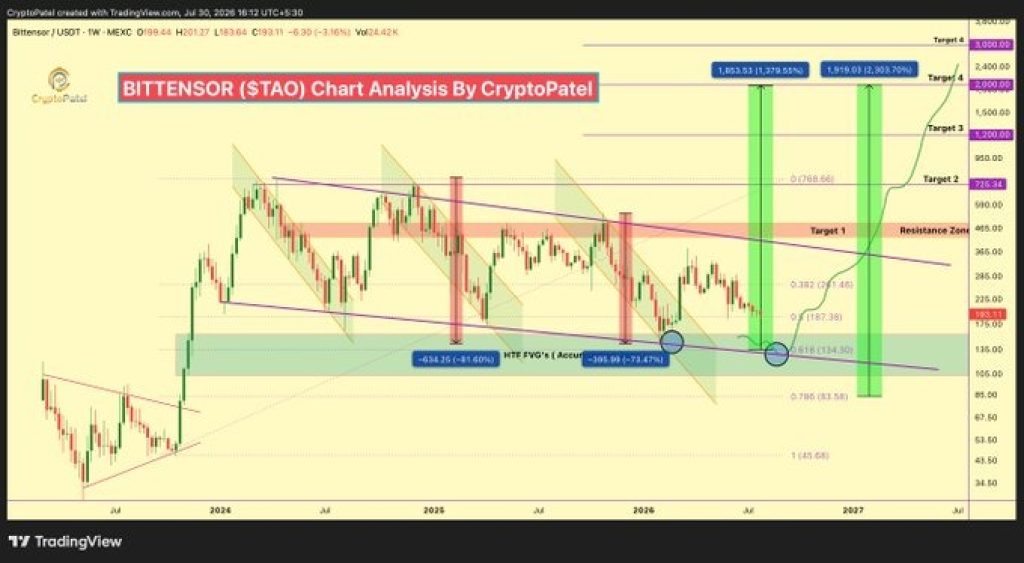
The chart also maps out several long-term milestones. The first major objective stands at $1,000, followed by $2,000 and $3,000 if buying pressure accelerates during future market cycles. Those levels represent technical targets instead of guaranteed outcomes and would require sustained demand across multiple years.
Momentum also appears healthier than it did during the first half of the year. The TAO price has continued posting higher lows, showing buyers have remained active on pullbacks. Even so, reclaiming previous cycle highs would be the first major confirmation before the market begins discussing four-digit price targets.
What’s Fueling Bittensor’s Growth in 2026?
Bittensor’s latest protocol upgrades continue strengthening its ecosystem. Version v431 introduced the Conviction mechanism as live infrastructure, requiring subnet owners to commit TAO through stake locking.
That change encourages longer-term participation across the network. The release also added new Rust-based development tools and security primitives aimed at improving operational security for developers and subnet operators.
Adoption is also expanding beyond the blockchain itself. MEXC has introduced centralized exchange staking for TAO, allowing users to earn staking rewards without operating validators. Given Bittensor already maintains one of the highest on-chain staking ratios among major cryptocurrencies, exchange staking could reduce liquid supply further if participation grows.
Development inside the ecosystem also continues producing measurable results. One of Bittensor’s decentralized AI subnets, Subnet 62, outperformed Cognition Labs on the SWE-bench benchmark, demonstrating that an open validator network can compete with well-funded centralized AI developers.
When Barry Silbert and Jason Calacanis land on the same thesis in the same week, that is not two opinions.
— 2xnmore (@2xnmore) July 27, 2026
That is a signal forming in public.
But read what Jason actually said, because most people will miss it.
Open competition vetted by validators is not a slogan on… https://t.co/IAyixb8Pbk pic.twitter.com/YzGsN8ga56
That result strengthens Bittensor’s core value proposition as decentralized artificial intelligence becomes an increasingly competitive sector.
Related Bittensor News: Bittensor News: Why Billionaire Jason Calacanis Believes TAO Could Follow Bitcoin’s Path
Can Bittensor Really Reach a $500 Billion Market Cap?
A $500 billion market cap would put Bittensor in the same league as the biggest digital assets out there. That kind of size doesn’t come easy. Bitcoin and Ethereum only got there after years of global institutional money flowing in, deep liquidity, and network growth.
Bittensor does have things going for it, a fixed 21 million token supply, AI adoption picking up, more subnets coming online, and ongoing upgrades.
But hitting $500 billion would take a lot more: big companies actually using it, developers building on it, regulators playing nice, and decentralized AI becoming one of the defining technologies of the next decade. The upside is huge, but so is the work needed to get there.
Bittensor remains one of the crypto market’s most closely watched AI projects. Whether the Bittensor price ultimately reaches Jason Calacanis’ ambitious target will depend less on market hype and more on the network’s ability to convert technical progress into real-world adoption.
Frequently Asked Questions
Subscribe to our YouTube channel for daily crypto updates, market insights, and expert analysis.