
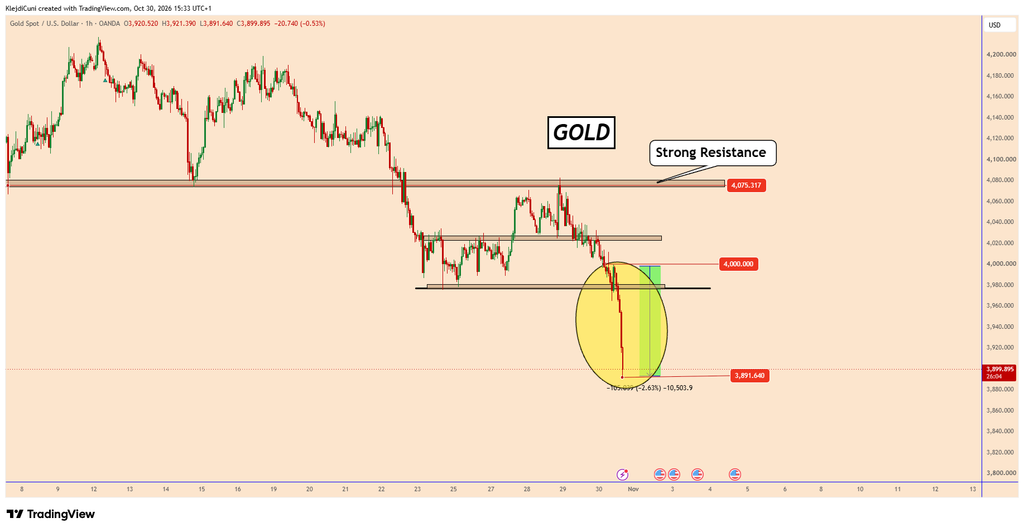
Gold price has gone through another brutal selloff, and fell from around $4,000 toward $3,890 and briefly trading even lower.
Spot gold ultimately dropped more than 3% during Friday’s session and touched its weakest level in roughly a year. Silver fell even harder, while equities and copper also came under pressure.
What makes the move unusual is the timing.
Gold did not collapse during Wednesday’s FOMC decision. It also survived the ECB meeting.
Instead, the strongest selling arrived later, without one obvious new headline that would normally explain a move of this size.
Trader Klejdi Cuni finds that suspicious.
He argues that gold’s failure near $4,060-$4,070 invalidated the latest bullish structure, but believes the speed and timing of the subsequent drop look disconnected from normal technical or fundamental catalysts.
Cuni even raised the possibility of manipulation or insider activity, although he clearly presented that as his personal interpretation.
There is no evidence establishing that explanation.
A broader look at markets offers a more conventional reason for what happened.
What you'll learn 👉
Gold Was Caught in a Broader Liquidity Selloff
Macro analyst Sunil Reddy pointed out that almost everything except oil was being sold.
Gold, silver, copper and equities all moved lower together.
That is important because when several normally different assets fall at the same time, the move can be less about investors suddenly changing their view on gold and more about investors raising cash.
That appears to have happened here.
A technology-led equity selloff intensified on Friday, with the Nasdaq falling about 2.9% and the S&P 500 losing roughly 1.8%. As losses spread, investors facing margin pressure and portfolio losses began selling liquid assets, including gold.
This also explains one of the strangest parts of the move.
Except oil, almost everything is getting hit today. Gold, silver, copper, equities. All under pressure. But the most important development is the recent change in market behaviour. Higher oil prices are no longer pushing bond yields higher. The most likely interpretation is that markets are starting to price the growth damage from higher energy prices more aggressively than the inflationary impact. This is a significant shift. Oil is increasingly being priced as a threat to economic growth, not just an inflationary force. Things are changing.
— Macro Liquidity by Sunil Reddy (@Macrobysunil) October 30, 2026
Treasury yields actually declined.
The 10-year yield moved toward 4.93%, which would normally be supportive for gold.
But gold kept falling anyway.
That points toward forced liquidation and portfolio rebalancing playing a larger role than the usual yield relationship.
Oil Is Sending a Different Signal
Reddy also noticed a change in the relationship between oil and bond yields.
Oil prices remain extremely high, with Brent around $113 and WTI above $104 after another tanker attack in the Strait of Hormuz.
Earlier in this cycle, rising oil often pushed yields higher because traders focused on the inflation impact.
Now oil is still rising, but yields are falling.
Reddy interprets that as the market beginning to focus more on the damage expensive energy could do to economic growth.
That would be a significant change.
Higher oil can still keep inflation elevated and make the Fed cautious, but if investors begin expecting slower growth at the same time, money can move toward government bonds even as stocks, industrial metals and eventually gold are liquidated.
Gold is currently caught between those forces.
$3,975 Failed and Selling Accelerated
There is also a technical explanation.
Gold had been holding around $3,970-$4,000 for days.
Once that support gave way, stop-losses and trend-following selling likely added to the decline.
MarketWatch noted that the break below the roughly $3,975 technical area helped accelerate Friday’s move.
Gold then fell below $3,900, with spot prices reaching around $3,870-$3,890 late in the session.
The next larger support region is now around $3,780-$3,800.
On the upside, gold would first need to recover $3,890-$3,910, followed by approximately $3,975, before the chart starts looking less damaged.
For more financial news and price predictions, click here.
My Take
I understand why Cuni finds the timing strange.
Gold ignored several obvious macro events and then collapsed on a session without one clean headline explaining a 3% move.
But I would not jump from that observation to manipulation.
The broader market provides a reasonable explanation.
Stocks were being sold aggressively, silver and copper were falling too, investors were raising cash, and gold had just broken an important technical support.
At the same time, high oil and persistent inflation continue to leave the Fed in a restrictive position.
So this looks less like one piece of bad news hitting gold and more like several pressures finally meeting at once.
Subscribe to our YouTube channel for daily crypto updates, market insights, and expert analysis.