Silver’s recent correction has not stopped Tim Hack from making a price prediction that stretches far beyond a normal recovery. His argument centers on a possible clash between silver’s monetary role and its technological uses, with both competing for the same metal.
That argument deserves a closer look because the size of his forecast requires much more than stronger industrial consumption. Silver would need a major repricing, even as its immediate technical outlook remains uncertain. Klejdi Cuni’s separate analysis provides a useful starting point for judging whether the metal can first repair its recent losses.
What you'll learn 👉
Tim Hack’s Silver Price Prediction Targets $500 And $1,000
Tim Hack projects silver could reach $500 in 2027 and $1,000 in 2028. He connects those targets to a historical valuation reference from 1802 and what he describes as official inflation data.
His central argument is that silver’s relationship with energy and technology creates conditions that earlier centuries did not face. He expects competition between investment demand and technological consumption to produce an exceptional increase in silver’s value.
The distinction matters because these sources of demand serve different purposes. Investment buyers acquire silver for exposure to its price or monetary characteristics. Industrial buyers require the metal for products and equipment, so their purchases depend partly on production requirements.
Hack believes those demands could collide before supply can adequately respond. His forecast therefore depends on silver becoming much more expensive as buyers compete for available metal.
Silver 1802 real, official inflation data I see $500 in 2027 and $1000 in 2028 In the previous centuries the value wasn’t coupled to energy as it is beginning now. The competition between monetary and technological value will lead to the greatest rise in its history. This unique situation happens only once in a civilizational development. The coming rise will pave the way for the enormous amounts of silver needed for the technological age. Monetary value will see the last big glow up in the coming years and will then be ousted by gold. And much later by nothing once abundance has arrived.
— Tim Hack (@realTimHack) October 20, 2026
However, his post does not identify the inflation series, historical starting price, or calculation behind the 1802 comparison. That leaves the historical valuation difficult to reproduce from his explanation alone. His targets should consequently be understood as his personal forecast, rather than an independently established valuation.
Silver Would Need An Extraordinary Repricing To Reach Hack’s Targets
The scale becomes clearer when measured against the $57.70 rebound level referenced in Cuni’s analysis. Silver would need to rise approximately 767% to reach $500 and roughly 1,633% to reach $1,000.
Those calculations describe the distance to Hack’s targets, not the likelihood of reaching them. A recovery toward nearby resistance would cover only a small portion of that journey.
His thesis also extends beyond a conventional supply shortage. Hack expects silver’s monetary importance to expand before gold eventually takes a larger role. He then describes a much more distant future in which abundance changes the need for monetary stores of value.
Read Also: Bitcoin and XRP Price Predictions for Today (October 20)
These are broad economic expectations without a measurable timetable beyond his silver price targets. They help explain his conviction, although they do not provide a method for testing the forecast today.
A more practical assessment requires several questions. Would industrial buyers maintain consumption at dramatically higher prices? Would investment demand remain strong through large corrections? Could recycling, substitution, or reduced silver use ease pressure on supply?
Those responses matter because higher prices can change demand itself. Manufacturers have incentives to reduce material costs, so technological growth does not automatically produce an equivalent increase in silver consumption.
Hack’s forecast requires several favorable developments together:
- Investment demand would need to remain strong through substantial price increases.
- Industrial consumption would need to withstand much higher silver costs.
- Available supply would need to remain insufficient despite those higher prices.
The argument offers a clear bullish possibility, although the dates and price targets remain highly uncertain.
Klejdi Cuni’s Silver Price Outlook Focuses On A Recovery Toward $63
Klejdi Cuni presents a more immediate silver price outlook after a decline from around $71 toward $55.50. That represents a correction of approximately 22% within the move he describes.
Cuni identifies a bullish harmonic pattern that completed near $55.50. His analysis then notes a rebound toward $57.70, which he interprets as a possible early recovery from the pattern’s final point.
The important distinction is between a potential reversal area and a confirmed recovery. A harmonic pattern identifies a zone where a reversal may develop, but subsequent price action must support that interpretation.
Silver therefore needs to defend the lower area and recover resistance before the bullish case becomes more convincing. Cuni places the initial objective at $60, followed by $63.
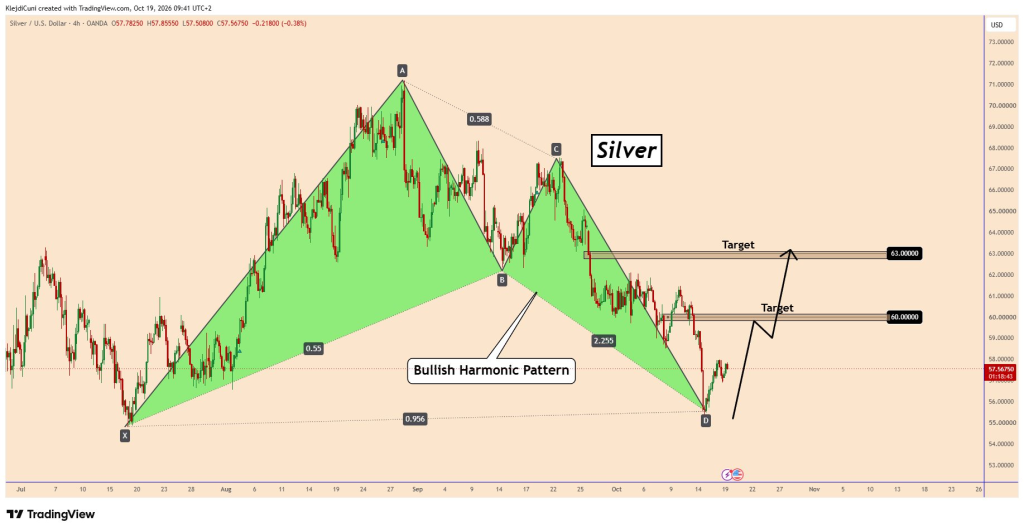
These levels create a practical framework:
- Silver needs to hold around $55.50 to preserve the proposed reversal.
- A sustained recovery above $60 would strengthen the case for $63.
- A decisive break below $55.50 would weaken the bullish harmonic setup.
Even a move to $63 would leave silver below the $71 high referenced in his analysis. That makes the setup a possible recovery within the recent decline, rather than confirmation that the broader advance has resumed.
Recent Silver Updates Show Inflation And Supply Remain Important
Recent market developments explain why the recovery still faces obstacles. Reuters reported that silver fell 6.6% to $55.53 on October 14 after stronger US inflation data increased expectations for higher interest rates. A firmer dollar and higher Treasury yields accompanied that pressure.
Silver then recovered 2.5% to $57.05 on October 15 as the dollar weakened and Treasury yields declined. Those consecutive moves demonstrate how quickly monetary conditions can interrupt an otherwise bullish silver price argument.
Read Also: Ethereum Price Prediction: Here’s Wall Street Strategist’s Shocking Target
The supply picture offers a separate consideration. The Silver Institute’s World Silver Survey 2026 forecasts a 6th consecutive annual market deficit. However, the report also warns that high prices can weaken consumption and affect investment sentiment if industrial demand declines.
That combination gives Hack’s argument some relevant context without validating his targets. Persistent deficits can support the bullish case, but demand responses can limit how far prices rise.
FAQs
Subscribe to our YouTube channel for daily crypto updates, market insights, and expert analysis.