
Bitcoin is trading around $85,300 at press time, holding well above the lows seen earlier this year and keeping the idea of a new bull phase alive.
A growing part of the market now appears convinced that the worst is over and the next major step is simply a return to all-time highs.
CryptoCon is not convinced.
The analyst continues to argue that several pieces of Bitcoin’s traditional cycle structure remain unfinished, and his latest SOPR chart raises the possibility that the current recovery could still be taking place inside a broader bear-market cycle.
What you'll learn 👉
CryptoCon Says Bitcoin’s Cycle Data Is Still Incomplete
CryptoCon’s concern centers on SOPR, or Spent Output Profit Ratio.
The indicator tracks whether Bitcoin being moved onchain is generally being sold at a profit or a loss.
Historically, major Bitcoin cycle bottoms have been accompanied by periods where SOPR moved deeply into what CryptoCon labels the “high loss” zone.
That happened around the major bottoms in:
- September 2014
- December 2018
- March 2020
- November 2022
This time, the indicator has not reached the same cycle-bottom region.
That is the “loose end” CryptoCon thinks the market may still need to resolve.
His argument is simple: if Bitcoin has already entered a completely new bull market, then the current cycle would be one of the first to skip a signal that has appeared near several previous macro bottoms.
The Chart Shows a Repeating Profit-and-Loss Cycle
CryptoCon’s chart maps Bitcoin price against SOPR going back to 2011.
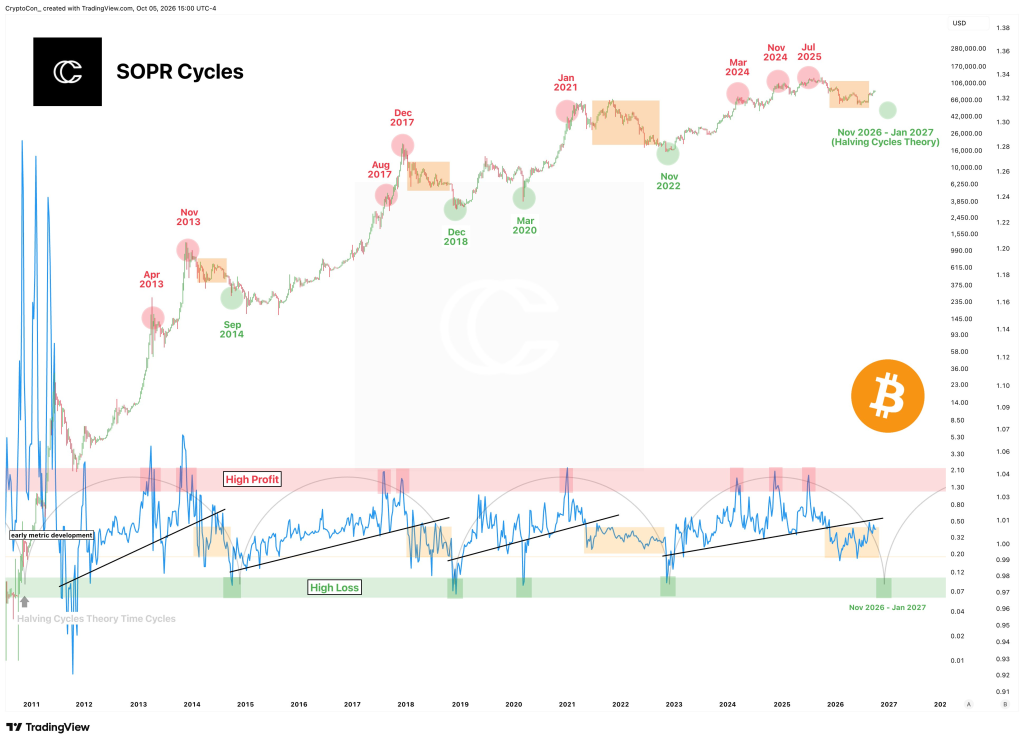
The pattern is fairly consistent.
During major bull-market peaks, SOPR pushes into the red high-profit zone as investors increasingly realize gains.
After the peak, the indicator trends lower and eventually falls into the green high-loss region near the end of the bear market.
Bitcoin then starts a new long-term expansion.
The current cycle looks different.
SOPR fell considerably during the downturn but never reached the same deep-loss levels seen at previous major bottoms.
CryptoCon sees that as evidence that the market may not have completed a full capitulation cycle yet.
Read also: Why America’s Wealth Divide Could Be a Major Bull Case for Bitcoin
Could the Real Bottom Still Come Between November and January?
Timing is the second part of his argument.
Under CryptoCon’s Halving Cycles Theory, the cycle-bottom window does not necessarily fall in October.
His chart places the potential bottom between November 2026 and January 2027.
That would actually fit some previous cycle timing.
The 2014 bear market bottom came in September, the 2018 low arrived in December, and the post-2021 cycle bottom came in November 2022.
CryptoCon points out that a January bottom would not be historically unprecedented either, citing the 2015 cycle.
So he questions the assumption that Bitcoin must already have completed its low simply because October has arrived.
Is This a False Start to the Bitcoin Bull Market?
This is the uncomfortable part of the thesis for bulls.
Bitcoin has recovered strongly enough that many traders are treating the bear market as finished.
CryptoCon sees another possibility: the recovery itself may be convincing enough to make investors believe a new bull market has begun before the final cycle low arrives.
His chart illustrates that scenario with the current price structure followed by a potential decline into the November-to-January period.
That does not mean Bitcoin must collapse.
CryptoCon has repeatedly said the cycle could behave differently this time.
His point is that declaring the four-year cycle dead before several historically important indicators complete their usual behavior may be premature.
For more crypto news and price predictions, click here.
Subscribe to our YouTube channel for daily crypto updates, market insights, and expert analysis.