Kaspa’s Toccata upgrade could change what developers build on the network, and Crypto Mark believes its importance goes beyond faster transactions. His recent comments focus on a question that matters more than another speed comparison: what can Kaspa do with its expanded programming capabilities?
That question gives the upgrade a different kind of relevance for KAS. Faster payments have been central to Kaspa’s identity, but applications that manage assets, enforce spending rules, and verify complex calculations could broaden the network’s usefulness. Kaspa price is also approaching an important technical test in the supplied analysis, so the technology discussion comes alongside a possible support retest.
Crypto Mark, who posts as @markcrypto8, said his renewed research into Kaspa made Toccata more interesting than he initially realized. His comments point to programmable UTXOs, covenants, and native zero knowledge verification as the features worth examining.
His main argument is that these capabilities become more useful when developers combine them. Spending rules can control assets, proofs can validate calculations, and Kaspa can provide the underlying transaction infrastructure.
Kaspa’s official Toccata guide identifies native covenant programming and infrastructure for ZK applications as core elements of the upgrade. That supports the broader point in Crypto Mark’s commentary: Toccata expands the network’s capabilities beyond transaction speed.
The practical importance will depend on what developers turn those capabilities into. A technical feature becomes easier to appreciate when it solves a problem for an actual user.
I’ve been looking into Kaspa again, and Toccata is more interesting than I initially realised.
— Crypto Mark ⚡️ (@markcrypto8) October 1, 2026
It didn’t just make $KAS faster.
It added programmable UTXOs, covenants and native ZK verification to the L1.
The interesting question is what you can actually build with that…
What you'll learn 👉
Kaspa Covenants Let Developers Attach Rules To Funds
A UTXO is an unspent transaction output, which represents funds available for a future transaction. A basic payment requires the spender to satisfy the conditions attached to those funds.
Covenants extend those conditions by allowing scripts to inspect and restrict the transaction that spends an output. Developers can define how assets move and which conditions must remain true after a transaction.
Kaspa’s KIP 17 describes this functionality as a way to enforce changes to application state through UTXOs. Its listed use cases include tokens, smart vaults, and bridges that combine covenant rules with proof verification.
That creates possibilities such as:
- Controlled Treasury Payments: Funds could require several approvals or restrict transfers to permitted destinations.
- Protected Vault Withdrawals: A vault could require a delay before funds become available for withdrawal.
- Asset Issuance Rules: Token systems could enforce conditions around how assets are created and transferred.
These examples explain why programmable funds matter. A wallet could enforce a policy through network rules instead of depending entirely on someone to follow an internal procedure.
Native ZK Verification Connects External Computation To Kaspa
Zero-knowledge technology provides another part of the picture. A proof can demonstrate that a calculation followed specified rules without requiring the blockchain to repeat every step of that calculation.
Kaspa’s application documentation describes a model in which the network orders transactions, an application executes operations outside the base layer, and a settlement covenant later verifies a proof of the resulting state change.
Think of an application that processes many user actions. Its execution system handles the detailed work, then submits proof that the final result follows the application’s rules. Kaspa verifies that proof at settlement.
This could support more complex applications without forcing every operation into a base layer script. The important connection is between computation and asset control: proofs establish that a result is valid, and covenants determine whether funds can move based on that result.
Read Also: XRP Price’s Next Test of $1.70 Could Be the Most Important Yet!
Privacy applications are another possible use case. However, proof verification alone does not make every Kaspa transaction private. Developers would need to build systems that deliberately protect the relevant transaction information.
DeFi Applications Need More Than Fast Blocks
Decentralized exchanges and lending platforms introduce a harder problem than straightforward payments. Several users may need to interact with the same pool or application state, which requires a reliable way to order and process their actions.
Kaspa’s documentation distinguishes between covenants for asset rules and based applications for products with shared state and built in accounts. It also states that developer tools and workflows remain under development.
KIP 21 contributes sequencing commitments organized around application lanes. This lets an application prove its own relevant activity without having to process all unrelated network activity within the same proof.
That is useful infrastructure, but it should not be treated as proof that every proposed exchange already delivers hundreds of trades per second or instant settlement. Fast block production, application execution, proof generation, and final settlement describe different parts of the process.
The stronger case for Toccata is that developers have more components available to build useful products. Successful applications could broaden Kaspa’s role beyond payments and give users additional reasons to interact with the network.
Kaspa Price Could Retest $0.037 Before Another Recovery
The supplied Kaspa price analysis describes an ascending trendline that has supported the market since September.
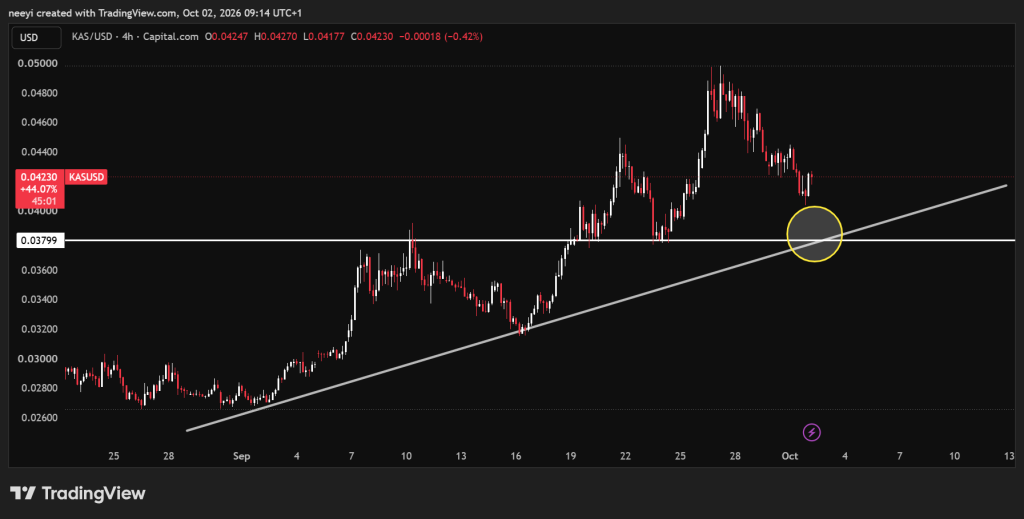
A look at the Kaspa chart analysis shows price near $0.042 and a possible retracement toward $0.037. That lower level aligns with the trendline support described in the outlook, so a test there could determine whether the bullish structure continues.
A decline from $0.042 to $0.037 would equal approximately 11.9%. Such a pullback could remain part of the ascending structure if support holds and buyers produce a recovery.
The possible outcomes are:
- Support Holds Near $0.037: Kaspa price could rebound toward $0.049 and potentially establish a higher high above that level.
- Price Breaks Above $0.043 First: KAS could revisit $0.049 before completing the deeper retracement described in the analysis.
- Trendline Support Fails: A sustained break below $0.037 would weaken the bullish structure and reduce confidence in the expected bounce.
Toccata’s development potential and Kaspa’s immediate price movement operate on different timelines. The upgrade could become more valuable as useful applications reach users, but the current price structure still depends on support and resistance.
FAQs
Subscribe to our YouTube channel for daily crypto updates, market insights, and expert analysis.