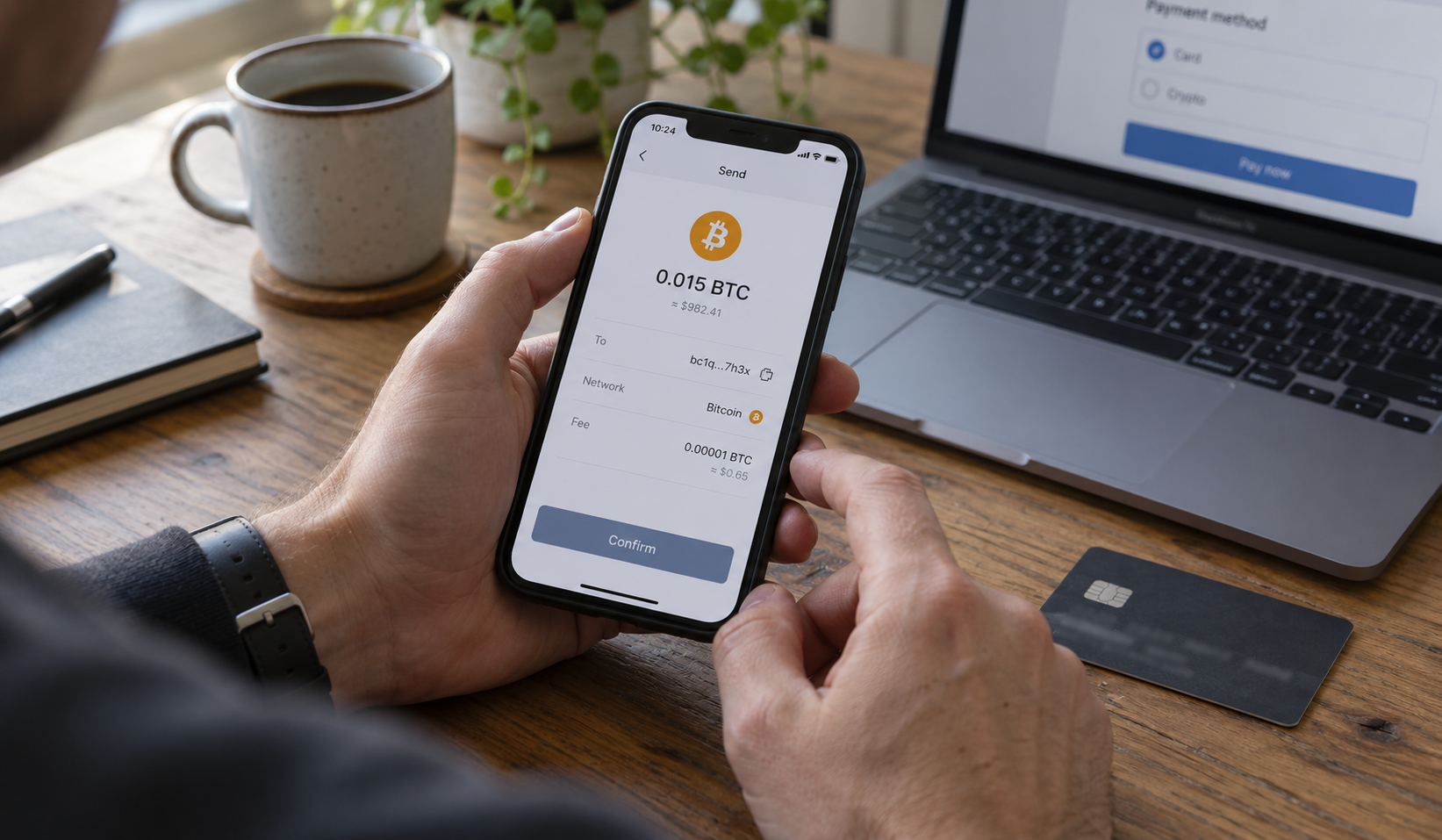
Paying by card has become almost thoughtless. You type the number, approve the payment and move on. If the card details are wrong, the transaction usually fails. If the merchant looks suspicious, the bank may block it. If something goes badly wrong later, there is at least a payment provider somewhere in the chain that can be contacted.
Bitcoin does not really work like that. The payment itself can be very simple, but the responsibility is much more visible. Before sending anything, you need to know that the wallet address is right, that the asset is right and that the network matches what the other side is expecting. Those checks are not difficult, but they are easier to ignore when you are used to card payments doing so much of the checking for you.
What you'll learn 👉
A wrong card number usually stops you
A wrong crypto address may not. That is one of the biggest differences between the two systems. With a card, entering bad information normally leads to a decline or an error message. With Bitcoin, a correctly formatted address can still be the wrong address for you. The network does not know who you meant to pay. It only knows where you told it to send the funds. That is why experienced users tend to glance at the first and last few characters of an address after pasting it.
It is not glamorous advice, but it is the kind of habit that matters much more in crypto than in normal card payments. The same applies when moving money onto a trading platform, paying a merchant or making safe bitcoin deposits on a service that accepts BTC. Most of the time, the actual transfer takes less thought than checking the details immediately before it.
The network can trip people up
This becomes more noticeable when a platform supports several coins or several networks. A normal card payment does not ask whether you want Visa routed one way or another. Crypto sometimes does ask questions like that, especially on exchanges and services that support multiple chains. The names can also look similar enough to make people rush. That is where a little patience helps. If the receiving page says Bitcoin, send Bitcoin to the address it provides. If a platform gives specific network instructions, follow those instructions rather than assuming two options are interchangeable because the labels look familiar. People who use crypto regularly tend to become quite boring about this. Boring is good when money is moving.
A blockchain confirmation is not the same as a card approval
Card payments usually give you an answer almost immediately: approved or declined. Bitcoin has another stage. A transaction can be broadcast to the network and visible within seconds, while the receiving service still waits for confirmations before crediting it. That gap sometimes causes unnecessary panic because the money has clearly left one wallet but has not yet appeared in the account on the other side.
This is where a transaction ID becomes useful. Instead of refreshing the destination every ten seconds, you can look up the transaction and see whether it is waiting, confirmed or already included in a block. That is a very different experience from card payments, where almost all of that infrastructure is hidden from the customer.
More control also means fewer excuses
Crypto users often talk about control, and they are right. You can hold your own funds, move them without asking a card issuer for permission and send value directly to another address. But direct control removes some of the cushion as well. There is no chargeback button built into Bitcoin. There is no bank employee who can reverse a transfer because you copied the wrong address.
Once the transaction is final, the blockchain is not interested in whether you changed your mind. That sounds harsher than it really is, because most crypto payments go through without drama. You just have to pay attention before pressing send. Cards are designed to let people be careless. Crypto works better when you are not.