
In our last Gold price outlook, we said the $4,400 area was the level buyers needed to defend. So far, that’s exactly what’s happened. The Gold price is still holding above support and has started to steady after its drop from the recent $4,760 high.
Right now, gold is trading around $4,430, caught between two opposing forces. On one side, higher rate expectations are weighing on sentiment after Fed Chair Warsh doubled down on fighting inflation. On the other, gold has reached a support zone between $4,320 and $4,400, an area where buyers have stepped in before.
The next level to watch is $4,500. If the gold price pushes back above that, buyers could start eyeing $4,600, with $4,700 not far behind. As long as gold holds above $4,400, the recovery case stays alive. Break below that, and $4,300 and $4,200 come into focus fast.
What you'll learn 👉
Gold Is Testing a Zone Buyers Have Defended Before
Analyst Rashad Hajiyev believes the worst of the selloff may already be over. In his latest market update, he pointed to Gold’s arrival at a key support area and argued that downside potential looks limited compared to what traders have already seen during the correction.
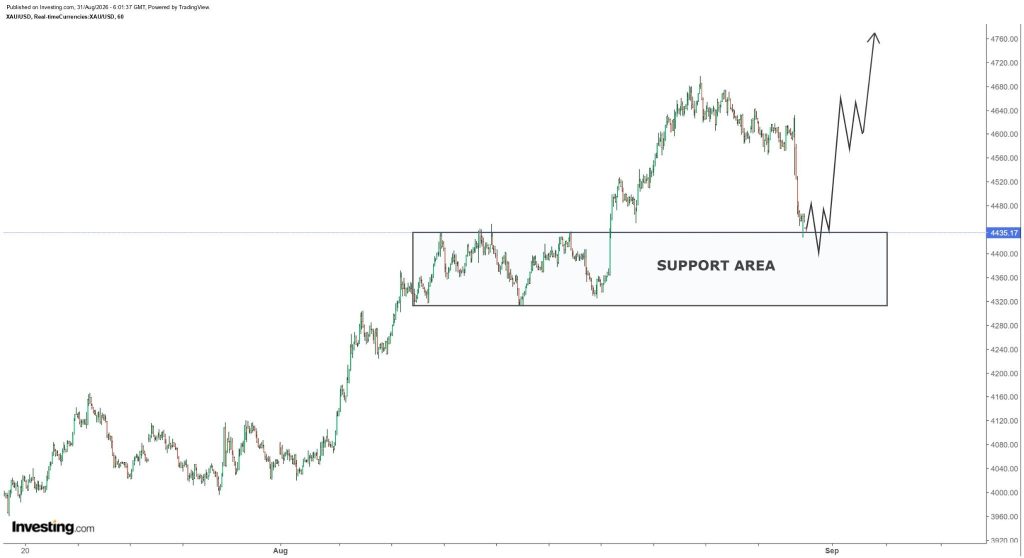
We analysed the gold chart. It’s trading around $4,430, trading just above a support zone that runs from $4,320 to $4,400. This area has drawn buyers before, so a lot of traders are watching it closely.
Gold has been drifting lower since peaking near $4,760, but the selling has started to slow down as it gets closer to this support region. If buyers keep defending the zone, we could see a rebound take shape over the next few sessions.
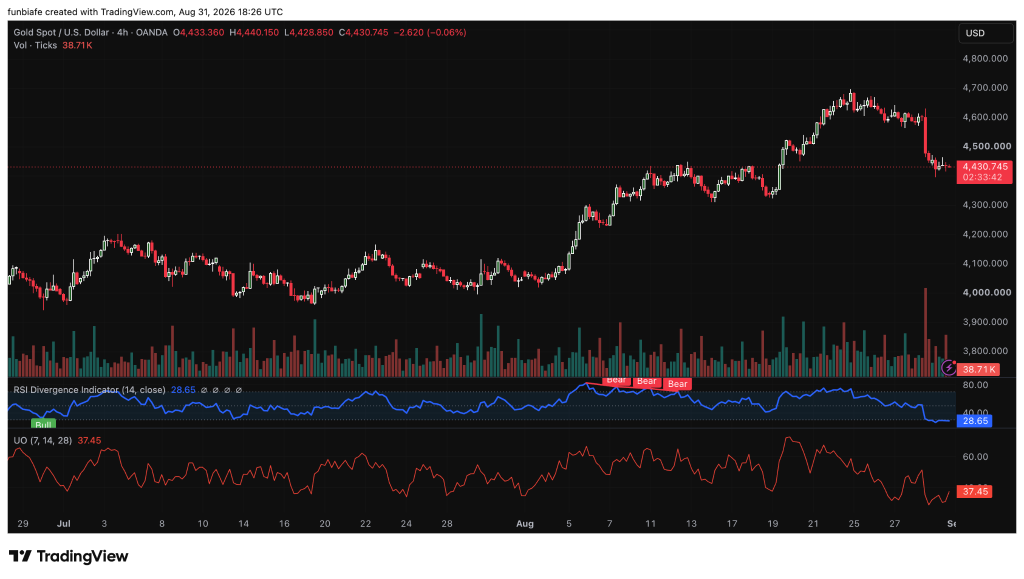
The first hurdle would be $4,480, followed by resistance levels around $4,520 and $4,560. If momentum improves, Gold could then challenge $4,600 and potentially move back toward the $4,700 area that Hajiyev has identified as a recovery target.
Interest Rate Concerns Are Still Hanging Over the Market
Even with technical support coming into play, Gold is still facing pressure from the broader macro environment. Bloomberg reported that the metal steadied after dropping more than 3% as traders reacted to comments from Federal Reserve Chairman Kevin Warsh.
His tough stance on inflation made traders think rates could stay high, or even go higher if prices don’t cool down fast enough. At the same time, tensions in the Middle East pushed crude oil above $85 a barrel.
Gold steadied after falling more than 3% on Friday as US Federal Reserve Chairman Kevin Warsh’s pledge to fight inflation lifted bets the US central bank will raise interest rates https://t.co/SixaquAodm
— Bloomberg (@business) August 31, 2026
Higher energy costs tend to feed into inflation, which only strengthens the case for tighter monetary policy. Treasury yields climbed as investors adjusted to the new reality. So it’s a double whammy, geopolitical risk and inflation concerns hitting at the same time.
That combination is not ideal for Gold. Since the metal does not offer a yield, rising interest rates often make bonds and other income-producing assets more attractive. That has been one of the key factors limiting Gold’s upside despite ongoing geopolitical risks.
Read Also: Here’s Why Gold and Silver Prices Are Getting Hammered Right Now
Where Could the Gold Price Head Next?
The big level to watch is the support zone between $4,320 and $4,400. If gold holds above that range, buyers could target $4,480 and $4,520. A stronger recovery would open the door to $4,560, $4,600, and maybe even $4,700.
If support fails, the picture flips. A break below $4,320 exposes $4,200, then $4,000 and $3,960. So it’s a critical zone, how gold reacts here will likely set the tone for the next move. For now, the Gold price is trading at a critical point.
The correction from $4,760 has brought the market into a major demand zone, and the next few sessions should reveal whether buyers are ready to regain control or if sellers still have one more leg lower in store.
FAQs
Subscribe to our YouTube channel for daily crypto updates, market insights, and expert analysis.