Panda Bundler puts Pump.fun launch preparation, wallet distribution and post-launch trading in one browser workspace. The useful question is not whether it can hide a launch. It cannot. The question is how much of the launch workflow an operator can prepare and manage without switching tools at the moment the token goes live.
What you'll learn 👉
Panda Bundler at a glance
- Access: browser-based workspace opened with a support key issued through PandaBoost Support. No Telegram bot and no Wallet Connect.
- Scope: launch setup, operator-controlled wallets, distribution, coordinated submission, chart monitoring and post-launch trading in one workspace.
- Cost: no subscription, no launch fee and no Panda Bundler platform fee on buys. A 5% platform fee applies on sells.
- Limits: Solana activity remains publicly traceable; transaction landing, buyers, chart shape and profit are not guaranteed.
The first minute of a Pump.fun launch is unforgiving. Token details, funding, wallet allocations and initial buys have to be prepared before the market starts moving. Once the launch lands, outside buyers can enter, liquidity changes and the operator has to shift from setup to monitoring and trading.
Many Solana bundler tools focus on one part of that sequence. They prepare a launch or coordinate an initial set of transactions, then leave the operator to move elsewhere for charts, wallet management and post-launch orders.
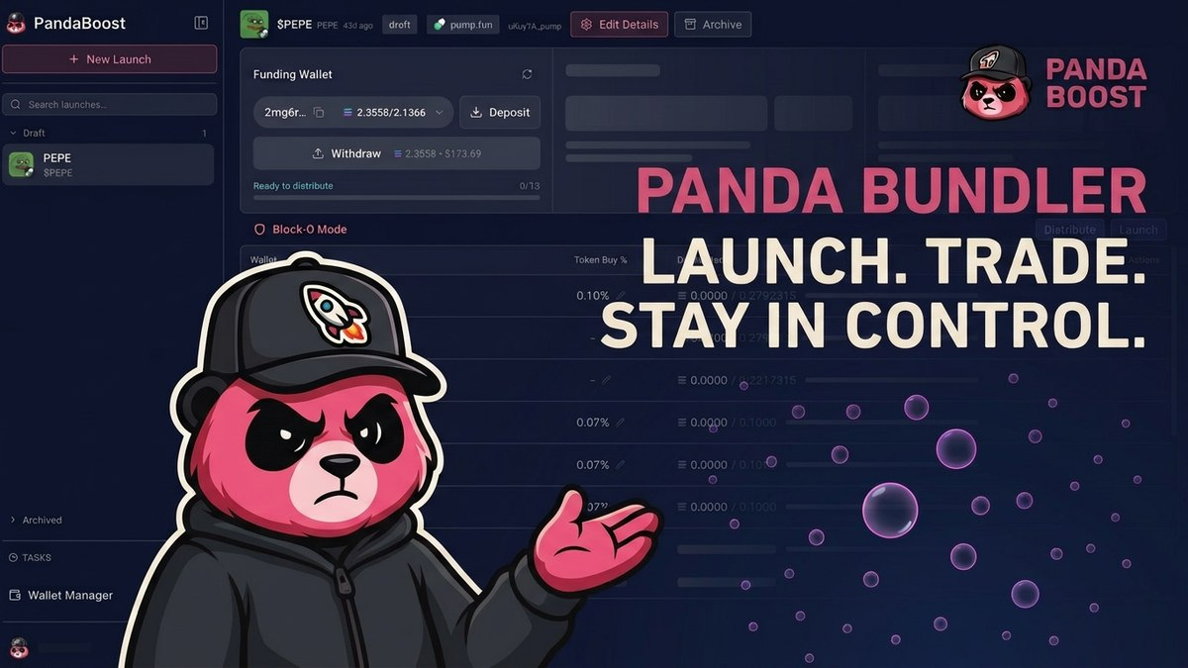
Panda Bundler takes a wider approach. It is a browser-based PandaBoost product that keeps launch preparation and the live trading phase inside one workspace. Operators can configure a Pump.fun launch, create or import wallets they control, assign buy amounts, fund and distribute SOL, submit the launch and continue into a native trading terminal.
What a Solana bundler actually coordinates
A Solana transaction can contain several instructions that either succeed or fail together. Bundle infrastructure can extend that atomic behavior across a short ordered group of signed transactions. A commercial bundler sits above that infrastructure and gives the operator a way to configure what will be submitted.
Panda Bundler’s Block-0 Mode groups the token launch and configured initial buys into a coordinated submission flow. The setting controls packaging and timing. It does not guarantee first-block inclusion, a fixed transaction order or protection from outside buyers. A submitted bundle can be received without landing, so the resulting transactions still need to be verified on-chain.
The difference between a narrow bundler bot and a broader platform becomes clearer after submission. A bot may complete the launch action and stop. Panda Bundler continues into wallet monitoring, charts and trading controls.
For a fuller explanation of the underlying workflow, PandaBoost maintains a Solana bundler guide covering transactions, wallet preparation, fees and post-launch operations.
The launch workflow inside Panda Bundler
The current workspace moves through six practical stages:
- Create a draft launch and enter the token details.
- Generate new wallets or import wallets the operator already controls.
- Set the intended buy amount or percentage for each wallet.
- Fund the workspace wallet with enough SOL for allocations, network costs and tips.
- Distribute the configured amounts and review the final balances.
- Choose the launch mode and submit.
The advantage is not fewer checks. It is that those checks happen in one operational view. The interface keeps the funding wallet, wallet roles, distribution table and launch controls together, making it easier to compare the planned allocation with the available balance before signing.
The clean bubblemap question
“Clean bubblemap” is common launch-team shorthand for a holder map that does not collapse into one obvious, tightly connected cluster. It is also an easy phrase to misuse.
Panda Bundler lets an operator define the allocation for each controlled wallet before launch, then fund and distribute the planned amounts through the workspace. That can produce a more deliberate distribution pattern than sending identical amounts through one unplanned cluster.
It does not make the wallets invisible. Funding paths, wallet activity, buys and sells remain public. Analytics tools can still identify relationships from transaction history and other on-chain evidence. A cleaner visual pattern should therefore be read as a distribution outcome, not proof that a launch is unrelated or risk-free.
For an operator, the practical value is planning. Before launch, the team can see how much SOL each wallet requires and decide what it will do when trading starts. Panda Bundler moves those decisions into the preparation phase instead of leaving them for the launch window.
What happens after the launch
Once the token is live, the same workspace becomes a trading and monitoring terminal. The current interface includes a chart, live trade feed, wallet list, position information and Market, Limit and Grid order tabs.
The feature set is designed around the operator’s own wallets:
- Market, Limit and Grid: prepare supported post-launch order workflows, but cannot guarantee execution price or remove slippage.
- Wallet controls: create, import, fund and organize operator-controlled wallets without making wallet relationships private.
- Auto Sell: applies supported sell conditions configured in advance; it does not predict market conditions or guarantee execution.
- Sniper Guard: reacts to observed outside buying activity using the selected response, but cannot prevent outside buyers or make a launch sniper-proof.
- Claim Rewards: supports the visible reward-claim workflow without guaranteeing that rewards are available.
- Nuke: provides a one-action multi-wallet sell path; price impact and execution risk still apply.
This is where Panda Bundler is more useful than a one-purpose Pump.fun bundler bot. The team does not have to reconstruct its wallet set in another terminal immediately after the launch. The chart, own fills and wallets remain visible while the next order is prepared.
Automation still needs supervision. Liquidity can move between configuration and execution, and a multi-wallet sell can create material price impact. Operators should check balances, selected wallets, slippage and transaction status before and after large actions.
Read also: Best Solana API Providers for 2026
Access and pricing
Panda Bundler is a web workspace opened with a support key issued through PandaBoost Support. There is no email-and-password signup, Telegram bot or Wallet Connect login. The official PandaBoost Telegram bot is a separate product used for PandaBoost service ordering, not Bundler control.
Panda Bundler’s current pricing model is tied to sells:
- no subscription;
- no fee on the launch itself;
- no Panda Bundler platform fee on buys;
- 5% Panda Bundler platform fee on sells.
Solana network fees, priority fees, bundle tips, protocol fees and third-party costs remain separate. Teams should confirm the current terms before funding a live launch.
The access model also acts as a useful qualification step. Instead of opening an account and improvising with a live token, a team can request a key, walk through the workspace and prepare the launch scenario before the listing window begins.
Who Panda Bundler is for
Panda Bundler fits operators who want one place to prepare a Pump.fun launch and remain in control after trading begins. It is especially relevant when the team expects to manage several wallets, wants a documented allocation plan and needs post-launch order tools without immediately switching platforms.
It is not a promise of a particular chart, holder map, first-block position or market result. No interface can guarantee transaction inclusion, buyers, profit or invisibility on a public blockchain.
The practical proposition is simpler: fewer handoffs during the most time-sensitive part of a launch. Wallet preparation, distribution, submission, chart monitoring and post-launch trading stay inside the same browser workspace.
Teams with a launch date already fixed should request a support key while the allocation plan is still on paper. Rehearsing wallet funding, distribution and submission before the listing window is cheaper than rebuilding the workflow while the first trades are already landing.
Suggested disclosure
This article was produced in partnership with PandaBoost. Product terms may change. Solana transactions and market conditions remain outside PandaBoost’s control.