
Bitcoin has never been easy to predict. Every cycle produces bold forecasts ranging from six‑figure moonshots to major crashes, and both camps usually find data to support their case.
So instead of asking another analyst, we asked ChatGPT a simple question: Where will Bitcoin trade in 2027?
The goal was to use its prediction as a starting point and compare it with what the market is actually saying today. That matters since Bitcoin is entering 2027 from a very different position than it was a year ago.
Institutional ETF demand has weakened, macro uncertainty remains elevated, and investors have moved firmly into risk‑off mode even with long‑term adoption continuing to grow.
What you'll learn 👉
Before We Ask ChatGPT: Where Is Bitcoin Heading Into 2027?
Bitcoin enters the second half of 2026 in a bear market. After reaching an all‑time high near $126,000 in late 2025, BTC has spent months correcting.
Prices have fallen from the peak while investor sentiment has deteriorated alongside weakening liquidity and persistent institutional selling.
One of the biggest stories this year has been Bitcoin ETFs. When spot ETFs launched, many investors believed they would permanently reduce volatility by bringing in long‑term institutional capital. Instead, 2026 has shown that institutional investors also sell when macro conditions worsen.
U.S. spot Bitcoin ETFs have seen billions of dollars in net outflows throughout much of the year. Although early July produced a modest rebound in inflows after an extended streak of redemptions, the overall trend still shows institutional caution rather than aggressive accumulation.
The overall macro backdrop hasn’t helped either. Higher interest rates, a stronger U.S. dollar and tighter financial conditions have reduced demand for risk assets across markets.
At the same time, increased tensions in the Middle East have repeatedly triggered risk‑off moves. Bitcoin sold off alongside equities whenever geopolitical headlines intensified.
Market sentiment shows that change. Fear has dominated most of 2026. Social engagement has faded, retail participation has slowed, and many altcoins remain deep below previous highs.
This combination of weak participation, falling ETF demand and cautious positioning is consistent with previous Bitcoin bear markets rather than the beginning of a new bull cycle.
Still, one important distinction remains. Even with the bearish price action, many institutional investors continue viewing Bitcoin as undervalued over the long term.
Read also: Zcash (ZEC) Surges, NEAR Protocol Could Be Next: Why This Analyst Is Waiting Before Buying
Here’s Exactly What ChatGPT Predicted for 2027 (Screenshots)
ChatGPT’s prediction is based on its outlook on three primary assumptions:
- ETF demand eventually turns positive again.
- Interest rates become more supportive for risk assets.
- Bitcoin continues gaining institutional adoption.

Those are reasonable assumptions. But the important question is whether today’s market supports them.
What is the market saying?
The ETF story remains mixed. Yes, Bitcoin ETFs recently snapped a prolonged outflow streak, but one positive week doesn’t erase months of institutional selling. Since May alone, billions have exited spot Bitcoin ETFs.
ChatGPT’s prediction also assumes macro conditions improve. But that hasn’t happened yet.
Federal Reserve policy remains restrictive, geopolitical tensions continue supporting the U.S. dollar, and investors remain defensive across multiple asset classes. Until liquidity improves, Bitcoin price faces a difficult environment regardless of its long‑term fundamentals.
What the Bitcoin Chart Is Actually Saying About 2027
Bitcoin is consolidating between $62,000 and $64,200 after recovering from the late‑June low near $58,000. Buyers have created higher lows, but momentum has stalled beneath resistance.
The Ultimate Oscillator sits near 42, while the Stochastic RSI is deeply oversold below 10. This is a condition that often precedes short‑term relief rallies. However, confirmation needs reclaiming $63,500‑$64,000.
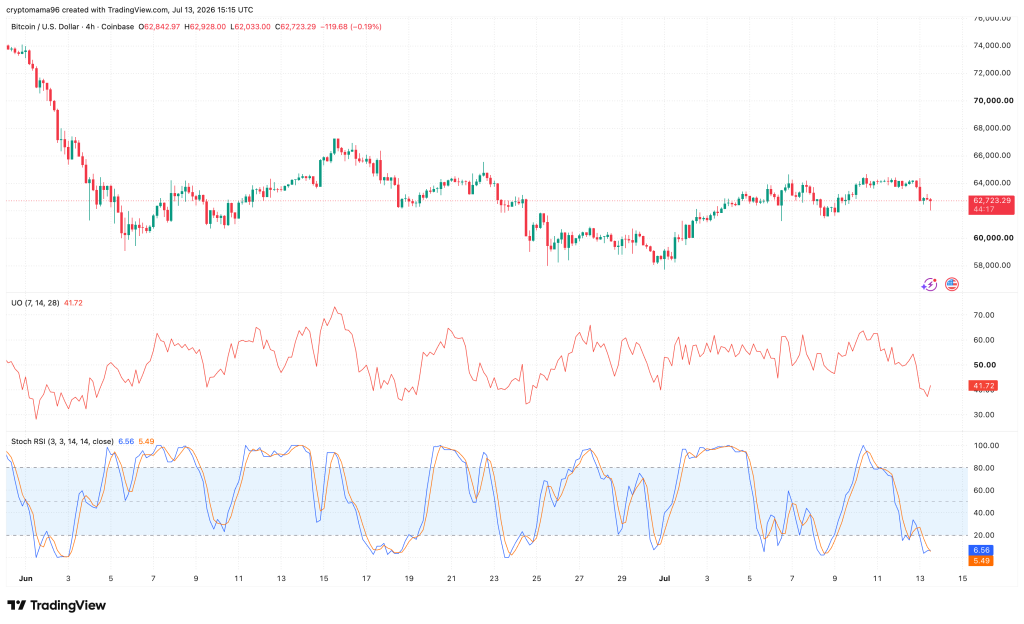
The sideways range resembles a bullish continuation flag; a breakout above $64,000‑$64,500 would target $66,000 and then $68,000. However, a break below $62,000 would invalidate this setup and open a retest of $60,000 or $58,000.
From a cycle perspective, this consolidation fits an accumulation phase rather than a distribution top. Repeated defenses of the $58,000‑$60,000 zone suggest longer‑term buyers remain active.
If Bitcoin clears the $66,000‑$68,000 resistance cluster, the technical structure would support a move toward $100,000‑$150,000 during the next expansion phase before 2027.
Our Final Take: Should You Trust AI Predictions?
ChatGPT’s forecast is neither wildly optimistic nor unusually bearish.
Its projected range of roughly $140,000 to $180,000 depends on several developments that experienced analysts are already watching: improving liquidity, sustained ETF inflows, regulatory progress and recovering institutional demand.
The AI isn’t discovering new information. It’s synthesising existing market drivers into a logical scenario.
That’s exactly how investors should use AI. Not as a crystal ball. The market is still sending a cautious message.
ETF flows remain the clearest gauge of institutional conviction, macro conditions continue to pressure risk assets, and geopolitical uncertainty hasn’t disappeared.
Until those trends reverse, Bitcoin remains in a corrective environment even with its strong long‑term adoption story.
If 2027 finally delivers new all‑time highs, the groundwork will likely appear first in the data, not in an AI prediction.
Frequently Asked Questions
Subscribe to our YouTube channel for daily crypto updates, market insights, and expert analysis.