The UNI price has spent months trading well below its late-2025 highs, but the network behind the token is moving in the opposite direction. Trading volume is climbing, user activity is picking up, and whales are becoming more active, creating a noticeable gap between Uniswap’s fundamentals and its market price.
That disconnect is starting to attract attention. As decentralized finance expands into tokenized stocks and real-world assets, Uniswap is growing beyond its role as a decentralized exchange and positioning itself as a key piece of on-chain financial infrastructure.
What you'll learn 👉
Uniswap Activity Continues Growing
The UNI price is still trading around the $3.10-$3.50 range after dropping from the $12-$15 levels reached in late 2025. Even with that decline, protocol activity remains strong.
Over the past 24 hours, Uniswap processed roughly $1.9 billion in spot trading volume, generated $1.5 million in spot fees, and recorded 175,100 daily active users. The protocol also holds $4.3 billion in total value locked (TVL) against a market capitalization of about $2.2 billion.
Long term figures are even more spectacular. Uniswap has already traded more than $3.5 trillion worth of tokens and performed over 465 million swaps, which generate about $900 million in trading fee revenue per year, and works on 18 different blockchain networks. Those metrics continue improving even though the UNI price remains far below previous highs, giving investors plenty to think about.
Read Also: Bitcoin Price News: Why BTC Is Falling After Kevin Warsh’s First Fed Meeting
Tokenized Assets Could Become a Major Growth Driver for UNI
One of the biggest developments for Uniswap is its move into tokenized real-world assets as shared by DukeDefi. The protocol now supports tokenized versions of companies including Apple, Tesla, Nvidia, SpaceX, Amazon, Alphabet, Coinbase, and Circle, expanding its role beyond crypto-native trading.
Every tokenized asset needs liquidity, settlement, and trading infrastructure, and Uniswap already provides those services at scale. If tokenized equities become a larger part of the financial system, the protocol is well positioned to benefit from that growth.
Gm, for a long time, the investment case for $UNI was relatively simple:
— DukeD | Defi (@DukeD_Defi) June 17, 2026
Bet on DeFi growth.
Today, I think the thesis is becoming much bigger than that.
Over the past year, several developments have started changing the picture:
– Uniswap V4 expanded the protocol's… https://t.co/ph1gy4pyan pic.twitter.com/HSXNcNytwJ
The ecosystem is also evolving through Uniswap V4, which introduces customizable hooks and advanced pool functionality, alongside Unichain, Uniswap’s own execution layer designed to improve network efficiency.
Its token model is changing too. Fee capture mechanisms and UNI burn programs continue reducing supply, with more than $596 million worth of UNI burned since 2025, strengthening the token’s value proposition over time.
UNI Whale Activity Is Picking Up as Users Return
Santiment’s on-chain data also provides an interesting story. Daily active addresses hit a four-month high mid-June, indicating that more people are using the protocol despite poor price action.
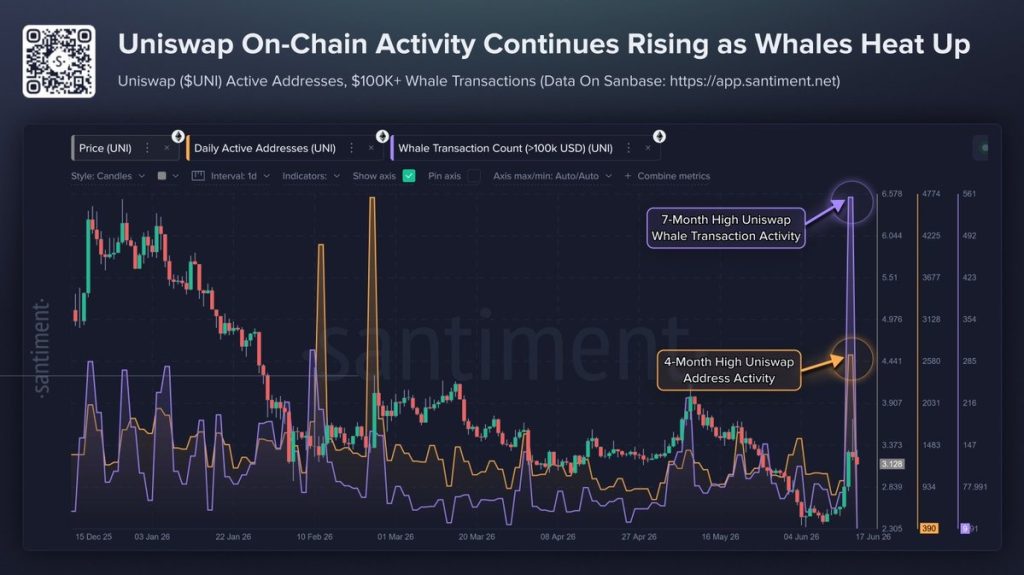
Big wallets are also getting busier. Transactions of at least $100,000 have hit a seven-month high, which is the highest activity level seen since late 2025. This combination stands out because it comes during a prolonged correction in the UNI price.
User engagement is improving, whale participation is increasing, and protocol usage continues expanding even though the token itself remains under pressure. For many traders, that kind of divergence is worth watching closely.
What Could Be Next for UNI?
The UNI price still needs to overcome its broader downtrend, but the protocol continues posting strong numbers. Trading volume remains close to $1.9 billion, there are more than 175,000 users that use the platform daily, TVL is $4.3 billion, and total trading volume has exceeded $3.5 trillion.
Whale transactions have reached their seven-month peak, active addresses have hit their four-month peak, and Uniswap keeps growing its business into tokenized stocks and other assets. Taken together, those metrics paint a much stronger picture than the price chart alone.
If DeFi activity keeps growing and tokenized assets become a larger part of the market, the UNI price could have a solid foundation for a recovery. For many investors, the story is no longer limited to decentralized exchange volume, it is becoming a bet on the infrastructure powering the next generation of on-chain finance.
FAQs
Subscribe to our YouTube channel for daily crypto updates, market insights, and expert analysis.