
Crypto is going through one of its worst weeks – not just during this bear market, but in the entire history of digital assets. Just a couple of weeks ago, Bitcoin traded above $80,000. Today, it’s closer to $60,000, with a session low of $61,057 on June 5 marking the weakest daily close since February.
Ethereum is in even worse shape. ETH broke below $1,800 for the first time since May 2025. Ethereum now struggles to hold $1,700, down roughly 45% year‑to‑date.
The selling accelerated sharply over the final days of May and the first week of June. Over $1.1 billion in leveraged positions were liquidated in a 48‑hour window, with long traders absorbing the vast majority of the damage.
The result is a market that looks fundamentally different from just two weeks ago – less leverage, lower open interest, and traders questioning whether the bottom is anywhere close.
What you'll learn 👉
Santiment Report: Liquidations Reset Overcrowded Markets
According to Santiment, the big crypto selloff at the end of May and beginning of June triggered a wave of liquidations across leveraged futures markets. When leveraged longs get liquidated, exchanges automatically close positions to cover losses, creating additional selling pressure that accelerates market declines.
The result was a substantial reduction in speculative activity across both Bitcoin and Ethereum derivatives markets. Over just four days, Bitcoin’s total open interest fell roughly 25% to $23.2 billion, its lowest level since early April. Ethereum’s open interest dropped 13% to $9.8 billion, reaching levels not seen since March. These declines indicate a large amount of leveraged capital was flushed from the market during the downturn.
While liquidations are painful for traders caught on the wrong side of the move, they often help reset market conditions. Elevated open interest signals excessive speculation and overcrowded positioning, making markets more vulnerable to sharp corrections. By removing a significant portion of that leverage, the recent liquidation event has brought Bitcoin and Ethereum open interest back toward multi‑month lows.
Historically, periods of declining open interest following major liquidations reduce the risk of further cascading selloffs because fewer leveraged positions remain to be forcibly closed.
Chart Analysis: Open Interest Plummets on Both Chains
The Santiment chart attached to the report tells the full story. Bitcoin’s total open interest in USD dropped from roughly $31 billion in late May to $23.2 billion by June 4 – a 25% collapse in four days. The annotation on the chart confirms this as the lowest level since April 2.
Ethereum’s open interest followed a similar but less severe path, falling 13% from approximately $11.3 billion to $9.8 billion over the same period. That marks Ethereum’s lowest open interest reading since March 10.
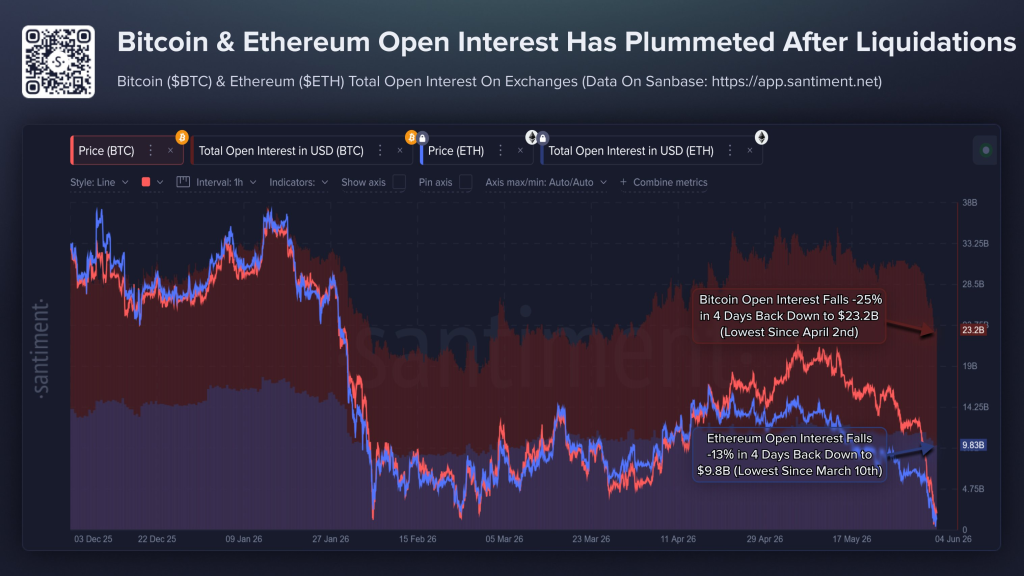
The chart uses a 1‑hour interval, capturing the speed of the liquidation cascade. Both price lines (BTC and ETH) show sharp downward slopes during the final week of May, with open interest tracking price lower in near‑lockstep.
What the chart does not show is the composition of that open interest. Data from Coinglass indicates long positions accounted for roughly 85‑90% of the liquidated volume, meaning the majority of the leveraged capital wiped out belonged to traders betting on higher prices.
Bitcoin ETF Outflows: 13 Straight Days of Redemptions
The spot Bitcoin ETF market has been bleeding. Multiple data providers report that U.S. spot Bitcoin ETFs recorded 13 straight sessions of net outflows through early June – the longest streak since launch. Roughly $4.4 billion has been redeemed since mid‑May, representing about 59,000 BTC sold out of the cohort.
BlackRock’s iShares Bitcoin Trust (IBIT) led the selling, with around $3.3 billion of redemptions – roughly three‑quarters of the total outflow. Fidelity’s FBTC and Grayscale’s GBTC contributed smaller but still significant amounts. On a recent single day alone, Bitcoin ETFs lost about $396.6 million, with IBIT accounting for more than $340 million of that session’s move.
Aggregate Bitcoin ETF assets under management have taken a hit. One analysis shows U.S. spot ETF AUM dropping from roughly $104 billion to around $83 billion over the past month. A broader measure of BTC ETF AUM sits near $103 billion, down about 5% in 30 days.
The outflows signal waning institutional conviction. Earlier in the year, these same ETFs were the primary drivers of Bitcoin’s rally. Now they work in reverse, adding selling pressure at exactly the wrong time.
Read also: MicroStrategy Faces Record Unrealized Loss on Bitcoin Holdings
Bankless Co‑Founders Disagree on ETH’s Value
The Ethereum selloff has been compounded by a very public disagreement between the two co‑founders of Bankless, one of crypto’s most popular podcasts.
Ryan Sean Adams and David Hoffman publicly disagreed over the necessity of the ETH token to the Ethereum network’s value. Adams argued that Ethereum’s success is inseparable from ETH becoming a global store of value. Hoffman countered that the network and the token should be assessed separately.
The rift was underscored by Hoffman’s sale of his ETH holdings in May 2026. When one of the most prominent voices in Ethereum media dumps his personal stack, the market takes notice. The timing – just weeks before the June crash – now looks prescient, whether intentional or not.
The disagreement reflects a broader uncertainty around Ethereum’s investment thesis. Is ETH a commodity like oil, consumed by network usage? Or is it a monetary asset like Bitcoin, held for its store‑of‑value properties? The Bankless founders could not agree. And with price down 45% on the year, neither can the market.
Where Do Bitcoin and Ethereum Go From Here?
The short‑term outlook remains fragile. Bitcoin’s 25% open interest drawdown clears some leverage, but the $60,000 support zone near the 200‑week moving average is the real line in the sand. A clean break below $60,000 would likely invite another wave of selling, with the next major support at $52,000‑$55,000 based on on‑chain realized price models.
Ethereum is in a more precarious position. Below $1,800, the next support sits at $1,700. Lose that and ETH could test the $1,500‑$1,600 range, levels not seen since early 2024. The open interest reset helps, but Ethereum needs a catalyst – a major network upgrade, a spot ETH ETF inflow reversal, or a decoupling from Bitcoin – to regain momentum.
Longer term, the liquidation event has done what liquidations always do: transfer coins from leveraged speculators to stronger hands. The 13‑day ETF outflow streak cannot continue forever. When inflows return, the reduced open interest means less overhead resistance.
For traders, the $60,000 Bitcoin and $1,700 Ethereum levels are the ones to watch. For long‑term holders, this zone has historically offered value – but only for those with the patience to sit through more red days.
FAQs
Subscribe to our YouTube channel for daily crypto updates, market insights, and expert analysis.