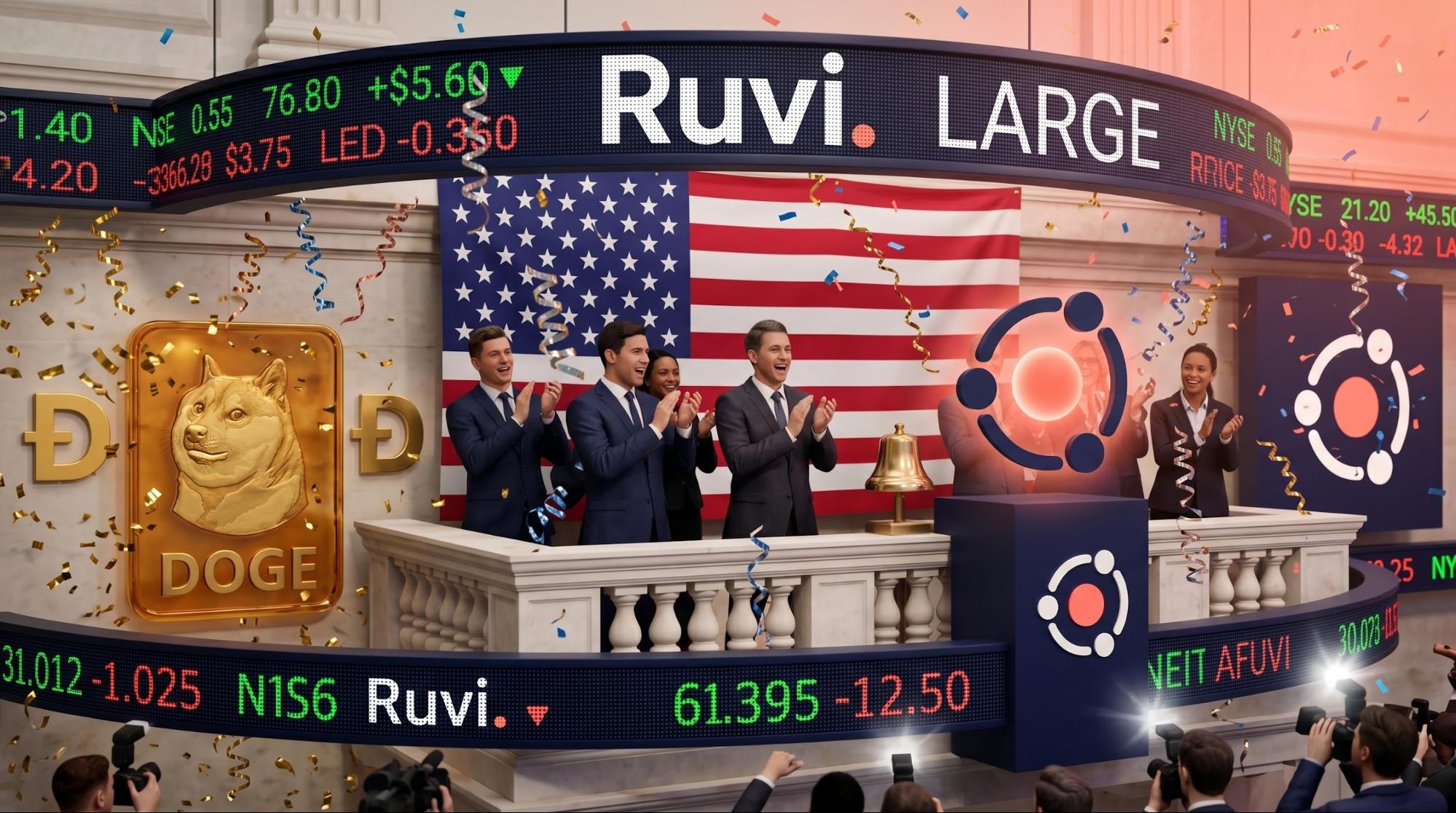
A newly launched Dogecoin spot ETF trading under the ticker DOJE reportedly attracted about $30 million from investors this week, reviving interest in the largest meme token. DOGE changes hands near $0.1058 as traders watch the Securities and Exchange Commission weigh pending DOGE ETF applications from 21Shares, Bitwise, and Grayscale, any of which could lift the token.
Analysts treat the inflows as sentiment-driven rather than tied to fundamentals. That distinction matters as flows rotate toward the Ruvi (RUVI) decentralized AI superapp at ruvi.io, where on-chain platform revenue, not speculation, drives token value through a transparent buyback mechanic.
What you'll learn 👉
How Platform Revenue Permanently Burns $RUVI
Ruvi platform revenue from subscriptions and AI tool fees funds open-market $RUVI buybacks, and a coming marketplace and autonomous agent layer will add further revenue streams. Purchased tokens move to a burn address and are never recovered, and every flow is recorded on-chain and publicly verifiable. As usage rises across the 20+ AI models metered through one token, circulating supply falls, making the model deflationary by design.
The contrast with Dogecoin is structural: DOGE carries uncapped annual issuance and pays holders nothing for activity, so demand alone must absorb a growing float. Ruvi instead converts real product usage into permanent supply reduction, linking adoption directly to scarcity.
Why Dogecoin Holders Are Studying the Rotation
Dogecoin momentum tracks headlines and ETF speculation, and its uncapped supply means holders capture none of the revenue the ecosystem generates. That gap is pushing some traders to look at projects with working economics before the end of the presale window closes.
Ruvi pays users for training its AI agents through a 1.25 billion token rewards pool, meters access across 20+ models in $RUVI, and recycles platform income into buybacks and permanent burns. Where DOGE relies on attention to sustain price, Ruvi ties value to measurable usage, payouts, and a shrinking float, an explicit contrast that data-focused buyers find easier to model.
What a $500 Position Looks Like Across Ruvi Phases
Ruvi runs a seven-phase presale priced from $0.010 to $0.070, with a $0.10 listing target and a fixed 5,000,000,000 non-mintable supply. Phases 1 and 2 sold out at $0.010 and $0.015. A $500 position at Phase 3’s $0.020 buys 25,000 $RUVI. At the $0.070 final phase that allocation is worth $1,750. At the $0.10 listing target that is $2,500. At a $1 token price that is $25,000. Those figures assume the project hits its targets and are not guarantees.

VIP tiers stack on top: a VIP 5 buyer holding 500,000 $RUVI adds a +100% bonus paid before listing. The buyback-and-burn engine then works against scarcity over time, removing tokens permanently as revenue arrives. By contrast, every new DOGE block expands supply with no offsetting burn and no holder revenue, leaving price dependent on continued inflows rather than structural demand.
Conclusion
Dogecoin’s $30 million DOJE inflow shows meme demand is alive, yet DOGE still pays holders nothing and prints new supply with every block. Ruvi offers a different model: a live presale at $0.020, more than 3,000 holders, and 20+ AI models metered through one deflationary token. For traders weighing flow-driven hype against revenue-backed scarcity, the structural case is clear. Review the tokenomics, phase schedule, and burn mechanics in full at docs.ruvi.io before the presale advances.
FAQs
What is the Dogecoin price prediction this week?
DOGE trades near $0.1058 this week, and several analysts see ETF inflows and pending SEC filings supporting short-term upside. Those moves remain sentiment-driven, so projections vary widely between sources.
Why are Dogecoin holders buying Ruvi?
Dogecoin captures no platform revenue and carries uncapped supply, while Ruvi pays users for AI training, meters 20+ models in $RUVI, and burns tokens from real income. That working economic loop appeals to holders seeking fundamentals.
Is Ruvi better than Dogecoin for long-term value?
Ruvi ties price to usage, a fixed supply, and permanent burns, whereas DOGE depends on continued demand. Each carries risk, but Ruvi’s deflationary design offers a clearer structural thesis.
Useful Links
Website/Buy $RUVI: Ruvi.io
Whitepaper: Docs
X/Twitter: @RuviAiOfficial
Telegram: @Ruviofficial
DISCLAIMER: CAPTAINALTCOIN DOES NOT ENDORSE INVESTING IN ANY PROJECT MENTIONED IN SPONSORED ARTICLES. EXERCISE CAUTION AND DO THOROUGH RESEARCH BEFORE INVESTING YOUR MONEY. CaptainAltcoin takes no responsibility for its accuracy or quality. This content was not written by CaptainAltcoin’s team. We strongly advise readers to do their own thorough research before interacting with any featured companies. The information provided is not financial or legal advice. Neither CaptainAltcoin nor any third party recommends buying or selling any financial products. Investing in crypto assets is high-risk; consider the potential for loss. Any investment decisions made based on this content are at the sole risk of the readCaptainAltcoin is not liable for any damages or losses from using or relying on this content.