
The Ethereum price fell 3.75% in the last 24 hours to $2,112.48 as rising oil prices and geopolitical tensions pushed investors away from risk assets. The decline followed President Donald Trump’s warning about possible U.S. strikes on Iran, which triggered a wider market sell-off and more than $657.9 million in crypto liquidations.
Ethereum accounted for $256.83 million of those wiped-out long positions, making it one of the hardest-hit assets. At the same time, spot Ethereum ETFs lost about $255 million in a week. Then the $11.58 million Verus-Ethereum Bridge hack made people feel even worse.
Oil also stayed on everyone’s mind. Brent crude rose to $111.15 as worries grew about supply problems near the Strait of Hormuz.
What you'll learn 👉
Rising Oil Prices Are Becoming a Major Problem for Ethereum
Top analyst Crypto Patel shared a macro-focused explanation for Ethereum’s weakness, arguing that traders should pay close attention to oil prices instead of focusing only on the ETH chart. The post referenced comments from Bitmine founder Tom Lee, who pointed to the strong inverse relationship between crypto and crude oil over the past year.
The idea is simple. When oil prices go up fast, inflation fears also rise. That pushes the Federal Reserve to keep interest rates high for longer. So people want less of risky things like crypto and tech stocks.
Why $ETH Is Bleeding: Watch Oil, Not Just The Chart
— Crypto Patel (@CryptoPatel) May 18, 2026
CryptoPatel Family, Here Is A Macro Lens Worth Understanding Right Now.
Tom Lee (Bitmine Founder) Has Been Pointing To One Chart Most Crypto Traders Ignore: WTI Crude Oil.
His Framework, In Easy to Understand For You:
1️⃣… pic.twitter.com/NKUsbFW1rP
In times like this, investors move their money to safer places, not speculative markets. That kind of pressure usually hits Ethereum harder. Because even now, ETH acts like a high-risk asset when the bigger economy drives a sell-off.
The post also noted that the inverse correlation between crypto and oil has reached one of its strongest levels in nearly a decade. In other words, oil moving higher has often matched weakness in Ethereum and Bitcoin. With WTI crude moving back near $106 and Brent crossing $111, traders are watching energy markets almost as closely as crypto charts.
One more thing from that thread: if oil settles down, it might be the first real sign of relief for Ethereum. If the Strait of Hormuz calms down and crude prices drop, markets could start hoping for softer inflation again. That would take pressure off risky assets and could help ETH climb back from the latest wipeout.
What’s Happening With Oil Prices?
Oil prices have risen sharply over the last week. Brent crude is now selling for $111 per barrel. U.S. WTI crude is priced at around $102 per barrel. The main cause of rising oil prices is the fear that a large cut in supplies will be made due to tensions in the Middle East. It’s one of the most important paths for oil ships in the world. Right now, tanker movement there is very restricted.
The Strait of Hormuz handles a huge share of global oil exports, especially from Gulf countries. With ships having trouble getting through, traders worry that millions of barrels each day could get stuck or delayed. That has tightened global supply conditions very quickly and pushed energy traders into aggressive buying positions.
Peace talks between the U.S. and Iran have stalled. That killed earlier hopes that tensions would ease fast. So now, oil reserves are emptying faster across the world. The International Energy Agency has already warned about serious supply shortages. Analysts at JP Morgan say supply chains would still face delays even if shipping routes opened up again tomorrow.
The run-up in oil is now feeding inflation worries everywhere. Higher energy prices raise the cost of moving goods and making things. That makes it harder for central banks to lower interest rates. Bond markets and stocks have already taken a hit. Crypto has followed the same path as people pull back from risky assets.
Related Ethereum News: Crypto Price Prediction for Today, May 18: XRP, Zcash (ZEC), Ethereum (ETH)
Ethereum (ETH) Chart Analysis
We had a look at the chart, and price action shows Ethereum breaking lower after failing several times to reclaim the $2,350 area earlier this month. Sellers regained control during the latest market-wide liquidation wave, pushing ETH down toward the $2,100 support zone. The move erased much of the rebound seen in early May.
Momentum indicators also weakened sharply. The RSI dropped near 29 on the 4-hour timeframe, moving deep into oversold territory and showing heavy bearish momentum in the short term.
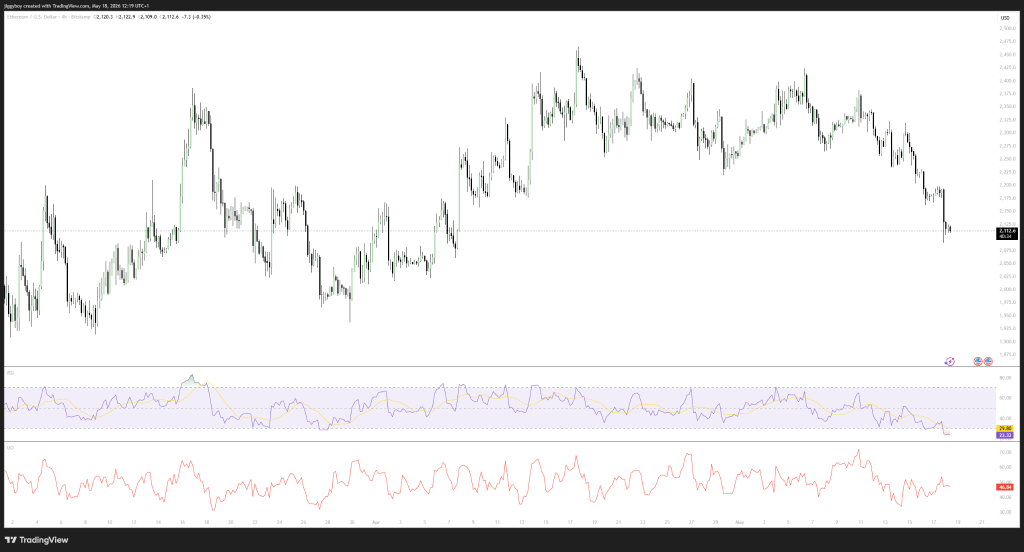
Also, the Ultimate Oscillator stayed below the neutral line near 46. That means buyers don’t have much confidence after the sell-off.
The $2,100 mark is now the big one traders are watching. If Ethereum loses that floor, the price could fall next near $2,000. For buyers to take back control, ETH first needs to climb above $2,250. Then maybe try for the $2,350 wall again.
But Ethereum’s drop isn’t just about crypto. Rising oil prices, fear of inflation, money leaving ETFs, and world tensions are all hitting risky assets at once. The wave of liquidations made things worse as leveraged long bets got wiped out across the board.
Right now, traders keep their eyes on two charts: ETH and crude oil. If oil starts to cool down and world tensions ease, crypto markets might settle too. Until then, the Ethereum price could keep taking hits from both the bigger economy and weak feelings in the market.
Frequently Asked Questions
Subscribe to our YouTube channel for daily crypto updates, market insights, and expert analysis.