
Bittensor has spent months building a reputation as one of the most ambitious AI crypto projects in the market. TAO price climbed sharply earlier this year as investors chased the decentralized AI narrative, but a new breakdown introduced a very different conversation. The analysis focuses less on whether Bittensor can survive the pressure that comes with scaling a blockchain based AI economy.
Bittensor itself operates very differently from most crypto projects. The network works like a decentralized marketplace for artificial intelligence models. Miners contribute compute power and AI models, validators score the quality of outputs, and the best-performing contributors earn TAO tokens as rewards.
The system runs through specialized subnets that focus on areas like text generation, image recognition, financial prediction, and decentralized computing services.
TAO tokenomics also resemble Bitcoin in several ways. The network has a fixed maximum supply of 21 million tokens and includes halving events that reduce emissions over time. Bittensor uses a model called Yuma Consensus to evaluate AI quality instead of traditional blockchain transaction verification.
The project launched without venture capital allocations or pre-mined tokens. That structure became one of the strongest arguments for supporters who view Bittensor as an attempt to build an open “internet of intelligence” outside large technology companies.
What you'll learn 👉
FireHustle Explains Why Several Bittensor Risks Cannot Be Ignored
FireHustle YouTube channel focused heavily on the economic side of the Bittensor network. The biggest concern came from the gap between network rewards and actual revenue generation.
The video explained that Bittensor currently distributes roughly $328 million worth of fresh TAO rewards yearly, yet estimated real customer revenue across the network sits somewhere between $3 million and $15 million annually. FireHustle cited research from Pine Analytics and crypto analyst Justin Bonds to support the argument.
That imbalance becomes harder to ignore after the first TAO halving. Daily payouts dropped sharply after the December event, which reduced rewards across the ecosystem. FireHustle explained that some subnets may struggle to survive if outside revenue does not increase quickly enough.
Another major concern involved decentralization. Covenant AI, one of the most recognized builders connected to Bittensor, publicly left the network after accusing leadership of excessive control behind the scenes. TAO price reacted aggressively during that period and dropped almost 18% within hours.
FireHustle also questioned whether Digital Currency Group and Yuma now hold too much influence over the broader Bittensor ecosystem. The argument centered around the idea that decentralized infrastructure becomes difficult to defend if a small group controls large operational power.
Regulation added another layer of uncertainty. FireHustle pointed to the ongoing Grayscale ETF filing and argued that the SEC could eventually challenge the legality of subnet reward systems tied to AI work. That possibility remains one of the biggest risks hanging over the entire TAO ecosystem.
Narrative rotation also entered the discussion. AI became one of crypto’s strongest sectors during the last cycle, yet liquidity can move quickly between narratives. FireHustle explained that capital rotating toward gaming, privacy coins, or real world assets could slow TAO price growth before revenue catches up to valuation.
Bittensor Still Shows Signs Of Becoming A Real AI Infrastructure Network
FireHustle did not stop at the bearish side. The second half of the analysis argued that many of these problems resemble issues faced by major technology companies during their early years.
Amazon operated at a loss for years before becoming dominant. Uber spent heavily for expansion long before profitability appeared. Ethereum also faced criticism over scaling issues and internal conflicts during earlier cycles.
That comparison formed the core bullish thesis behind Bittensor.
The discussion then focused on Rezzy, a Bittensor subnet building AI appraisal infrastructure for tokenized real estate. FireHustle explained that Rezzy already claims 98.6% property pricing accuracy and has active pilots with real estate-related firms.
Related Article: Is Bittensor ($TAO) About to Make Its Move? One Level Stands Between $285 and $1,000
That matters because critics argue that Bittensor subnets depend entirely on token subsidies instead of real customers. Rezzy presents a counter example because the platform already offers live products, institutional partnerships, and measurable AI performance.
Another important detail came from the broader structure of the Bittensor network. A decentralized AI ecosystem does not necessarily require every subnet to succeed. Traditional technology markets also operate through a few dominant winners surrounded by many failed projects.
That reality creates an interesting situation for TAO price. Failure remains possible, especially if revenue growth stalls or regulation becomes aggressive. Success also remains possible if even a small number of subnets develop profitable businesses that attract real customers over time.
TAO Price Outlook Shows Bulls Defending The Ascending Channel
A look at the TAO chart shows price continuing to trade inside a large ascending channel that started forming after the February lows. The structure still favors buyers for now because TAO continues printing higher lows inside the trend.
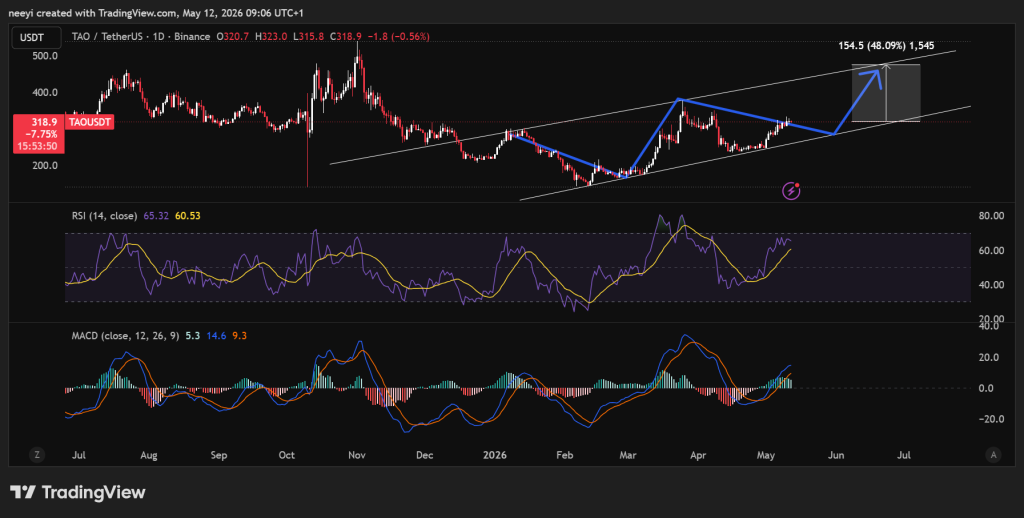
The current TAO price trades near $320, and the chart structure points toward a possible move close to $500 if buyers maintain control of the channel resistance breakout. The projected path on the chart suggests another upward expansion phase could develop during the coming weeks.
RSI currently trades near 66, which shows bullish strength remains active without fully entering extreme overbought territory. Previous rallies inside this channel pushed RSI close to 80 before sharp cooldowns appeared. Current RSI positioning leaves room for another upward attempt if volume remains stable.
MACD also continues printing bullish momentum. The MACD line remains above the signal line, and histogram bars continue showing positive strength. That setup often supports continuation rallies during trending markets.
Read Also: XRP’s $10+ Math: How the CLARITY Act Turns Ripple’s 40B Escrow Into Protocol‑Native Liquidity Pools
Price still faces important resistance near the upper channel boundary. Failure to break above that area could push TAO back toward support close to the middle or lower trendline zone.
Bittensor now stands at an unusual crossroads. The network faces real concerns involving revenue, regulation, and decentralization questions. Another side of the story points toward a growing AI infrastructure system that continues attracting developers, institutions, and speculative capital.
FAQs
Subscribe to our YouTube channel for daily crypto updates, market insights, and expert analysis.