Kaspa is entering a key phase fundamentally and on the chart. The Toccata hard fork reached code freeze on April 30, with mainnet activation set between June 5–20, 2026. This upgrade introduces SilverScript, ZK verification, and native KRC-20 tokens, expanding Kaspa into a programmable Layer 1.
Also, 95.4% of all the coins that will ever exist are already out there. That means less new selling pressure down the road. The KAS price is up 1.40% to $0.0341 in the past day. It is following Bitcoin, which rose about %1.97. $532 million also flowed into ETFs on May 5.
So here is how things stand. The long-term picture looks strong. But day-to-day moves still depend on bigger economic forces.
What you'll learn 👉
KAS Price Leverage Reset: Why the Market Structure Just Changed
A breakdown from Kaspa Daily shows a major structural reset in the KAS price. The Open Interest to Market Cap ratio is now at 4.37%, a level considered normal. With leverage now back to baseline, the price is no longer driven by excessive derivatives activity, meaning any breakout from here would likely require real spot demand.
From May through late September 2025, the ratio traded between 6% and 10%, repeatedly testing overleveraged conditions. That period aligned with aggressive speculative activity, where price moves were heavily driven by derivatives rather than spot demand. It created an unstable structure where liquidations could easily cascade.
Kaspa OI/Market Cap sitting at 4.37%. Normal leverage.
— Kaspa Daily (@DailyKaspa) May 5, 2026
The chart tells the story: ratio ran 6–10% from May through late September 25, repeatedly testing the overleveraged line.
Then the October 10 cascade flushed it in a single session, and it's traded in a 3–5% band ever… pic.twitter.com/08f2VW9dxG
That’s exactly what happened on October 10. A single-session liquidation event flushed the ratio sharply lower, wiping out leveraged positions across the board.
Since then, the metric has stabilized between 3% and 5%, and it hasn’t returned to those overheated levels. This cleaner structure reduces liquidation risk, but also means upside moves now depend more on fresh inflows rather than forced positioning.
Catalysts Driving KAS Price
The biggest near-term catalyst is the Toccata upgrade. Once deployed, it introduces programmable functionality directly on-chain, opening the door to DeFi, token issuance, and new developer activity.
With activation expected in early to mid-June, this puts a clear timeline on potential demand expansion. Taken together, these catalysts suggest that the next major move in the Kaspa price will depend on whether new demand enters ahead of the upgrade window.
Supply dynamics are also working in favor of Kaspa. With 27.41 billion KAS already circulating, representing 95.4% of max supply, emission pressure is minimal and set to decline further into late 2026.
Also, institutional rails are forming. Zodia Custody is offering infrastructure backed by Standard Chartered, and a regulated Kaspa ETP has launched in Sweden through Valour. These developments reduce friction for larger capital inflows.
Sentiment remains strong, with Kaspa ranking highly on community trackers and whale wallets accumulating millions of tokens. However, a prior rally saw a 97.72% drop in active addresses, showing that price strength has at times run ahead of real usage. That mismatch remains a risk if repeated.
Looking further ahead, DAGKnight in Q3 2026 and the long-term 100 BPS scaling vision both support structural growth, though execution timelines remain uncertain.
Here’s What the Kaspa Chart Is Showing
We had a look at the chart and price action is locked inside a clear range after the earlier deleveraging phase. The KAS price is trading around $0.0341, with repeated reactions at this level showing equilibrium between buyers and sellers.
Resistance is around $0.036–$0.037. Multiple attempts to break above this zone have failed, including a clear rejection wick, showing supply is still active there. On the downside, $0.031–$0.032 continues to act as support, with several defended reactions forming a stable floor.
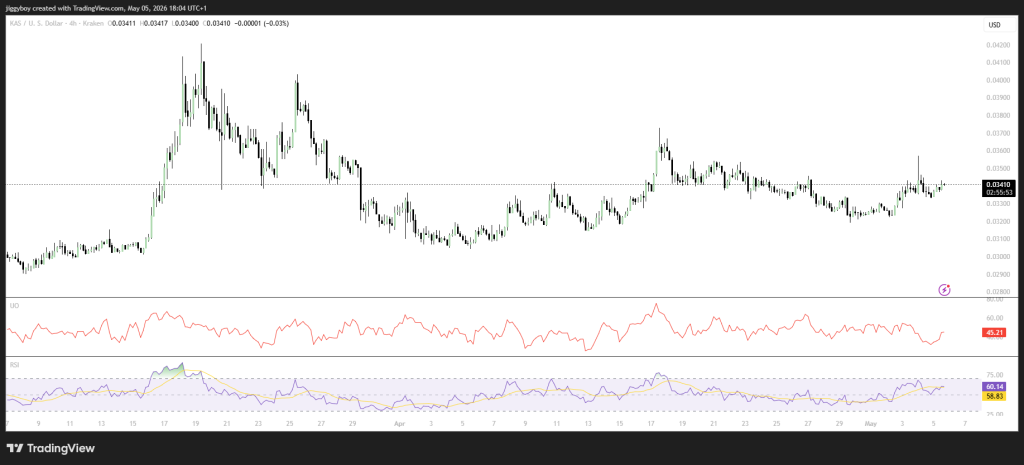
Indicators support the range view. RSI is around 60. That shows some strength, but nothing crazy. The Ultimate Oscillator is near 45, which means neither buyers nor sellers are running the show. The price is still squeezed into a tight range, and moves are getting smaller.
If the price closes above $0.037, that changes things to a bullish mood for the short term. If it breaks below $0.031, the range falls apart and lower levels come into view. Until then, the price stays stuck in its box, only moving when something pokes it.
Where Will Kaspa Price Go Next?
Most likely, KAS stays between $0.031 and $0.038 for a little while. A breakout try will probably happen as the Toccata upgrade window gets closer, that runs from June 5 to June 20. Until something clear happens or the price breaks out, people will stay careful.
Now for the good case. If Bitcoin stays strong and people get excited about the upgrade, that could push the KAS price above $0.038. A clean break opens up $0.042, and maybe $0.045. That is especially true if real buyers start leading the way instead of just traders betting on price moves.
In a bearish case, loss of BTC support or macro tightening could push Kaspa below $0.031. That exposes $0.028 as the next major level. Even though leverage is lower now, weak demand can still drive controlled downside moves.
However, the KAS price is now trading in a cleaner post-leverage structure. Moves are no longer driven by forced liquidations but by real demand and positioning ahead of a major upgrade. The range is tight, and it won’t stay this way for long. With Toccata approaching, the next breakout will depend entirely on which side steps in first.
Frequently Asked Questions
Subscribe to our YouTube channel for daily crypto updates, market insights, and expert analysis.