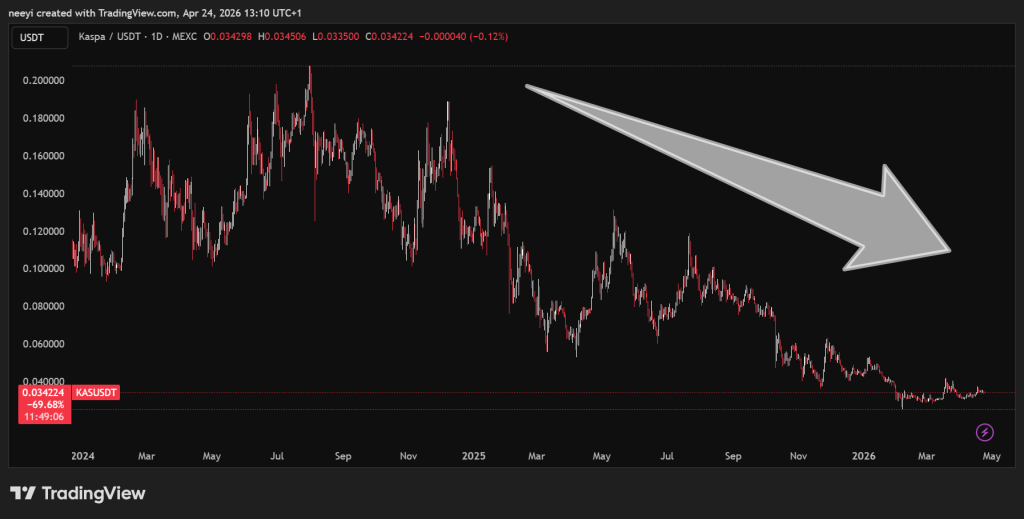
Kaspa price sits close to $0.034 today, giving the network a market cap near $1 billion. That number looks modest when compared to where it once stood, and it raises a bigger question. Can Kaspa realistically push toward a $10 billion valuation, or has that window already passed?
That question became the focus of a breakdown shared by Our Crypto Talk on X, who examined whether the current KAS price still leaves room for a large upside move.
Kaspa already proved it can attract serious capital during its last major cycle. The KAS price reached an all-time high of about $0.2075 in July 2024, which pushed its market cap close to $5 billion at the time.
That move did not happen randomly. Several key factors came together to support the rally. Kaspa’s BlockDAG design, built around GHOSTDAG architecture, allowed fast block confirmation without losing the security model of Proof of Work. That combination gave it a strong identity among Layer 1 networks.
Exchange listings also played a major role. Listings on platforms like KuCoin, Bybit, and Kraken expanded liquidity and made KAS accessible to a global audience. At the same time, its emission model created steady supply reduction over time, which supported price cycles.
Another detail that stood out was the fair launch structure. There was no pre mine, no venture capital allocation, and no insider unlock pressure. That narrative attracted a specific group of investors who preferred decentralized distribution.
What you'll learn 👉
Kaspa Price Needs More Than History To Reach $10 Billion
A move from $1 billion to $10 billion market cap would require more than repeating past performance. The previous peak shows what is possible, yet doubling that peak requires stronger fundamentals and new demand drivers.
The discussion from Our Crypto Talk focuses on what could push Kaspa into that next phase.
Fair Launch Structure Removes Typical Sell Pressure
Kaspa’s distribution model continues to stand out among major Layer 1 projects. Every KAS token was mined, similar to Bitcoin, which means there are no large allocations waiting to unlock over time.
That detail matters when compared to other networks. Many competing chains still carry large portions of locked supply that enter the market gradually. Each unlock creates potential sell pressure during rallies, which often limits price expansion.
Kaspa does not face that same structural issue. Circulating supply already sits above 95%, so future dilution remains minimal.
Can $KAS hit $10 billion?
— Our Crypto Talk (@ourcryptotalk) April 24, 2026
Let me break down why that is possible.
It is the most logical outcome if the roadmap delivers.
Yes, it is down by 83% from the highs.
It even dropped after its Crescendo Hard Fork
So what needs to be done?
👉 THE ONLY FAIR LAUNCH LEFT STANDING… pic.twitter.com/GuBcOaGo5G
Toccata Hardfork Could Transform Kaspa Into A Programmable Network
The next major development centers on the Toccata hardfork, which is expected to go live between June 5 and June 20 2026. This upgrade introduces native assets directly on the base layer.
That change expands Kaspa beyond its original identity as a fast payments network. Developers would be able to create tokens, build decentralized finance applications, and explore NFT use cases directly on the chain.
The upgrade also introduces KRC 20 tokens, which creates a foundation for broader ecosystem growth. Without native token support, most of these applications remain impossible. This update removes that limitation.
Network Performance Metrics Show Strong Technical Capacity
Kaspa has already demonstrated high throughput on its mainnet. The network has processed close to 2 billion transactions and reached thousands of transactions per second at peak periods.
Its current structure supports 10 blocks per second, which is a rare figure for a Proof of Work system. That performance level places it far above networks like Bitcoin in raw throughput terms, although each serves different design priorities.
These technical metrics suggest that the network can support higher usage if demand increases.
Market Cap Math Shows A Clear Path To $10 Billion
The math behind a $10 billion valuation is straightforward. A market cap of that size would place KAS price around $0.365, which represents roughly a 10.7x increase from current levels.
That figure becomes more realistic when supply dynamics are considered. Since most tokens are already circulating, price growth depends more on demand expansion than on absorbing new supply.
The argument from Our Crypto Talk emphasizes that point. Many competing networks require both market cap growth and supply absorption at the same time, which makes large gains harder to sustain.
Read Also: Gold and Silver Trading Just Got Cheaper as CME Lowers Margins
Kaspa Price Outlook Depends On Execution And Market Conditions
Kaspa sits in an interesting position today. The network already showed it can reach multi billion valuations, yet it now trades far below that previous peak.
Upcoming catalysts such as the Toccata upgrade, potential exchange expansion, and continued ecosystem development could create the conditions for another revaluation. Each of these factors would need to align for a move toward $10 billion to become realistic.
Market cycles still play a major role, and broader sentiment across crypto often determines how far these narratives can go. Kaspa has the structure and upcoming developments that support the argument, yet the final outcome depends on how those plans unfold over the next phase.
FAQs
Subscribe to our YouTube channel for daily crypto updates, market insights, and expert analysis.