
A $50 million Polymarket contract on whether the Iran–Israel–US conflict ended by April 7 is now locked in dispute, and the entire outcome hinges on whether arbiters are willing to call a day of active warfare a day of peace. The market’s own rules, printed on the contract page, are unambiguous: “Yes” requires a continuous 14-day period without qualifying military action that begins by the specified end date of April 7 ET and continues uninterrupted through 12:00 PM ET on the 14th calendar day.
The Office of the US Federal Register, in 14 CFR 117.3, defines “calendar day” as a 24-hour period from 00:00 through 23:59 — a definition echoed by every authoritative source. Fourteen calendar days therefore means 14 × 24 = 336 continuous hours. There is no partial-day carve-out in the rule, and none of the parties disputing the outcome claims otherwise.
The arithmetic is what makes the current resolution theory look impossible. For a 14-day silence window ending at 12:00 PM ET on April 21 to close inside the rules, it must begin no later than 12:00 PM ET on April 7. But confirmed reporting from Reuters, CBS News, and the Wikipedia timeline of the 2026 Iran war ceasefire all establish that US, Israeli, and Iranian strikes continued well past noon that day, intensifying as Trump’s 8:00 PM EDT ultimatum on the Strait of Hormuz approached.
Trump’s own ceasefire announcement on Truth Social landed at roughly 6:30 PM ET, and exchanges of fire were reported more than an hour after that. Taking the most generous possible reading — that silence began the instant the last strike ended — the clock cannot start before 8:00 PM ET on April 7. That pushes the 336-hour window’s completion to 8:00 PM ET on April 21, a full eight hours past the 12:00 PM ET cutoff the rules themselves fix. By the text of the contract, “Yes” is mathematically unreachable.
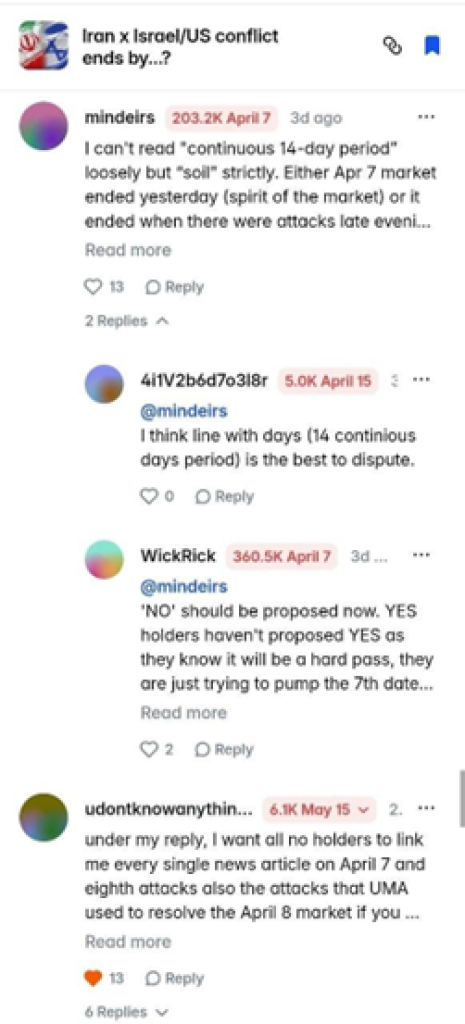
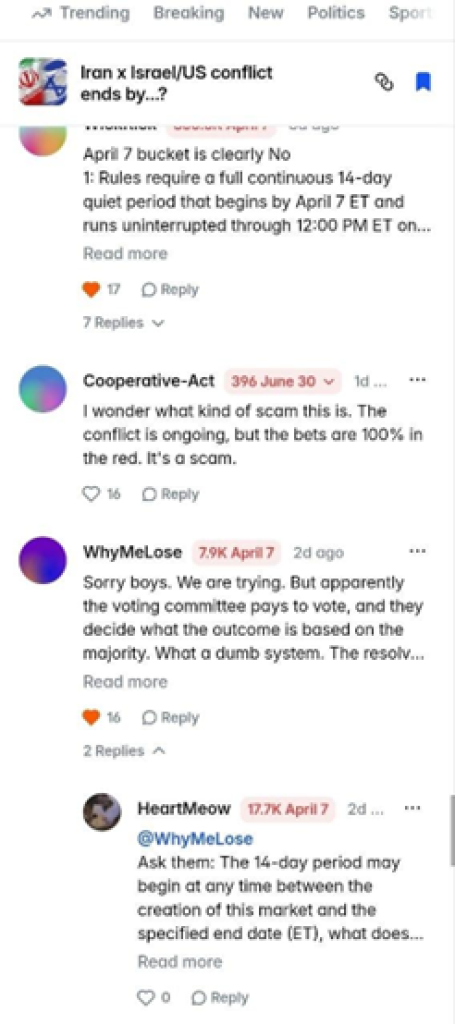
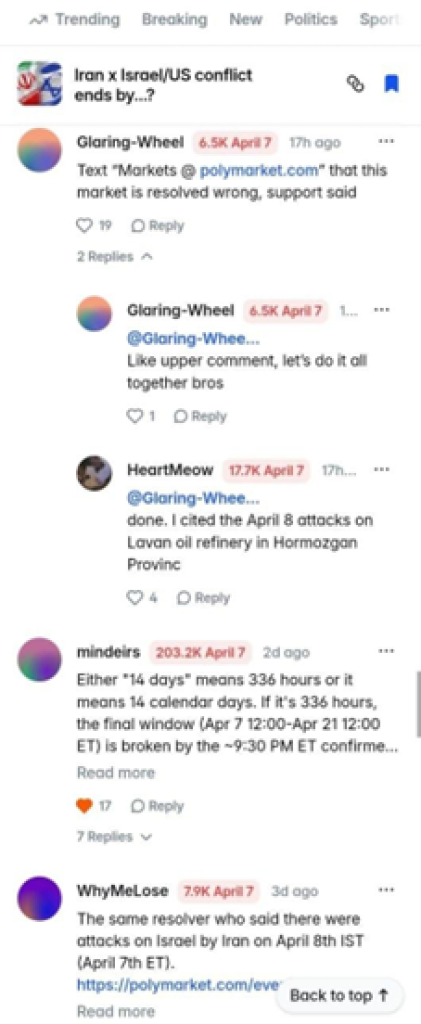
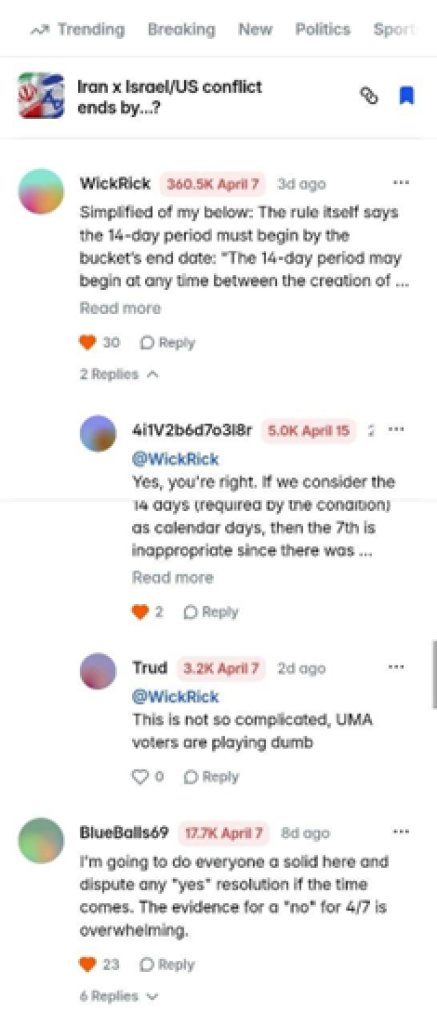
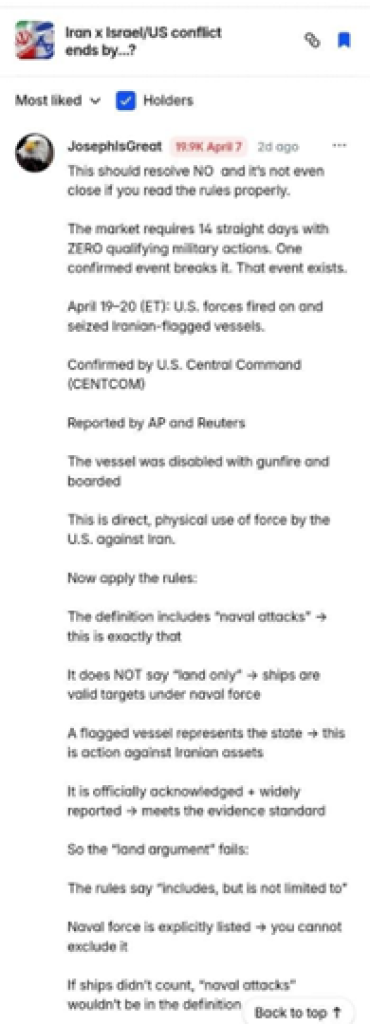
Yet the market shows two proposed “Yes” resolutions, two disputes, and a status of “Final review” — the exact escalation path that sends the decision to UMA token-holder voting. Critics argue the only way to force a “Yes” is to quietly count April 7 itself as day one of peace, despite roughly 20 of its 24 hours being consumed by open hostilities that neither side of the dispute denies took place.
Doing so would collapse “calendar day” into “part of a day,” a redefinition nowhere authorized by the rule text. With $50 million on the line and the resolution now in the hands of UMA voters reading the same headlines as everyone else, the question is no longer what happened on the ground — it is whether the platform’s arbitration process is willing to enforce its own written terms.
Sources: Polymarket contract