Don’t Sell Your Bittensor Tokens Yet – TAO Price Crashes, But Three Scenarios Point to a V‑Shape Recovery


Bitcoin and Ethereum rallied today, pushing total crypto market cap up 4.5%. But Bittensor (TAO) did not join the party. The token dipped another 5% and now trades around $240. That is a steep fall from the recent high of $350 just days ago.
The Covenant AI exit and the founder’s 37,000 TAO sale triggered a panic sell‑off. Leveraged longs got liquidated, stakers unstaked, and a negative flywheel pushed price down to $250. Today’s drop to $240 shows that selling pressure has not fully exhausted.
However, one well‑known analyst says this is not the time to sell. The full breakdown of events helps explain why the crash happened – and why holding may be the right move.
What you'll learn 👉
The Events – What Actually Happened in 72 Hours
Covenant AI publicly posted that it was leaving the TAO ecosystem. They questioned the governance of Bittensor. As an additional event, the founder sold 37,000 TAO on the open market. That caused a big chain reaction.
People reading the announcement from the biggest subnet panic‑sold their positions. Leverage on longs got stopped out or squeezed. That caused more negative momentum. The negative response continued due to unstaked TAO.
Here is the negative flywheel step by step. Covenant dumped 37,000 TAO, so price dropped. Other stakers saw the price drop and unstaked to protect their position. Unstaking goes through an AMM, which makes the conversion worse during a panic event. That caused more stakers to unstake. Validators saw their stake go away and their consensus power dropped. Rewards decreased. Lower rewards and higher risk implied decreasing positions – a full negative flywheel.
Const came out with a response to Covenant’s post. He made public statements to clarify everything from the TAO standpoint. At the same time, Teutonic‑I launched – a new version of Templar. The target is to build a model that hits 1 trillion parameters. They have already tested a 1 billion parameter model.
BIT‑0011 Proposal – Locked Stake and Conviction
The BIT‑0011 proposal introduces “Locked Stake and conviction.” This is a new mechanism to increase conviction. It credits your subnet by an alpha score. It erases the risk of subnet founders selling their position and harming the community.
Here is how the mechanism works. You lock your alpha tokens on a subnet for a chosen period. The lock is self‑decided. The score starts at 100%, and the closer you get to expiry, the lower the score becomes. Every 30 days there is a new conviction score. The staker with the highest conviction score becomes the subnet owner. You cannot unstake the locked tokens as long as the conviction exists.
This is a strong proposal. All these events happened within 72 hours of the actual crash. It is not clear whether the proposal will pass in this format. But discussion and open debate help create a better system. That is the upside of decentralized ecosystems. A stress test happens, a renewed model is designed, and it gets implemented until the next stress test. That is how new technology moves forward.
Read also: Polkadot and Bittensor Built the Same Trap – Both Networks Learned the Same Hard Lesson
Michaël van de Poppe’s Chart Analysis – Critical Support at $206
Michaël van de Poppe posted a daily TAO/USDT chart on Binance. The image, created by CryptoMichiNL, shows TAO trading at $251.9 after touching a low of $246.7. The token has dropped from $297.1, a decline of roughly 15% in a few days.
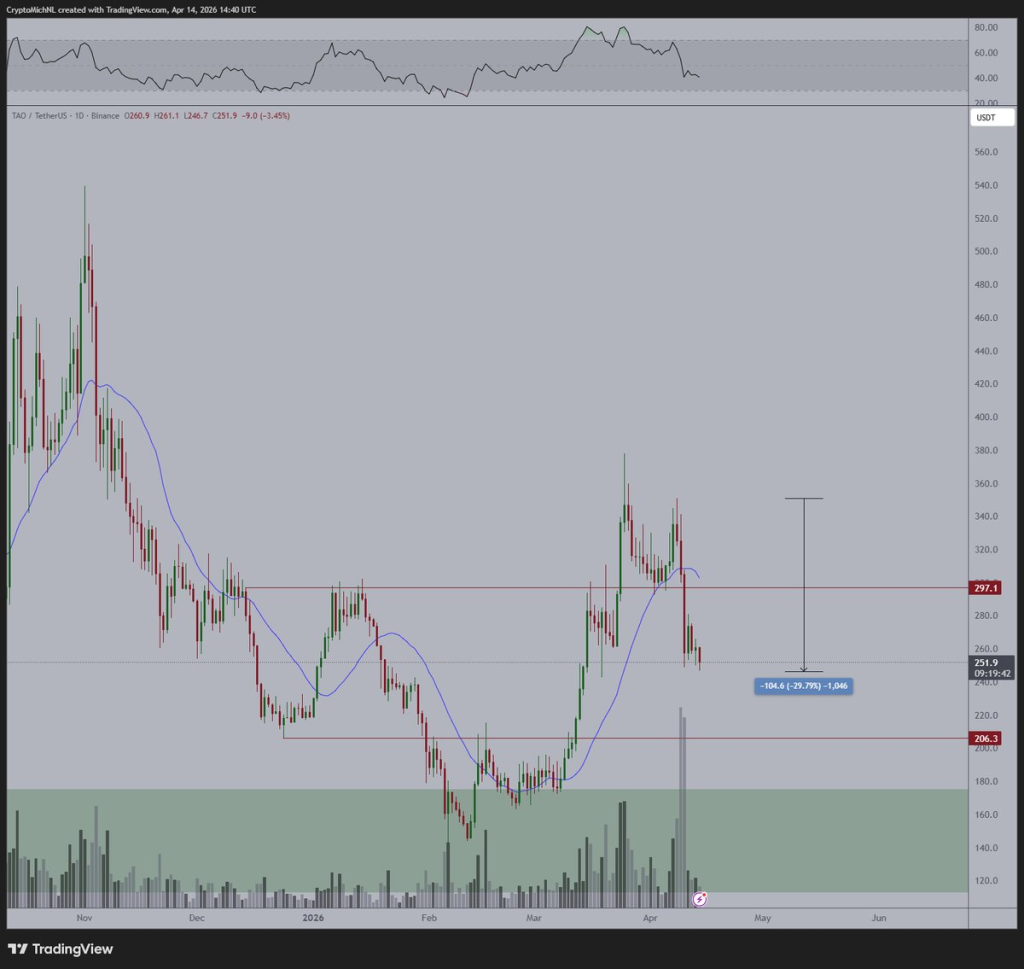
Van de Poppe draws attention to a deeper support level near $206.3. That level is marked clearly on the chart. A notation shows a 29.79% drop from the peak. The indicator at the bottom (likely RSI or a momentum oscillator) is deeply negative, suggesting oversold conditions.
Van de Poppe’s take is straightforward: the panic is overdone. The chart shows that TAO is approaching a major historical support zone. If that level holds, a V‑shape recovery becomes likely. He notes that the recent crash was triggered by a single bad actor, not a fundamental failure of the Bittensor protocol.
The fact that price has stabilized near $250 after the initial crash to $250 is actually a positive sign. In his view, selling now would lock in losses right before a potential rebound.
Three Scenarios for TAO – V‑Shape, Consolidation, or Retest
The recent crash is a 1.5 sigma crash – not outrageous, but still significant. The main thesis is that we are still at the forefront of the big AI and crypto narrative. It is a shame this happened, but it also provides a big opportunity to reclaim price quickly.
Scenario 1 – V‑Shape Recovery to $300‑340 (45% probability): If price remains flat over the next week and the BIT‑0011 proposal is approved, momentum could return quickly. Approval would increase this probability to 60%.
Scenario 2 – Consolidation Between $200‑260 (40% probability): If the proposal faces delays or outflows continue, price may consolidate in this range for weeks. Trust takes time to rebuild.
Scenario 3 – Retest at $180 and Further Crash (10‑15% probability): This would require multiple subnets leaving, strong token outflows, and rejection of the proposals. The analyst considers this unlikely given the swift community response.
Read also: Bittensor (TAO) Slides 25% in 3 Days: Time to Buy Again or Stay Off?
The TAO Price Today – Not a Bad Performance After a Stress Test
The day of the crash, price dropped to $250. The price today is at $253. To be fair, that is not a bad performance for such a big stress test of the entire ecosystem. The fact that a founder dumped 37,000 TAO impacted the price. That impact triggered trade‑based events like liquidations and stop losses. Trust was lost for a moment, so some staked tokens want to get out. The market now needs to find equilibrium.
The analyst holding a large TAO position confirms he is not selling. He sees this as analogous to Ethereum after the DAO hack – a crisis that ultimately strengthened the protocol. The asymmetric upside (AI adoption, subnet valuations, and the new conviction mechanism) far outweighs the downside risk of another 10‑20% drop. For investors who believe in decentralized AI, selling Bittensor tokens at $240 may be the mistake they regret most.
Subscribe to our YouTube channel for daily crypto updates, market insights, and expert analysis.