Solana is walking into March trying to shake off a tough February. On the monthly chart, the SOL price closed down about 21.5%, tracking the broader weakness across altcoins as risk appetite faded.
SOL was in the mid-$140s in the middle of the year, then fell precipitously, dropping to about $67 before rising gradually to the mid-$80s. What we need to determine now is quite simple: are we really seeing a rebound, or is this just a pause before the next fall?
What you'll learn 👉
Development Momentum: Speed, RWAs, and Stablecoins
Solana’s ecosystem continues to grow despite the current state of the market. The next major update is called Alpenglow, which is focused on the consensus layer. This is expected to come in early 2026 and is said to have finality in about 150 milliseconds. If things go according to plan, Solana is sure to secure its position as one of the faster performers in the cryptocurrency space.
Beyond speed, the network is pushing deeper into real-world assets. With over $1 billion in RWA-related total value locked, Solana is clearly targeting institutional use cases and tokenized finance products. That expansion could become more important later in the year if broader market conditions improve.
Stablecoins are another bright spot. Supply on Solana has climbed past $15 billion, strengthening its role in payments and on-chain settlement. The infrastructure is there: fast execution, deep liquidity, and growing integrations. The missing piece right now is sustained demand translating into upside for the SOL price.
SOL Chart Breakdown: From Breakdown to Sideways Grind
Technically, the damage from February is still visible. The monthly candle shows a sharp rejection from above $140, which marked a local top. Once that level failed, the selloff accelerated into late January and early February.
We had a look at the SHIB chart and the picture is more tactical. After the flush to roughly $67, the SOL price bounced hard but stalled below the $100 mark. Since then, it has been stuck in a sideways range between about $78 and $90.
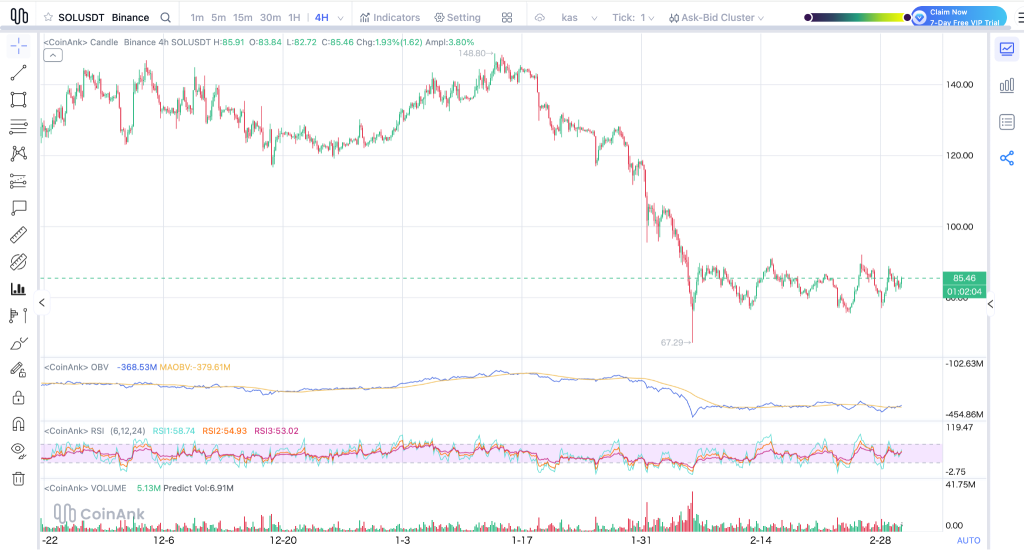
On-Balance Volume has flattened out, which tells us strong accumulation hasn’t kicked in yet. RSI on the 4-hour timeframe sits near the middle of its range. That’s not extreme oversold territory, but it’s not showing strong bullish momentum either. Most of the heavy volume came during the breakdown, not during the recovery.
In short, the SOL price is ranging inside a broader downtrend. It’s stabilizing, but it hasn’t flipped the structure yet. Lower highs are still present on shorter timeframes, and until resistance breaks cleanly, this remains consolidation.
The Levels That Matter
For March, the $99–$100 area is the key line to watch. If the SOL price can reclaim and hold above that zone, the structure would start to shift. That could open the door toward $110–$120, where previous selling pressure showed up.
If price keeps getting rejected below $100, the range is likely to persist. On the downside, $78–$80 is the critical support band. A clean break below that region would put the February low near $67 back in focus. In a renewed risk-off environment, a retest of that level wouldn’t be surprising.
Macro conditions still matter. Fear remains elevated across crypto, and the altcoin season index is weak. Even solid network fundamentals may struggle to lift the SOL price if broader liquidity stays cautious.
SOL Price Outlook for March
Right now, the SOL price is at a decision point. February delivered a hard reset, but development activity continues and the ecosystem is expanding.
If buyers push price decisively above $100, March could turn into a recovery month. If resistance holds and support gives way, the path back toward the lows becomes more realistic.
For now, Solana is stabilizing, not breaking out. March will show whether this range becomes a foundation for the next move up, or just a temporary pause inside a bigger correction.
Read Also: China’s DeepSeek AI Predicts the Price of XRP and Solana If U.S. and Iran Agree to a Ceasefire
Subscribe to our YouTube channel for daily crypto updates, market insights, and expert analysis.