Monero and Zcash have been compared side by side since their early days. Both were designed with the intention of facilitating private transactions in a world where most blockchain transactions are transparent. Fast forward to the end of February 2026, the gap between the two is no longer trivial.
Crypto Seth described it best without beating around the bush: Monero has more active users, handles many more transactions daily, and has privacy by default. Once you put the numbers out there, it’s hard to ignore how much of a disparity there is.
What you'll learn 👉
Privacy by Default vs Privacy by Choice
Monero (XMR) was built with one rule from day one: nothing leaks. Every transfer masks who sent it, who received it, and how much moved, all by default. There’s no setting to enable and no alternate mode to select. It simply works that way every time.
Under the hood, ring signatures blend each transaction into a crowd, stealth addresses generate one-time destinations for recipients, and hidden amounts prevent outsiders from seeing the value transferred.
Zcash takes a different route. It relies on zk-SNARKs, a sophisticated cryptographic method that can shield transaction details when that option is used. In shielded mode, Zcash transactions can be very private.
The key difference is that privacy is optional. Most Zcash transactions remain transparent by default. Users have to choose shielded transfers, and many simply don’t.
That difference matters. When privacy is optional, the anonymity set shrinks. Not every coin is equally private. In practice, Monero offers consistent protection on every transaction, which is why it’s often described as the gold standard for on-chain anonymity.
The Chart Tells a Clear Story
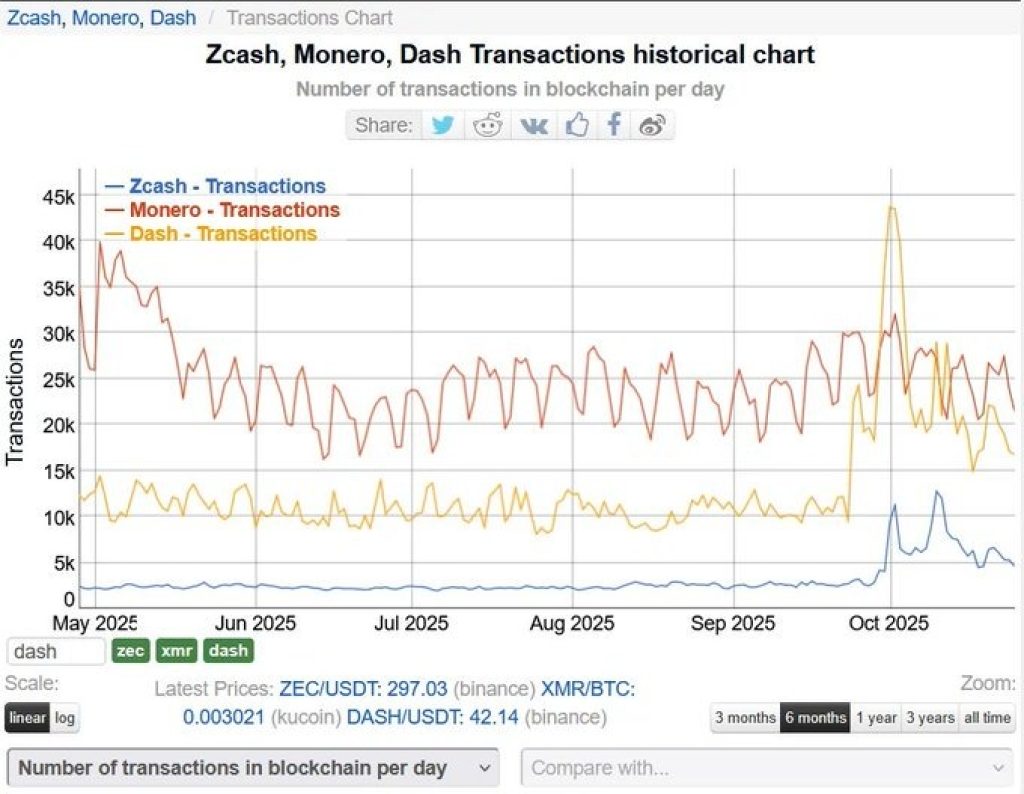
Looking at the historical transactions chart comparing Zcash, Monero, and Dash, the divergence becomes obvious.
The number of transactions per day for Monero has been constant at 20,000 to 30,000 for the past few months. It is not decreasing; it is just constant. There is a normal fluctuation, but the trend is stable.
The normal range for the number of transactions per day for Zcash is between 5,000 and 7,000. It is hard for Zcash (ZEC) to reach anywhere near the normal usage of Monero, let alone during the time of the spike.
This has been the case, not just during the time of the spike, which means it was not just a matter of Monero winning in theory. It was winning in reality.
What the Data Says Right Now
Recent figures reinforce that gap. Monero has been recording around 27,000 to 30,000 transactions per day. All of them are private by default.
Zcash (ZEC) has been averaging closer to 5,000 to 7,000 transactions daily. Only a fraction of those are shielded. That means actual private transfers on Zcash are even lower in comparison.
This isn’t a small edge. Monero is processing roughly four to six times more on-chain transactions than Zcash. And that pattern has held steady for years.
When measuring real users, on-chain transactions matter more than exchange trading volume. Trading spikes can be driven by speculation. Consistent daily transactions reflect actual utility.
What the Community Is Saying
The tone across crypto social channels has shifted over time. The early narrative framed Zcash as more “institutionally friendly” because it allows transparent transactions when needed. There are users who welcome this approach, especially in places where transparency can be a helpful ally in meeting regulations.
There is a contingent of privacy advocates who counter the optional approach. Their argument is quite simple: if the vast majority of transactions remain transparent, then the anonymity set is reduced, making the feature less potent.
Monero is often considered the de facto solution for transactions that need robust resistance to tracking or censorship within online communities. Zcash is still considered viable for users who prefer its approach to cryptography and selective shielding.
However, when the conversation turns to practical usage, Monero is more commonly referenced. Of course, both coins remain firmly entrenched in the multi-billion dollar market. Liquidity is solid in both cases. But leadership in privacy is not only about technology, it’s about usage.
Zcash has seen periods where interest spikes, usually around headlines or broader market excitement. But when the noise fades, the daily activity returns to a much lower baseline.
For anyone who wants privacy baked in without toggling settings or worrying about modes, Monero currently has the edge.
Read Also: Bitcoin Nears $70K, But Hedera (HBAR) Looks Set for Bigger Move as Bullish Metrics Build
Zcash remains an impressive piece of engineering, particularly for users who prefer the option to be transparent when needed, yet its everyday transaction count hasn’t caught up.
When you line up default privacy, consistent usage, and raw transaction numbers side by side, the trend isn’t subtle, the data leans heavily toward one network.. Monero processes thousands more private transactions every single day. Its privacy model is automatic and consistent.
Zcash (ZEC), however, has excellent cryptography and flexibility in use. Still, in terms of usage and practicality, Zcash is still far behind.
The privacy argument may or may not have been settled in theory. However, in practice, Monero has clearly left Zcash behind.
As always, with all altcoins, a lot of risk is involved. It is always recommended that you do your own research and risk assessment before coming to a conclusion.
Subscribe to our YouTube channel for daily crypto updates, market insights, and expert analysis.